

Choose the Right Label Format in 60 Seconds
Label format drives how your labels are delivered, applied, and priced. This guide compares the four main formats — roll, sheet, sticker, and foil — with an interactive cost chart, a 3-question format finder, and a clear decision matrix so you can spec the right format for your actual workflow.
Where Each Format Wins on Price
The cost-per-label curve tells you instantly which format is most economical at your order quantity. Hover over the chart to see cost-per-unit at any volume.
Cost per Label vs Order Quantity
Logarithmic quantity axis · indicative pricing · material & finish held constant
Answer 3 questions. Get the right format.
No more guessing between roll, sheet, sticker, and foil. Tell us your quantity, application method, and use case — we'll match the optimal format with reasoning.
Four Formats, Four Different Workflows
Each format is engineered for a specific production reality. Understand the tradeoffs before you commit.
Roll Labels — The Production Workhorse
Highest volume. Lowest cost-per-unit. Machine-ready.
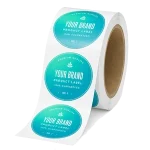
Roll labels are wound on a cardboard core and represent the highest-volume, lowest-cost-per-unit format. They're the only format compatible with automatic label applicator machines. If you label more than 500 pieces of the same artwork, roll is almost always the right answer.
When to choose
- Order quantity is 500+ pieces of same artwork
- You use an automatic label applicator
- You need lowest cost per label at production volume
- You need barcode or variable data printed inline
Specs to specify
- Core size: 1", 1.5", or 3" cardboard core
- Rewind direction: 4 wind directions
- Outer diameter: typically 6"–10" max
- Label gap: standard 3mm for sensor detection
Sheet Labels — Small Batch & Office Friendly
Flat, printable, easy to store. Perfect for short runs.
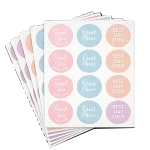
Sheet labels are flat rectangular sheets with multiple labels per sheet (or one full-sheet label). Standard sizes are A4, A5, US Letter, and US Legal. Sheets are easy to print on office inkjet or laser printers, easy to store, and ideal for small batches, prototypes, samples, or short-run projects.
When to choose
- Order quantity is under 500 pieces
- You apply labels by hand
- Multiple label sizes in one order (mixed layout)
- You want to print variable data later on office printer
Standard sizes
- A4 (210 × 297mm) — international standard
- A5 (148 × 210mm) — half A4
- US Letter (8.5 × 11 in) — North American
- US Legal (8.5 × 14 in) — for shipping labels
Stickers — Individual Die-Cut Labels
Standalone pieces. Designed to be peeled, one at a time.
Stickers are individually die-cut or kiss-cut labels on a release liner or backing card. They are designed to be peeled and applied one at a time — perfect for promotional giveaways, brand seals, packaging accents, retail merchandise, and any application where each label is a standalone piece rather than a production-run unit.
When to choose
- Promotional giveaways or retail merchandise
- Individually die-cut shapes (logo, contour cut)
- Branding packaging with seals, accents, limited runs
- Hand-only application, quantity 50–5,000
Cut types
- Die-cut: through label + backing
- Kiss-cut: through label only, backing intact
- Roll stickers: die-cut on a core for fast hand-app
- Sheet stickers: multiple kiss-cut on flat sheet
Foil Labels — Premium Metallic Accent
Hot-foil stamping. Real metal finish. Luxury shelf impact.
Foil labels use a hot-foil stamping process to apply real metallic foil (gold, silver, rose gold, copper, holographic) to a paper or film label. Foil can be combined with any base format — roll, sheet, or sticker — to deliver premium shelf impact for wine, spirits, cosmetics, candles, and luxury packaging.
When to choose
- Brand positioning is premium, luxury, or gift-grade
- Metallic accent on logo, border, or artwork areas
- Wine, spirits, candles, high-end cosmetics
- Shelf differentiation vs flat-printed competitor labels
Foil options
- Colors: gold, silver, rose gold, copper, holographic
- Placement: spot foil or full-foil background
- Base: paper, BOPP, PET, estate textured paper
- Combine with emboss, spot UV, soft-touch matte
Label Format Comparison Table
Click any column header to sort. Cost tier uses relative pricing — actual quotes depend on material, finish, and quantity.
| Format | Best Quantity | Application | Material Range | Cost Tier | Best For |
|---|---|---|---|---|---|
| Roll Labels | 500 – 100,000+ | Machine or manual | All films & papers | Lowest at volume | Production labeling |
| Sheet Labels | 1 – 500 | Manual only | Paper, BOPP, vinyl | Low at small qty | Small batches, samples |
| Stickers | 50 – 5,000 | Manual / giveaway | Vinyl, BOPP, holographic | Medium | Promotional, decals |
| Foil Labels | 100 – 50,000 | Machine or manual | Paper, BOPP, PET | Premium | Luxury shelf appeal |
Find Your Format in 60 Seconds
Common situations, mapped to the recommended format. Real production scenarios from our quoting desk.
Common Format Questions
What is the difference between roll and sheet labels?
Roll labels are wound on a cardboard core for machine applicators or high-volume manual application (500+ labels). Sheet labels are flat sheets for small batches, hand application, and office printing. Roll is the production format; sheet is the short-run format.
Which label format is cheapest for small batches?
Sheet labels are typically cheapest for batches under 500 pieces. Roll labels become more cost-effective at 500+ due to higher machine efficiency. See the cost chart above for the crossover point.
Can stickers be used as product labels?
Yes. Stickers work well for promotional labels, brand seals, giveaway items, and small-batch product labels. They are die-cut or kiss-cut individually rather than wound on rolls.
What format is best for machine labeling?
Roll labels are the only format compatible with automatic machine applicators. Specify core size (1-inch, 3-inch), rewind direction, and outer diameter when ordering for machine application.
Can I combine foil with any format?
Yes. Foil stamping can be applied to roll, sheet, or sticker base formats. Foil is a finishing option, not a separate format — so you can spec "foil roll labels" or "foil sheet labels" depending on your volume.
Tell Us Your Application — We'll Match the Format
Tell us your quantity, application method (machine or hand), and product. We'll match the right format and material for your workflow — typically within one business day.