
Industry · Candle & Home Fragrance
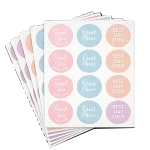
Candle Labels: Heat-Resistant & Oil-Resistant
Engineered for 200°F container surfaces, migrating fragrance oils, and the wet-out defect that ruins paper labels. Every material is tested for real candle-burning cycles.
200°F
Heat Rated
3
Core Materials
Any
Order Qty
F2058
ASTM Compliant
Ember & Co.
VANILLA · AMBER
NET 8 OZ · 226G
Core Summary · TL;DR
Three Failure Modes, One Solution
Candle labels require heat resistance (up to 200°F at container surface), oil resistance (essential and fragrance oils), and opaque backing to prevent "wet-out" translucent spotting from oils soaking into the material.H
Containers
Glass jars, tins, votives, pillar candles, wax melts.M
Materials
White BOPP, White Vinyl, Estate #8 with barrier coat.P
Performance
Heat-resistant to 200°F, oil-resistant, fully opaque.O
MOQ
None — order any quantity, even a single label. Tiered pricing on request.Definition
What are Candle Labels?
Candle labels are product labels engineered for the specific thermal and chemical conditions of candle containers: heat from the flame, migration of fragrance and essential oils, and outdoor/handling durability.Surface Temp
Container reaches 150–200°F during burning
Oil Migration
Fragrance & essential oils penetrate paper
Wet-Out
Oils cause translucent spots—visible defect
Shapes
Cylindrical jars, tins, votives, square pillars
Material Performance Matrix
5 Materials · 4 Performance Criteria
Every candle-label material is rated on the four criteria that determine pass or fail in real candle use.| Material | Heat Resistance | Oil Resistance | Opacity | Wet-Out Prevention |
|---|---|---|---|---|
| White BOPPPolypropylene Film | ✓ to 200°F | ✓ | ✓ opaque | ✓ |
| White VinylPVC Film | ✓ to 200°F | ✓ | ✓ opaque | ✓ |
| Estate #8 PaperTextured Paper | ✓ to 180°F | ~ | ~ | ~ barrier coat req. |
| Brown KraftUncoated Paper | ✗ | ✗ | ~ | ✗ not recommended |
| Clear BOPPTransparent Film | ✓ | ✓ | ✗ transparent | ✗ oil visible |
Best Practice
White BOPP for all candle applications requiring opacity and oil resistance. Estate #8 with barrier coat for premium handmade positioning. Avoid Clear BOPP and uncoated paper for scented containers.
Sub-Category Recommendations
Material Picks by Candle Type
For premium candle brands, foil-stamped labels (gold, silver, rose gold, copper, holographic) are available on Estate #8 and White BOPP materials; see our foil candle label options + foil artwork guide for artwork specifications, minimum line weights, and lead times.
C
Container Candles
- Glass Jars (8–16 oz)White BOPP · Permanent Acrylic · Die-Cut
- Tin ContainersWhite BOPP or White Vinyl · Permanent
- Concrete / CeramicWhite Vinyl · High-Tack Adhesive
O
Other Candle Types
- VotivesWhite BOPP · Small Label Format
- Pillar CandlesWhite BOPP or Estate #8 · Barrier Coat
- Wax Melt PackagingWhite BOPP · Oil-Resistant Adhesive
- Tea LightsSmall White BOPP Labels
F
Home Fragrance
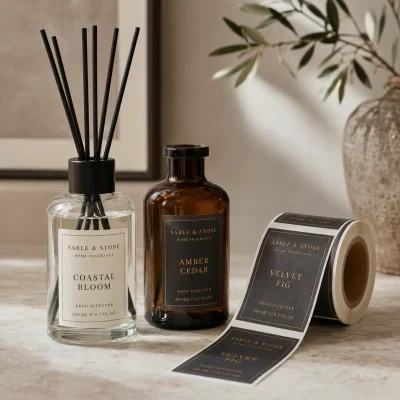
- Reed Diffuser BottlesWhite BOPP · Oil-Resistant (critical)
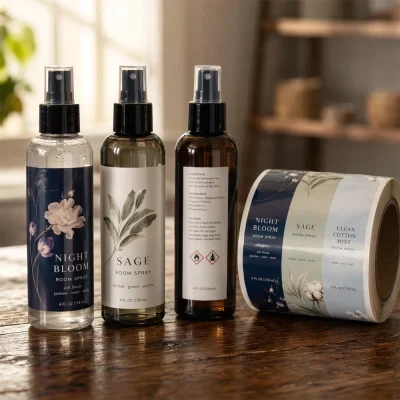
- Room SpraysWhite BOPP · Chemical-Resistant
- Incense BoxesEstate #8 or White Paper
Compliance Requirements
Regulatory Frameworks
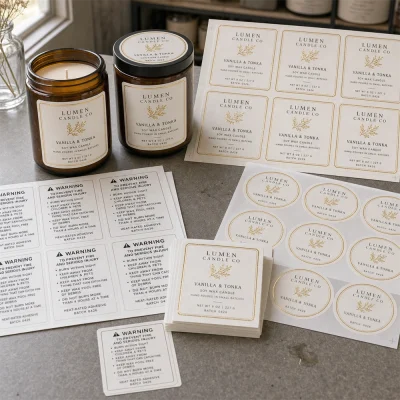
Candle labels carry mandatory safety information. LabelsAgent prints all required compliance elements per your specs.US · ASTM F2058
Standard Specification for Fire Safety
- Fire safety pictograms required on all candle products
- Warning text: "Burn within sight. Keep away from things that catch fire. Keep away from children."
- Burn instructions: Trim wick to 1/4", burn 2–4 hours, stop use when 1/2" wax remains
- Net weight required in ounces and grams
EU · CLP Regulation
Classification, Labelling & Packaging
- Hazard pictograms for fragrances with sensitizers
- Allergen disclosure for regulated fragrances above 0.01%
- UFI code — Unique Formula Identifier for poison center calls
- Language requirements translated per member state
FAQ · Candle Labels
Six Common Questions
Why do candle labels sometimes turn translucent or "wet-out"?
Wet-out occurs when fragrance and essential oils migrate through paper label materials, creating visible translucent spots. To prevent wet-out, use non-porous materials like White BOPP or White Vinyl. Paper materials (kraft, estate) without a barrier coat are at risk.
What temperature can candle labels withstand?
Container candle surfaces reach 150–200°F during burning. White BOPP and White Vinyl withstand these temperatures without curling, fading, or adhesive failure. Paper materials may discolor or curl above 180°F.
Which adhesive works best for glass candle jars?
Permanent acrylic adhesive is the standard. It bonds to glass at room temperature, resists heat migration, and maintains adhesion through burning cycles. Removable adhesive is not recommended—it can fail at candle-burning temperatures.
Can I use kraft paper labels for candles?
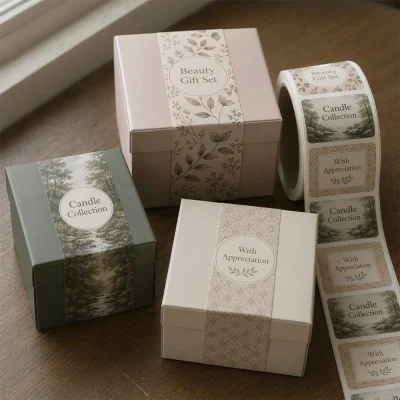
Brown Kraft is not recommended for container candles with fragrance oils. The porous paper absorbs oils, causing wet-out within weeks. Kraft works for unscented pillar candles or for outer packaging (boxes) not in direct oil contact.
What size should a candle label be?
For an 8 oz straight-sided glass jar (3" diameter, 3.5" tall), a typical main label is 2"×3" or 2.5"×3.5". Use the container's flat front face as the primary label, with a smaller bottom label for safety/compliance information.
Do candle labels require safety information?
Yes, per ASTM F2058 (US) and CLP Regulation (EU). Required elements: fire safety pictograms, "Burn within sight," warning text, net weight, fragrance allergen disclosure. LabelsAgent prints all required compliance elements per your specs.
Next Steps