

Custom Barcode Labels for Retail & Logistics
UPC-A, EAN-13, Code 128, ITF-14, Code 39, and Data Matrix barcodes printed at 300+ DPI on matte-finish white materials for 100% first-scan reliability. GS1-compliant quiet zones, accurate bar-width ratios, and variable data printing for unique barcodes per label.
Barcode labels integrate a machine-readable linear or 2D barcode into the product or shipping label, allowing scanners, POS systems, and smartphone cameras to read product identifiers, pricing data, batch codes, or tracking numbers instantly. We print all major symbologies — UPC/EAN for retail checkout, Code 128 & ITF-14 for logistics, Code 39 for warehouse, and Data Matrix for pharma serialization — at 300+ DPI on white matte substrates that maximize contrast between black bars and white spaces.
When You Need Barcode Labels
Seven core scenarios where reliable barcode scanning is non-negotiable — from retail checkout to pharmaceutical serialization.
Retail Product Checkout
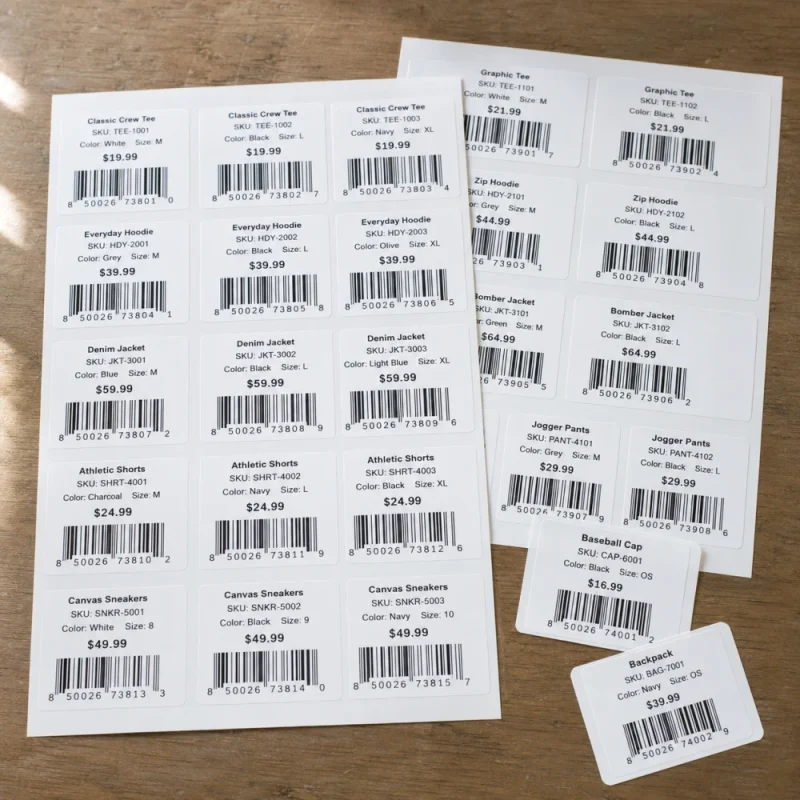
UPC-A and EAN-13 barcodes on retail product labels for fast, accurate POS checkout. Required by Amazon, Walmart, Target, and major retailers for product listing and warehouse receiving.
Shipping & Carton Labeling
ITF-14 and Code 128 barcodes on shipping cartons, case packs, and outer packaging for supply chain scanning at distribution centers and retail receiving docks.
Warehouse & Inventory
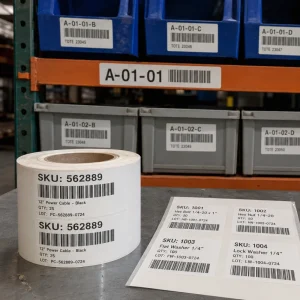
Code 39 and Code 128 barcodes for warehouse rack labels, bin labels, inventory tags, and location markers that warehouse scanners read from distance.
Asset Tracking
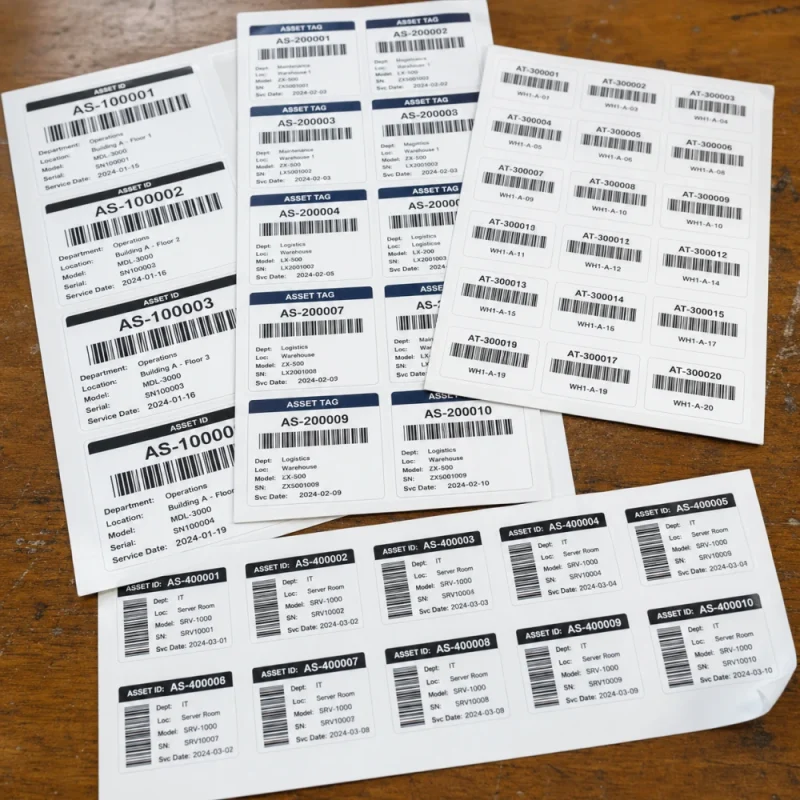
Sequential barcode labels for equipment, machinery, IT assets, and tools. Each asset receives a unique barcode for check-in/check-out tracking and audit trails.
Variable Data & Serialization
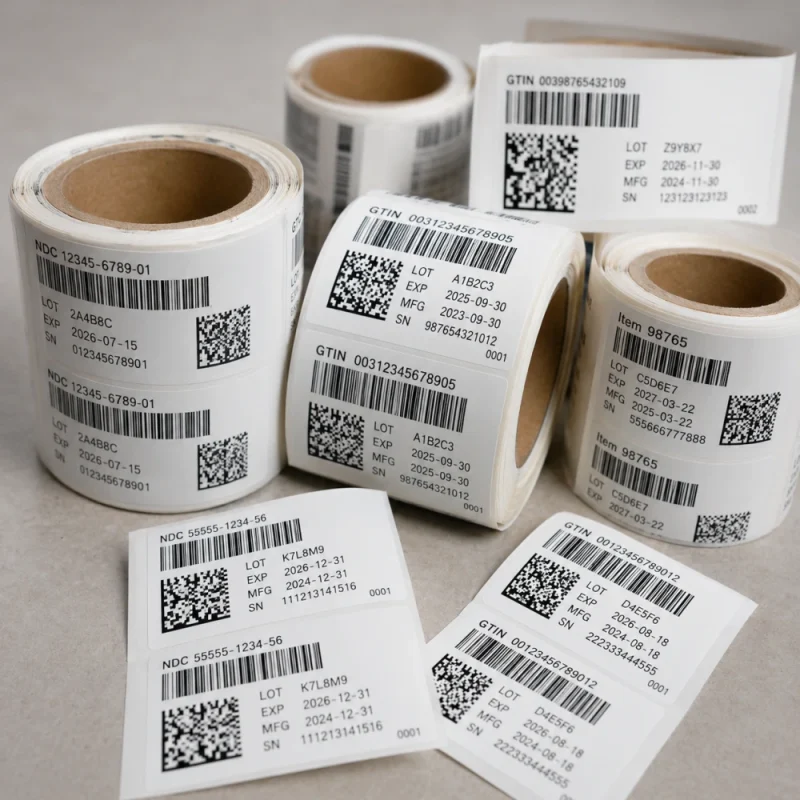
Unique barcodes per label for product serialization, batch and lot identification, expiration date encoding, and pharmaceutical track-and-trace compliance.
Amazon FNSKU & FBA Labels
FNSKU barcode labels for Amazon FBA fulfillment. Product identification barcodes that meet Amazon's labeling requirements for FBA shipment and warehouse processing.
GS1 Data Matrix Coding
2D Data Matrix codes for pharmaceutical serialization, medical device UDI, aerospace part marking, and high-density data encoding in small label areas.
Materials Built for Barcode Scanning
White matte substrates deliver the maximum PCS contrast scanners need. Glossy and reflective surfaces are intentionally excluded.
| Material | Scan Reliability | Why It Works |
|---|---|---|
| White BOPP Matte Laminate |
Excellent | White background with matte surface provides maximum barcode contrast. Waterproof and durable for products that encounter moisture, condensation, or handling. Top choice for retail product barcodes. |
| White Paper Matte Finish |
Excellent | Cost-effective for dry indoor retail products, food packaging, and short-shelf-life goods. Matte finish eliminates glare for scanner readability. Most economical barcode label material. |
| White PET Matte Laminate |
Excellent | Premium durable film for long-shelf-life products, industrial assets, and outdoor applications. Tear-resistant and dimensionally stable so barcodes remain scannable over time. |
| Thermal Transfer Paper | Very Good | For on-demand barcode printing with thermal transfer printers. Allows in-house printing of variable barcodes, batch codes, and date codes. Compatible with resin and wax-resin ribbons. |
| White Vinyl Matte Finish |
Excellent | Heavy-duty matte vinyl for warehouse rack labels, outdoor asset tags, and industrial barcode applications requiring durability against abrasion, chemicals, and weather. |
| Direct Thermal Paper | Good | For short-life barcode labels such as shipping labels, warehouse pick labels, and receipt labels where the barcode only needs to remain scannable for days or weeks. No ribbon required. |
Where Barcode Labels Perform Best
Eight industries that depend on every-label, every-scan reliability.
Retail Products
Supermarket, pharmacy, and specialty retail checkout. Amazon FNSKU compliance.
Food & Beverage
Packaged food, beverage, wine, spirits. Nutrition and ingredient barcodes for database lookup.
Logistics & Shipping
Code 128 shipping labels, GS1-128 logistics labels, carton ITF-14 barcodes for case-level scanning.
Warehouse Management
Rack labels, bin labels, location barcodes, inventory tags. Long-range scannable for pick-and-pack.
Healthcare & Pharma
Data Matrix serialization, NDC barcodes, UDI compliance, track-and-trace for pharmaceutical products.
Asset Management
Sequential barcode tags for IT equipment, fixed assets, tools, machinery. Check-in/check-out systems.
E-Commerce Fulfillment
FNSKU for Amazon FBA, product barcodes for Shopify fulfillment, multi-channel order labels.
Manufacturing
WIP tracking, part identification, quality control checkpoints, batch traceability for production lines.
The Science of Reliable Scanning
Six technical factors that separate first-pass scans from frustrating resubmits.
Print Resolution & Bar Edge Sharpness
Barcodes require crisp, sharp bar edges for reliable scanning. We print at 300 DPI minimum (600 DPI for high-density codes like Code 128 and Data Matrix). Low-resolution printing causes bar edge blur, making bar-width measurement inaccurate and leading to scan failures.
GS1-Compliant Quiet Zones
The quiet zone is the blank white margin around the barcode that lets scanners detect code boundaries. GS1 standards mandate minimum quiet zones: 9 modules left/right for UPC/EAN, 10 modules for ITF-14. We enforce these minimums on every label.
Bar-Width Ratio (X-Dimension)
The X-dimension is the width of the narrowest bar in a barcode. GS1 specifies minimum X-dimensions for each barcode type and application. Too-small X-dimensions cause unreliable scanning; too-large wastes label space. We scale to the correct X-dimension for your scanner type.
Contrast & Surface Finish
Scanners read the contrast between dark bars and light spaces. Black bars on white background provide maximum contrast (highest PCS value). Matte finishes eliminate surface glare that can blind scanner sensors. Glossy surfaces reduce effective contrast and cause failures under angled lighting.
Magnification & Truncation
GS1 recommends 80%–200% magnification range for UPC/EAN. Barcodes should never be truncated (height reduced) to save space, as truncated barcodes fail with omnidirectional supermarket scanners. We maintain correct height-to-width proportions and advise against truncation.
Verify Before Mass Production
We recommend printing a proof and verifying barcode scan grade with a barcode verifier (ISO/IEC 15416). A scan grade of C or better ensures reliable scanning across all scanner types. We adjust print parameters, material, and laminate to achieve the target grade before full production.
Barcode Label Formats
Choose the format that matches your application volume and dispensing method.
Barcode Roll Labels
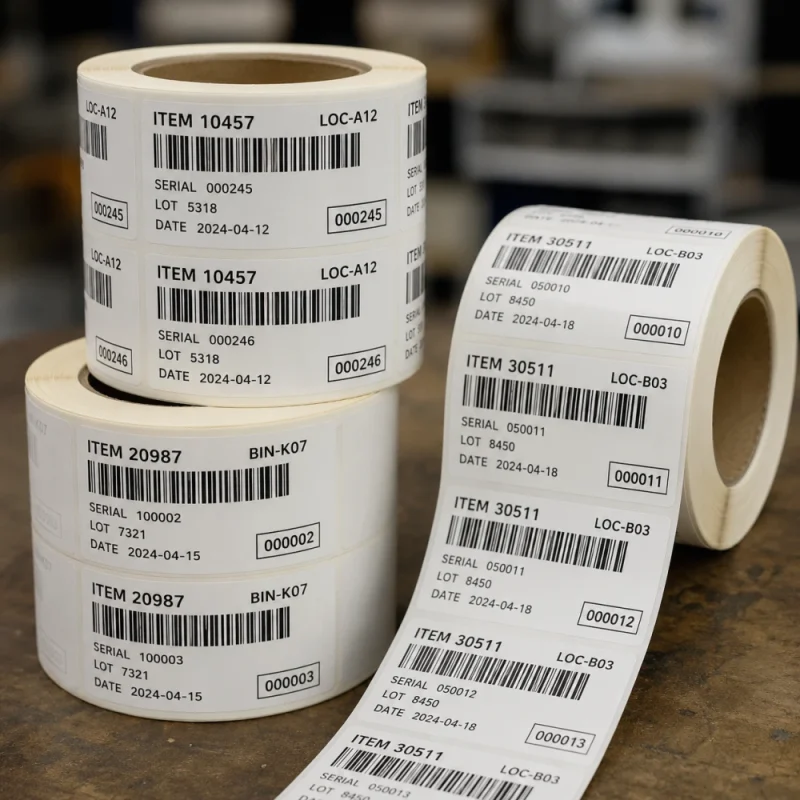
For automated label application and variable data printing. Each label can carry a unique barcode for serialization and traceability. Compatible with auto-applicators.
Barcode Sheet Labels
For small-batch products, short-run retail labels, and office printing. Good for limited product runs where a single barcode is used across all labels.
Barcode Stickers
For asset tags, inventory labels, warehouse bin markers, and equipment identification. Die-cut in any shape with scannable barcode and human-readable text.
What Kills Barcode Scans
Six buyer mistakes that turn barcode labels into rescan headaches — and how we prevent each.
Insufficient Quiet Zone
Designs that place text, graphics, or borders too close to the barcode reduce the quiet zone below GS1 minimums. Scanners cannot detect code boundaries without adequate white space.
Printing Barcodes Too Small
Reducing barcode size below the GS1 minimum X-dimension causes scan failures. UPC-A should not be scaled below 80% magnification; Code 128 should maintain at least 7.5 mil X-dimension.
Truncating Barcode Height
Cutting the barcode height to save label space makes omnidirectional supermarket scanners unreliable. GS1 specifies minimum heights (UPC-A: 1.0", EAN-13: 0.91").
Glossy or Reflective Materials
Glossy laminates and metallic materials reflect scanner light, creating hot spots that blind the scanner sensor. Always use matte finish for barcode label areas.
Low-Resolution Printing
Printing barcodes below 300 DPI causes bar edge blur and inconsistent bar widths. Ink spread on certain materials can also affect bar-width accuracy.
Wrong Barcode Symbology
Using the wrong barcode type for the application leads to scanning failures at retail or logistics. Always confirm the required symbology with your retail partner or supply chain.
Explore Related Label Solutions
QR Code Labels
2D QR codes for scan-to-link marketing.
VIEW →Permanent Adhesive Labels
Tamper-evident barcode labels.
VIEW →White BOPP Labels
Best material for high-contrast barcodes.
VIEW →Thermal Transfer Paper
On-demand variable barcode printing.
VIEW →Custom Roll Labels
Variable data printing for unique barcodes.
VIEW →Material Guide
Compare all materials for scan reliability.
VIEW →By Features
Browse all label performance features.
VIEW →Get Quote
Request a barcode label recommendation.
VIEW →Barcode Label FAQ
What types of barcodes can you print on labels?
We print all major barcode symbologies: UPC-A (12-digit, North American retail), EAN-13 (13-digit, international retail), Code 128 (logistics, shipping, variable data), ITF-14 (carton and case barcodes), Code 39 (industrial and automotive), Interleaved 2 of 5, and Data Matrix (2D matrix for pharma and high-density applications). Each barcode is scaled, sized, and printed to meet GS1 specifications for its scanning environment. We also print Amazon FNSKU barcodes for FBA sellers.
What resolution are barcode labels printed at?
All barcode labels are printed at a minimum of 300 DPI (dots per inch), with 600 DPI used for high-density barcodes like Code 128 with many characters, Data Matrix codes, and small X-dimension barcodes. Resolution directly affects bar edge sharpness — the most critical factor in scan reliability. Low-resolution printing causes bar edges to blur, making the barcode appear to have inconsistent bar widths. Our digital and flexographic presses maintain tight dimensional tolerances.
What is a quiet zone and why does it matter?
The quiet zone is the blank white margin on all four sides of a barcode that allows scanners to identify where the barcode begins and ends. Without an adequate quiet zone, the scanner cannot distinguish the barcode from surrounding graphics or text. GS1 standards specify minimum quiet zones: 9 modules (narrowest bar width) on the left and right sides of UPC-A and EAN-13 barcodes, and 10 modules for ITF-14. For 2D codes like Data Matrix, the quiet zone must be at least 1X-dimension on all sides. We enforce these minimums on every barcode label.
Can you print variable barcodes with unique data per label?
Yes. Variable data printing (VDP) allows each label on a roll to carry a completely unique barcode. Common applications include sequential numbering (00001, 00002, 00003...), unique product serial numbers, batch and lot codes, expiration dates encoded in Code 128, warehouse location identifiers, and pharmaceutical serialization codes. We accept variable data in CSV, Excel, TXT, or database formats. Each barcode in a VDP run is printed at the same size and resolution for consistent scanning across the entire batch.
What material is best for barcode labels?
The best material for barcode labels is a white, matte-finish substrate that provides maximum contrast and eliminates surface glare. White BOPP with matte laminate is the top choice for retail product barcodes — waterproof, durable, and excellent scan contrast. White paper with matte finish is the most cost-effective option for dry, indoor, short-shelf-life products. Thermal transfer paper is used for on-demand barcode printing. White vinyl with matte finish is ideal for warehouse, outdoor, and industrial applications requiring durability against abrasion and chemicals.
Get Scannable Barcode Labels on the First Pass
Tell us your barcode symbology, label size, material, and volume. We'll ensure your barcodes print crisp, GS1-compliant, and scannable — backed by an ISO/IEC 15416 verification report.
No reviews yet.


Write a Review
You must be logged in to post a comment.