

How Much Do Custom Foil Labels Cost in 2026?
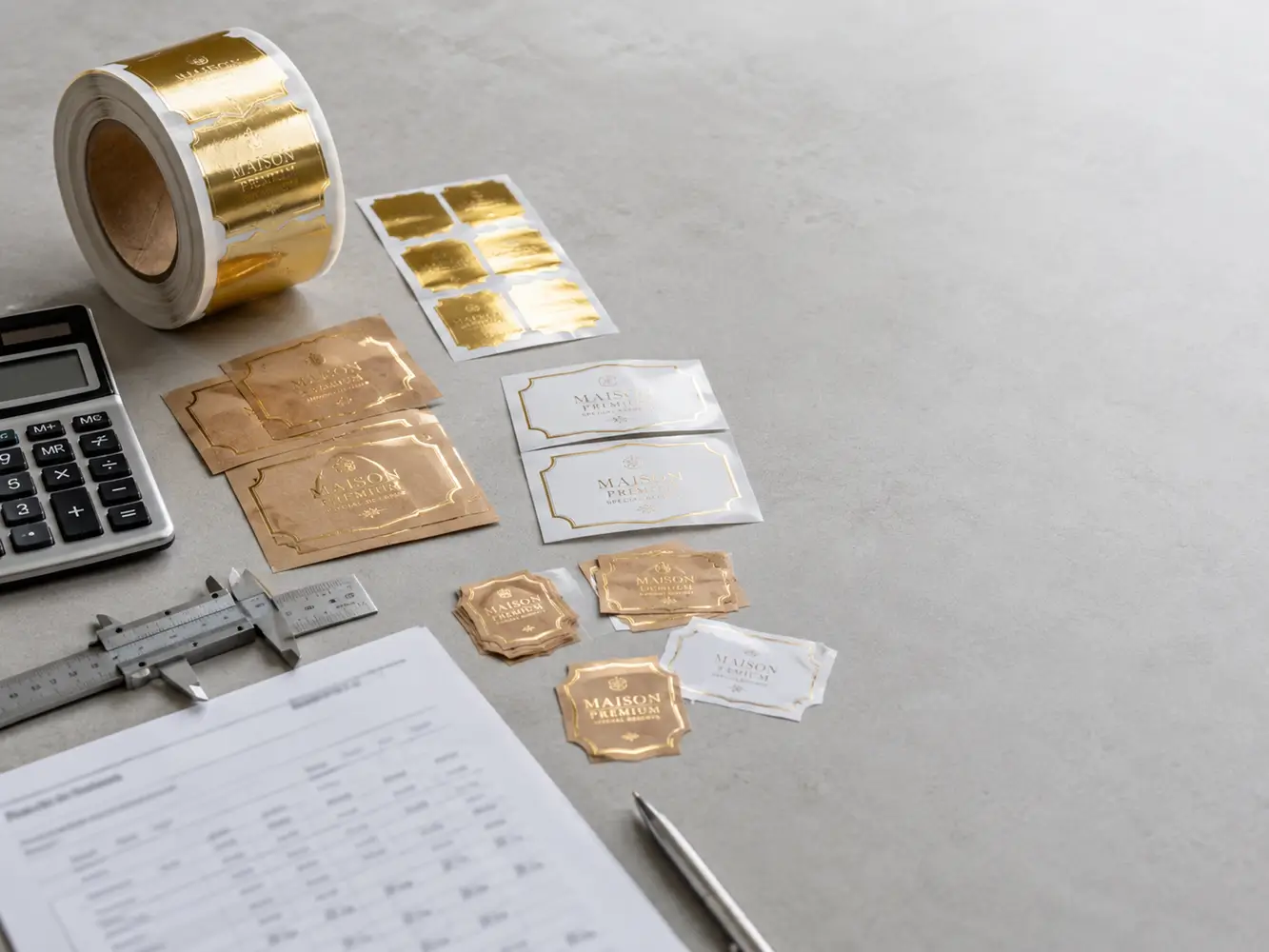
The cost of custom foil labels varies sharply with quantity, material, size, foil process, finishing, and supplier pricing structure. In one August 2026 price check for 2″ × 2″ Kraft Brown Paper labels with gold foil, recorded prices ranged from $55.69 for 100 labels to $396.51 for 5,000 labels at LabelsAgent, while the compared Inkable Label configurations ranged from $160 to $417.[5] These figures are examples, not universal market prices.
The most useful number is therefore not simply the order total. Buyers should compare cost per label, setup charges, process, material, shipping, and minimum quantity under the same specification.
What Does a Custom Foil Label Actually Cost?
There is no defensible single industry-wide price for a custom foil label. A 2-inch Kraft-paper logo label ordered in a batch of 100 is economically different from a waterproof BOPP roll ordered in quantities of 10,000.
Quantity has a particularly large effect because some production costs are spread across the entire print run.
LabelsAgent’s current custom foil label page lists real hot foil stamping, eight foil tones, multiple paper and film stocks, no minimum order requirement, and currently waived plate-making charges. Its standard foil production time is listed as 6-8 business days after proof approval.[1]
A useful budget should therefore be built from:
Total landed cost = label production + setup/tooling + premium finishing + shipping + applicable taxes or duties
Then calculate:
Cost per usable label = total landed cost ÷ usable labels received
That second number is usually more useful than the headline order total.
2026 Price Check: 2″ × 2″ Kraft Paper Gold Foil Labels
The following comparison uses an August 2026 manual price check for 2″ × 2″ Kraft Brown Paper gold foil labels. The recorded comparison held size, substrate, gold foil appearance, and quantity constant.
LabelsAgent was configured with hot foil stamping. Inkable Label’s current public page states that it offers both hot and cold foil stamping, but the exact process attached to the recorded Inkable prices could not be independently reconstructed from the publicly crawled pricing interface.[2][5]
For that reason, this should be treated as a same-size/material/foil-color price comparison, not proof of a perfectly identical production specification.
| Quantity | LabelsAgent | Cost / Label | Inkable Label | Cost / Label | Recorded Price Difference |
|---|---|---|---|---|---|
| 100 | $55.69 | $0.557 | $160.00 | $1.600 | 65.2% lower |
| 500 | $118.95 | $0.238 | $164.00 | $0.328 | 27.5% lower |
| 1,000 | $154.70 | $0.155 | $196.00 | $0.196 | 21.1% lower |
| 5,000 | $396.51 | $0.079 | $417.00 | $0.083 | 4.9% lower |
Source and limitation: First-party price check supplied for this article, August 2026.[5] The percentages are calculated from the recorded prices. Shipping, taxes, promotions, artwork differences, and the exact Inkable stamping method were not independently normalized.
The More Important Finding Is the Shape of the Cost Curve
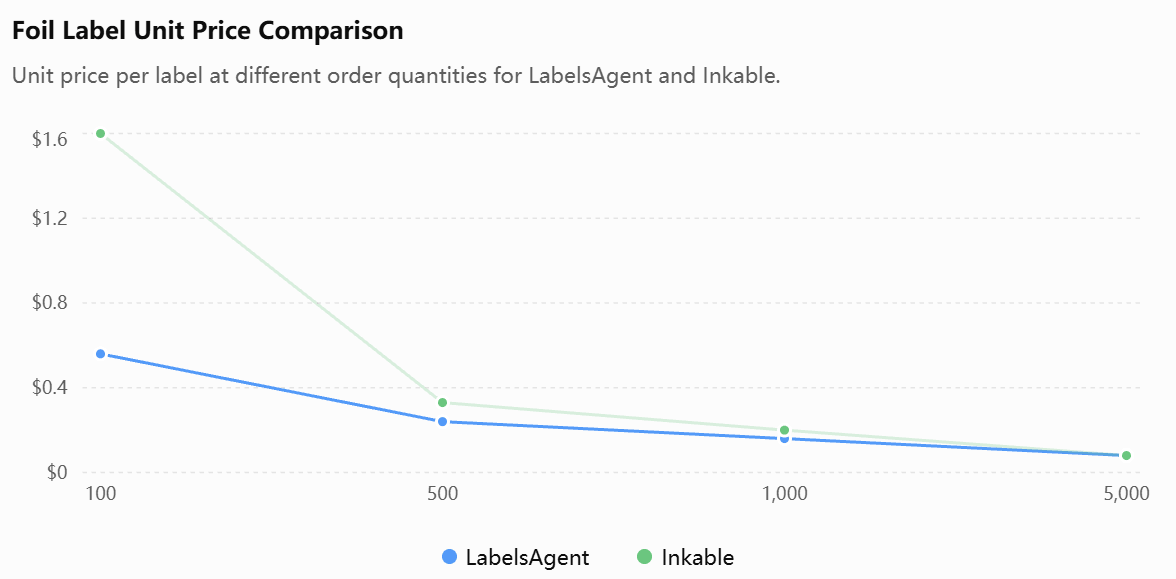
The largest difference appears at the smallest quantity.
At 100 labels, the recorded LabelsAgent price equals about $0.56 per label, compared with $1.60 per label in the Inkable price check. At 5,000 labels, those figures narrow to roughly $0.079 and $0.083 per label.[5]
That produces an important purchasing insight:
Low-order pricing structure can matter more than headline unit-price competitiveness at scale.
A supplier optimized for 5,000-label runs may be perfectly competitive at volume yet comparatively expensive for a 100-label product launch.
For startups with many SKUs, that difference matters because inventory risk often matters as much as unit cost.
Why Does the Cost Per Foil Label Fall as Quantity Increases?
Foil stamping involves production work that does not increase proportionally with every additional label.
Artwork inspection, proofing, machine preparation, foil setup, and production handling must occur whether the order contains 100 labels or several thousand. As output increases, those fixed or semi-fixed costs can be distributed across more units.
The supplied LabelsAgent figures illustrate this clearly:
- 100 labels: about $0.557 each
- 500 labels: about $0.238 each
- 1,000 labels: about $0.155 each
- 5,000 labels: about $0.079 each[5]
Ordering 50 times more labels—from 100 to 5,000—does not increase the recorded total price by 50 times.
That does not mean brands should automatically order more. Excess labels tied to discontinued scents, outdated ingredients, redesigns, seasonal products, or changed packaging are wasted inventory.
The right quantity is the lowest-cost quantity you are reasonably likely to use before the design changes.
What Factors Have the Biggest Effect on Foil Label Pricing?
1. Order Quantity
For many projects, quantity is the strongest driver of unit cost.
Small runs carry more production cost per piece. Larger runs distribute preparation and setup costs across more labels.
This is why both total price and price per label should be recorded when comparing quotes.
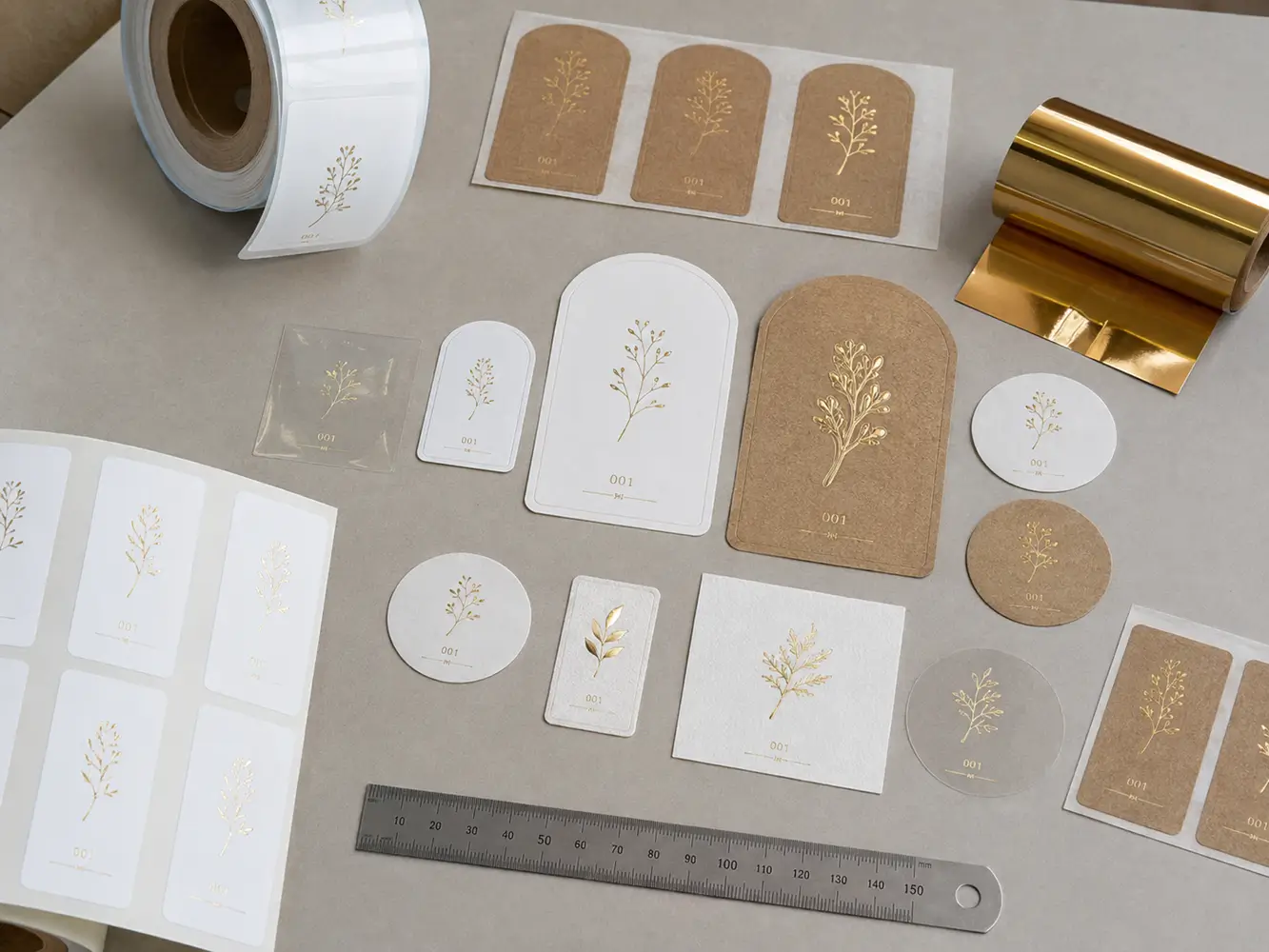
2. Label Size
A larger label consumes more substrate and potentially more foil.
Comparing a 1″ circle with a 4″ × 6″ bottle label tells a buyer almost nothing about supplier pricing competitiveness.
Always compare the same finished dimensions.
3. Foil Process
Not all foil labels create their metallic effect in the same way. Real foil stamping should not automatically be grouped together with metallic substrates or metallic-looking print effects.
Inkable Label’s current foil-stamped-label page explicitly describes both hot foil stamping and cold foil stamping.[2]
Avery’s specialty roll-label page, by contrast, describes metallic effects produced using chrome film and metallic-colored printing; the examples identify chrome BOPP and metallic inks. That is a legitimate premium metallic label option, but it is not a like-for-like substitute for every real hot-foil specification.[3]
Similarly, OnlineLabels sells Gold Foil Inkjet sheet material and separately offers custom printed labels, so its gold-foil material product should not automatically be treated as a direct hot-foil-stamping price comparison.[4]
Before comparing prices, ask:
Is the metallic appearance created by hot foil stamping, cold foil, metallic ink, or a metallic substrate?
Without that answer, the quotes may represent different products.
4. Substrate
Kraft paper, textured papers, BOPP films, PET, clear films, and specialty papers do not necessarily cost the same or behave the same during finishing. If material choice is still open, compare Kraft, paper, BOPP, PET, clear film, and textured stocks in our foil label material guide before choosing based on price alone.
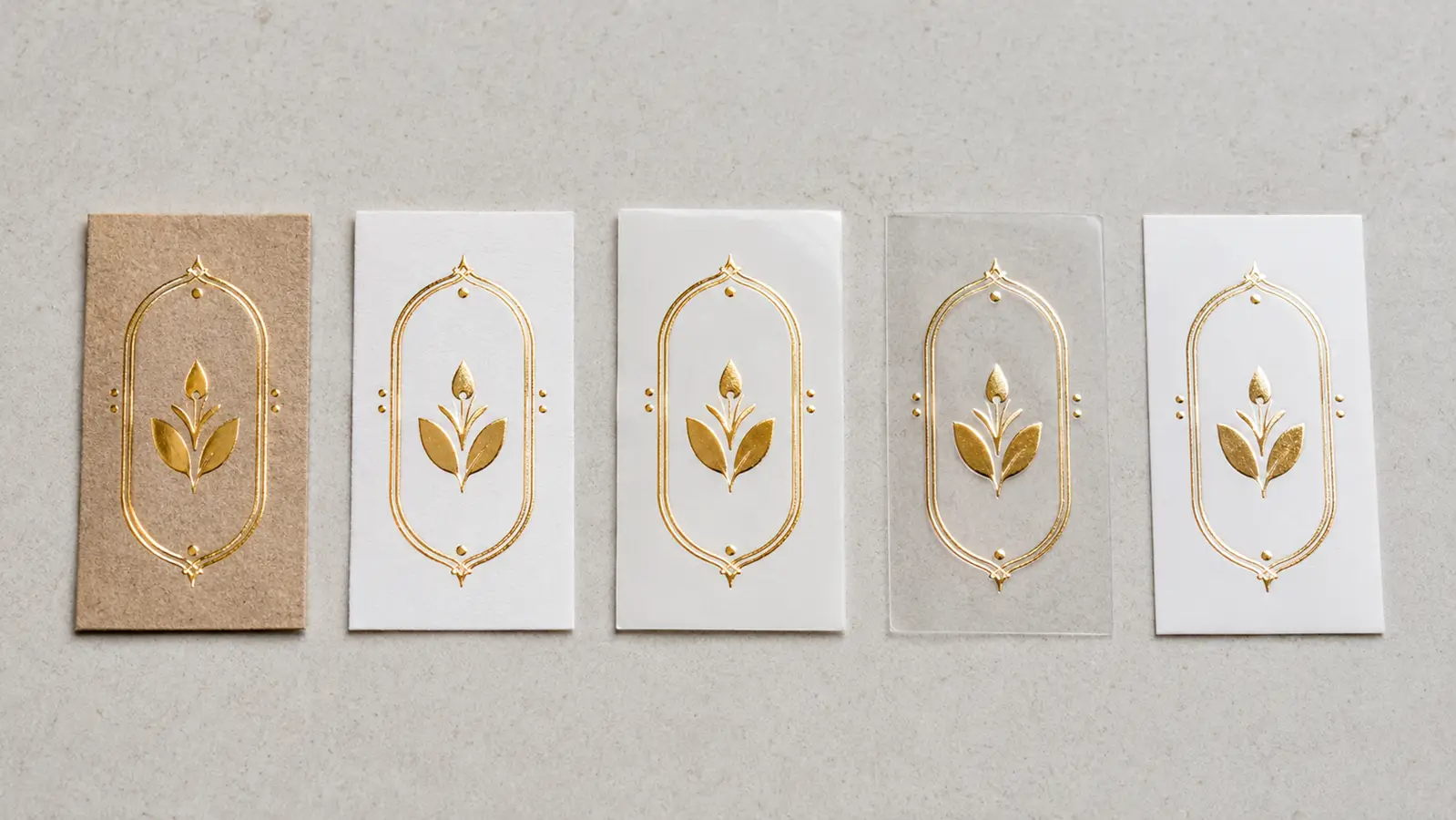
Material should therefore be held constant in a price comparison.
The least expensive substrate is also not automatically the lowest-cost choice. A cheaper paper label that fails in a wet or oily application can create more waste than a correctly specified film.
5. Does Roll vs. Sheet Format Affect Foil Label Cost?
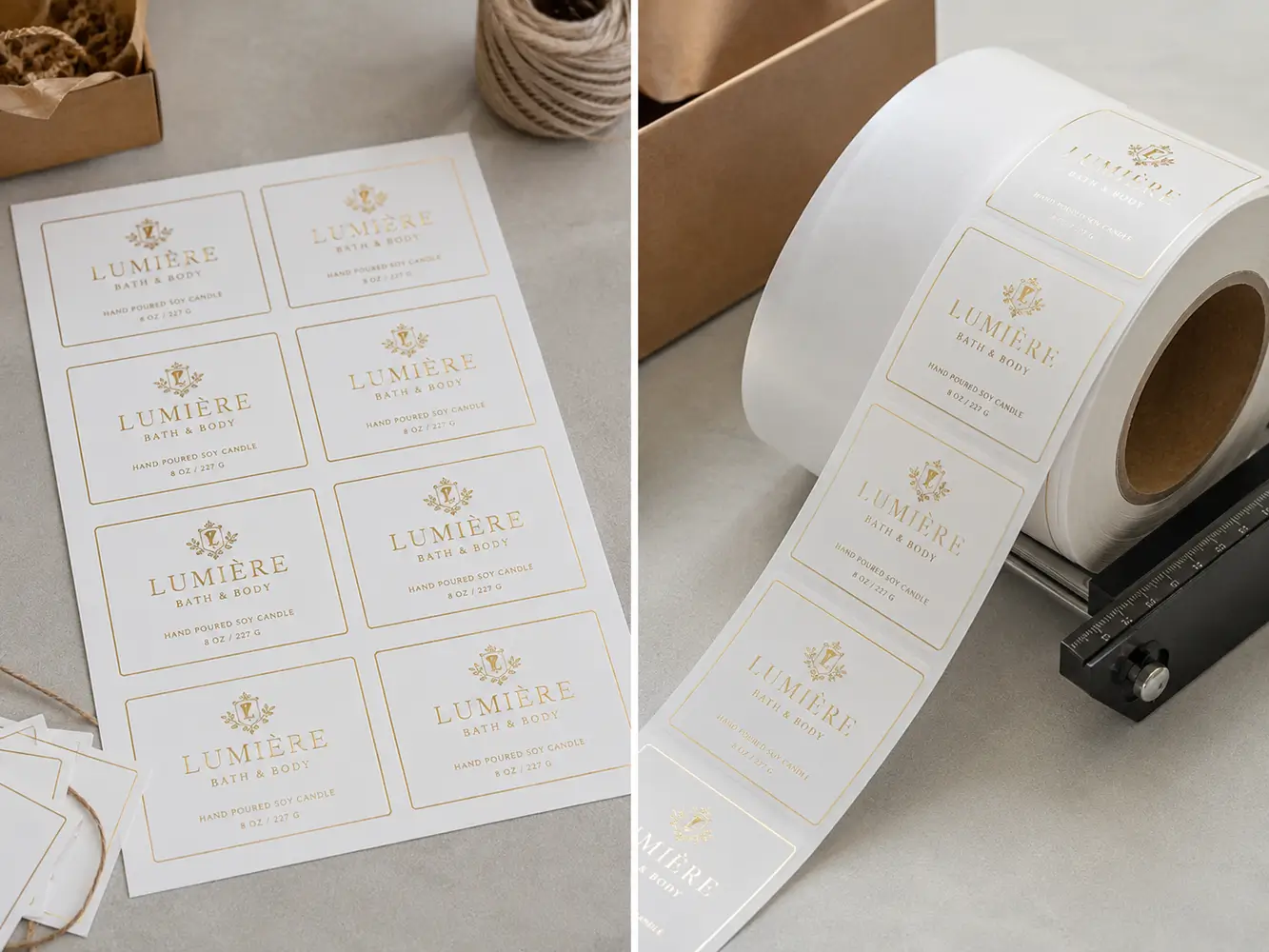
Format can affect both production economics and the cost of applying labels after they arrive. Foil sheet labels are particularly relevant to small runs, multiple designs, and manual application, while foil roll labels are often considered for repeat dispensing and higher-volume packaging workflows.
Do not assume one format is always cheaper. Compare the same size, material, foil process, quantity, and finishing before judging the price difference.
6. Embossing and Other Finishes
Combining foil with embossing, spot UV, specialty laminates, or other finishing steps introduces additional production operations.
LabelsAgent currently states that standard foil production takes 6-8 business days after proof approval, while embossing or spot UV adds 1-2 business days.[1]
Inkable also publicly offers foil stamping with embossing and other specialty effects.[2]
The practical rule is simple:
Compare single-process foil with single-process foil, and multi-process labels with the same finishing stack.
Do Setup, Die, or Plate Fees Change the Answer?
They can, especially on small orders.
Artwork preparation can also affect prepress work, especially when a design contains very fine foil details, multiple finishing layers, or complex cut lines. Before requesting production pricing, make sure you know how to prepare artwork for foil stamping.
LabelsAgent’s current public custom foil page states that plate-making is currently waived on all custom foil label orders.[1]
Inkable’s current foil-stamped-label page advertises no setup costs for standard configurations and says die-cut fees apply to non-standard shapes.[2]
This illustrates why buyers should not compare only the apparent unit price.
Ask every supplier for these items separately:
| Cost Element | Question to Ask |
|---|---|
| Label printing | What is the production price at my quantity? |
| Foil process | Hot foil, cold foil, or another metallic process? |
| Plate/tooling | Is there a foil plate or setup charge? |
| Custom die | Does my shape create an additional charge? |
| Proof | Is digital or physical proofing included? |
| Finishing | What does embossing, spot UV, or laminate add? |
| Shipping | Is freight included in the displayed price? |
| Taxes/duties | Are these included or payable separately? |
A $60 production quote plus $70 in tooling and freight is not cheaper than a $100 quote with those items included.
How Much Should a Small Brand Budget?
A practical budget depends more on launch strategy than on a universal label-price benchmark.
For a new product or untested SKU
Prioritize low inventory exposure.
A 100-label order may have a higher unit price than 1,000 labels, but spending less money overall can be rational if the packaging may change after launch.
This is where no-MOQ or very-low-MOQ production has the greatest commercial value.
LabelsAgent currently states that its general custom foil label product has no minimum order requirement.[1]
For an established product
Once artwork, dimensions, material, and sales volume are stable, higher quantities normally deserve consideration because the unit-cost curve becomes more favorable.
The supplied benchmark shows LabelsAgent falling from roughly $0.557 per unit at 100 labels to $0.079 at 5,000 labels.[5]
The decision, however, should be based on expected consumption—not simply the cheapest unit price.
For a multi-SKU brand
Calculate inventory by design rather than total brand volume.
Ten fragrances requiring 100 labels each do not create the same inventory risk as one product requiring 1,000 identical labels.
A supplier’s policy toward small runs and multiple designs can therefore be more commercially important than its absolute lowest price at high volume.
What About Shipping and Lead Time?
Production price is only part of the purchasing decision.
LabelsAgent’s currently published custom foil page lists:
- 6-8 business days for standard foil production after artwork approval;
- +1-2 business days for embossing or spot UV;
- 25-40 business days for economy sea freight;
- 4-8 business days for DHL/FedEx air shipping;
- economy freight listed at $18, free over $70.[1]
These are current supplier terms, not industry-wide shipping standards, and they can change.
A low production price becomes less useful if a launch deadline forces an unexpectedly expensive shipping upgrade.
For international sourcing, compare:
Production cost + freight + required delivery speed
rather than production cost alone.
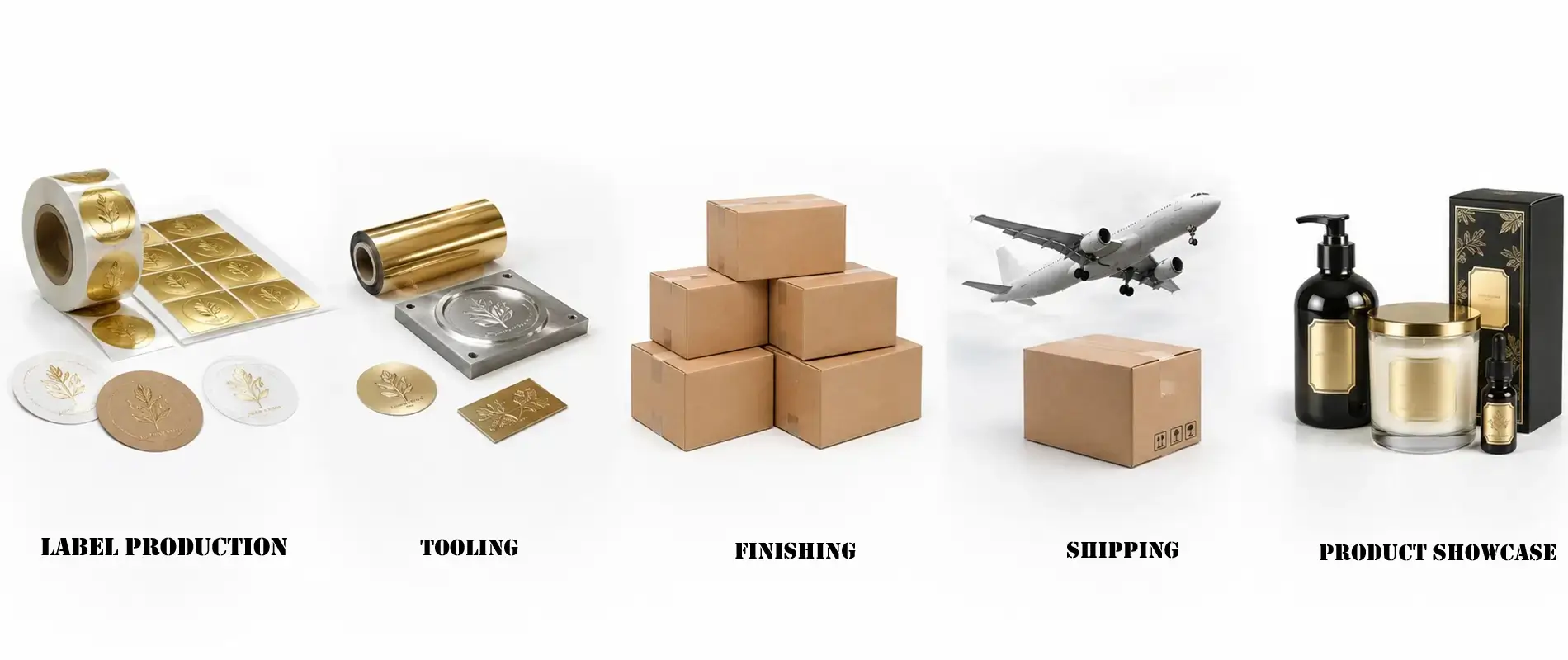
If you are comparing overseas production with a domestic supplier, our guide to ordering custom labels from China explains how production cost, international shipping, lead time, customization requirements, and sourcing risk fit into the decision.
How to Compare Two Foil Label Quotes Correctly
Before deciding that one supplier is cheaper, normalize these seven variables:
- Finished size
- Quantity
- Substrate
- Foil process
- Foil color and coverage
- Finishing and tooling
- Shipping and taxes
If one variable is materially different, label the comparison as approximate rather than like-for-like.
For small brands, also add an eighth variable:
inventory risk.
Saving two cents per label is not meaningful if achieving that price requires buying thousands of labels that may never be used.
The best-value order is therefore not automatically the quote with the lowest unit cost. It is the specification and quantity that minimizes the total cost of getting usable labels onto products.
Before requesting prices, use our guide to prepare an accurate foil label quote to organize the finished size, material, foil scope, quantity, and delivery requirements. Once you know your finished size, material, quantity, foil finish, and required delivery window, you can request a custom foil quote based on the actual specification rather than relying on an estimated unit price.
FAQ
How much do 100 custom foil labels cost?
There is no universal 100-label price. In an August 2026 first-party price check for 2″ × 2″ Kraft Brown Paper labels with gold foil, LabelsAgent recorded $55.69 for 100 labels, while an Inkable Label configuration was recorded at $160.[5] The exact Inkable stamping method for that captured price could not be independently verified, so the figures should be treated as a dated comparison rather than a permanent market rate.
Are custom foil labels expensive?
They generally require more production steps than a basic printed label, but quantity has a major effect on unit cost. In the supplied LabelsAgent price data, cost per label fell from about $0.557 at 100 units to $0.079 at 5,000 units.[5] Material, size, foil process, finishing, and setup charges can materially change the final price.
Do custom foil labels require a minimum order?
Minimums depend on the supplier and product. LabelsAgent’s current general custom foil label page states No Minimum Orders.[1] The current Inkable page exposes a quantity selector, but its public crawled content did not provide enough evidence to independently confirm the exact current minimum quantity. Buyers should verify MOQ at the specification level before comparing suppliers.
Is hot foil stamping the same as metallic printing?
No. Hot foil stamping transfers metallic foil to selected design areas using heat and pressure. Metallic printing may instead use metallic ink or a reflective metallic substrate. Inkable publicly distinguishes hot and cold foil processes, while Avery’s reviewed specialty metallic-roll examples use chrome film and metallic-colored inks.[2][3]
What is the best way to reduce foil label cost?
First optimize quantity, then simplify unnecessary finishing rather than compromising the material required for the application. Compare suppliers using the same size, substrate, foil process, finishing, and shipping basis. For a new SKU, ordering fewer labels can also reduce total financial risk even when the per-label price is higher.
References / Source List
[1] LabelsAgent — Custom Foil Labels
Source / Organization:
LabelsAgent
Page / Document Title:
Custom Foil Labels for Premium Product Packaging
Source Type:
Brand / First-Party Public Product Page
Used For:
Foil methods, foil color options, substrates, no minimum orders, waived plate-making, production time, finishing lead-time additions, and shipping terms.
Published / Updated Date:
Not clearly stated on page
Date Checked:
August 18, 2026
URL:
https://www.labelsagent.com/product/custom-foil-labels/
[2] Inkable Label Co. — Custom Foil Stamped Labels
Source / Organization:
Inkable Label Co.
Page / Document Title:
Custom Foil Stamped Labels
Source Type:
Competitor / Brand Product Page
Used For:
Hot and cold foil stamping availability, foil colors, embossing, setup-cost statements, shipping policy, and finishing capabilities.
Published / Updated Date:
Not clearly stated on page
Date Checked:
August 18, 2026
URL:
https://www.inkablelabel.com/custom-foil-stamped-labels
[3] Avery — Specialty Roll Labels
Source / Organization:
Avery
Page / Document Title:
Custom Metallic Foil Holographic Spot Varnish Labels & Stickers
Source Type:
Manufacturer / Commercial Product Page
Used For:
Distinguishing chrome-film and metallic-ink label construction from a necessarily like-for-like hot-foil-stamping specification.
Published / Updated Date:
Not clearly stated
Date Checked:
August 18, 2026
URL:
https://www.avery.com/custom-printing/roll-specialty-labels/
[4] OnlineLabels — Gold Foil Inkjet Labels
Source / Organization:
OnlineLabels
Page / Document Title:
8.5″ × 5.5″ Half Sheet Labels — Gold Foil Inkjet — OL400GI
Source Type:
Commercial Product Page
Used For:
Confirming availability of gold-foil printable material and showing why metallic-material offerings should not automatically be treated as a real foil-stamping benchmark.
Published / Updated Date:
Not clearly stated
Date Checked:
August 18, 2026
URL:
https://www.onlinelabels.com/products/ol400gi
[5] August 2026 Foil Label Price Check
Source / Organization:
LabelsAgent / supplied research data
Page / Document Title:
2″ × 2″ Kraft Brown Paper Gold Foil Price Comparison
Source Type:
First-Party Data
Used For:
Quantity pricing, price-per-label calculations, and LabelsAgent-versus-Inkable recorded price comparison.
Data Collected:
August 2026
Method:
Manual online configuration / supplied price check
Specification:
2″ × 2″; Kraft Brown Paper; gold foil appearance; quantities of 100, 500, 1,000, and 5,000.
URL:
Not Publicly Available
Evidence Type:
First-Party Data
Limitation:
Historical competitor prices could not be independently reproduced through publicly indexed page text, and the exact Inkable hot/cold stamping selection attached to those recorded prices was not independently verified.