



Thermal Transfer Paper Labels
Helpful Links
Thermal Transfer Paper Labels for Barcode & Variable-Data Print
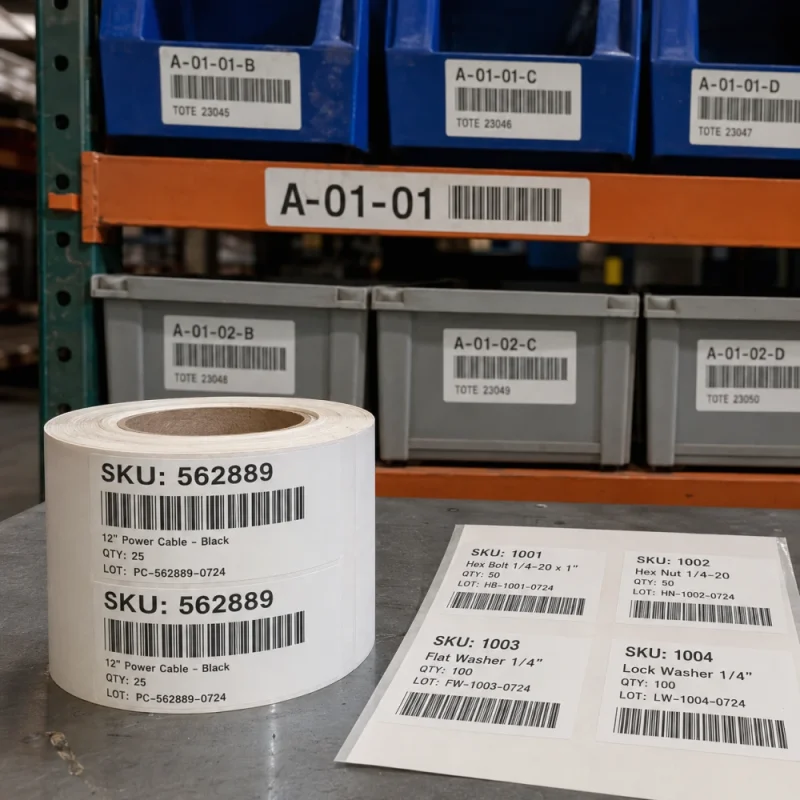
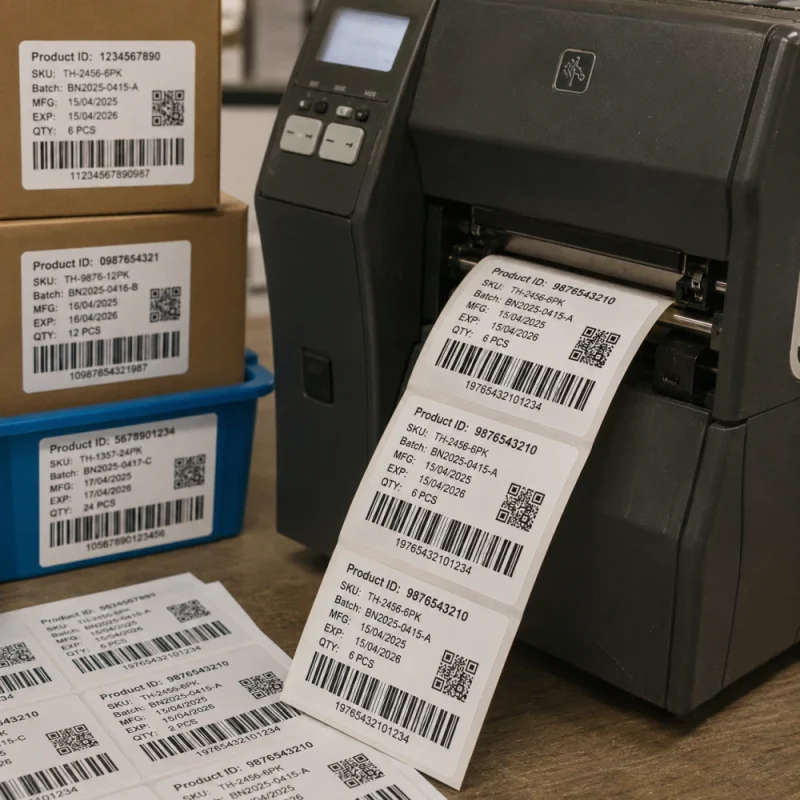
Engineered for on-demand printing with wax, wax-resin, or resin ribbons on Zebra, Sato, Datamax, TSC and Honeywell industrial printers. Smooth-coated surface delivers crisp barcodes, batch codes and shipping data — the workhorse substrate for warehouses, logistics, manufacturing and retail operations that print variable information in-house.
Where Thermal Transfer Paper Works Hardest
On-demand variable-data printing for the operations that run on barcodes, batch numbers and real-time inventory — print what you need, when you need it.
Barcode Labels
UPC, Code 128, QR, Data Matrix — crisp edge definition for first-pass scan reliability.
Product Identification
SKU, model, serial — variable text and graphics printed in-house on demand.
Shipping Labels
Carrier-compliant 4×6 shipping labels with routing, address and tracking data.
Warehouse Rack
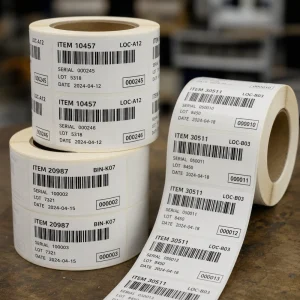
Location and bin labels for WMS-driven fulfillment and inventory accuracy.
Inventory Tags
Stock rotation, FIFO tracking, count tags — survive handling and dust.
Asset Tracking
IT equipment, tools, fixtures — long-lasting IDs with resin-ribbon durability.
Batch & Date Coding
Lot numbers, expiry, manufacture dates — printed at the line, on demand.
Retail Price Labels
Shelf-edge pricing, promotion, and SKU tags for retail floor operations.
Match Your Use Case to the Right Ribbon
Ribbon choice drives cost and durability. Use this matcher to align application, environment and label material with the optimal ribbon chemistry.
| Application | Environment | Recommended Ribbon | Print Life |
|---|---|---|---|
| Office / retail barcode | Indoor, dry, controlled | Wax |
6–12 months |
| Shipping & logistics | Indoor transit, mild moisture | Wax-Resin |
1-2 years |
| Warehouse rack & inventory | Dust, handling, abrasion | Wax-Resin |
2–3 years |
| Asset tracking (IT equipment) | Office, long-term | Resin |
5+ years |
| Industrial / manufacturing | Oils, solvents, heat | Resin |
3-5 years |
| Freezer / cold storage | Sub-zero, condensation | Resin |
Application-rated |
| Healthcare lab samples | Chemicals, alcohols | Resin |
Chemical-rated |
Three Ribbons, Three Trade-offs
Wax, wax-resin and resin ribbons sit on a cost-to-durability curve. The chart below compares the five performance dimensions that drive ribbon selection.
Wax Ribbon
EconomyThe default for high-volume barcode and product labeling in climate-controlled environments. Good print quality on coated paper; moderate scratch and smudge resistance.
Wax-Resin Ribbon
BalancedThe workhorse for shipping, warehouse and most operational labeling. Improved smudge and scratch resistance over wax; prints on paper and some synthetics.
Resin Ribbon
PremiumEssential for labels exposed to chemicals, solvents, abrasion, extreme heat or outdoor conditions. Bonded ink layer resists smudging, scratching and moisture.
Engineered for the Big Five Printer Brands
Our thermal transfer paper rolls are sized to exact OEM specifications for 1-inch and 3-inch cores, with custom widths available. We match the ribbon to your printer’s heat settings and print speed.
Don’t see your printer? Send the model number — we’ll size the rolls and match a ribbon.
Material Performance Specifications
Technical data for procurement and engineering teams. All specs verified against OEM printer testing and ISO 9001 production controls.
| Property | Specification |
|---|---|
| Material | Thermal transfer coated paper (white) |
| Face stock | White smooth-coated paper |
| Thickness | 50–60 lb (75–90 gsm) |
| Adhesive | Permanent acrylic (removable available) |
| Temperature range | -10°C to 60°C (14°F to 140°F) |
| Water resistance | Not waterproof — resin ribbon adds print-side resistance |
| Ribbon compatibility | Wax · Wax-Resin · Resin (all grades) |
| Print durability | Months (wax) · 1-2 yr (wax-resin) · Multi-year (resin) |
| Roll format | 1-inch core, 3-inch core, custom OD sizing |
| Minimum order | No minimum quantity |
Crisp Edge Definition for Grade A Scan Rates
The smooth coated surface produces barcodes that scan first-pass across handheld, presentation, fixed-mount and 2D imaging scanners — verified against GS1 and ISO/IEC 15416 print quality standards.
ISO/IEC 15416 Grade Scale
Thermal transfer prints typically achieve Grade A or B on coated paper with properly matched ribbon and printer heat settings.
When Thermal Transfer Paper Is — and Isn’t — the Right Call
Thermal transfer is the industry standard for on-demand variable printing. But it is not always the right answer. Honest guidance below.
You print variable data on-site
Barcodes, batch numbers, dates, shipping info printed in-house, on demand, by your own team.
Labels must stay readable for years
Unlike direct thermal which fades, thermal transfer prints last years in storage without degradation.
You print high volumes of barcodes
Paper + wax ribbon is the most cost-effective combination for high-volume barcode printing.
Labels face heat or UV exposure
Thermal transfer prints withstand higher temperatures and UV than direct thermal paper.
You need consistent scan rates
Smooth coated surface produces barcodes with excellent edge definition for reliable scanning.
Waterproof labeling required
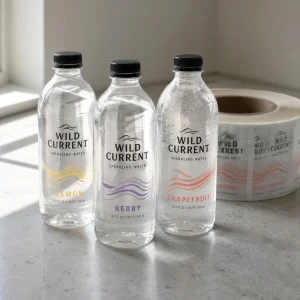
Paper absorbs moisture. Choose White BOPP, PET or Vinyl thermal transfer materials for wet environments.
Pre-printed custom labels suffice
If you don’t need on-demand printing, flexographic or digital pre-printed labels offer better quality at lower unit cost.
Labels face sustained outdoor UV
Thermal transfer paper has limited UV resistance. Choose White Vinyl with UV-resistant inks.
Premium retail product labeling
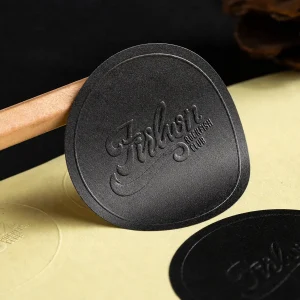
Thermal transfer paper is functional, not decorative. Choose BOPP, Estate Paper or Vinyl for premium shelf impact.
Practical Guidance for Print-Ready Files
Set up your artwork, ribbon and printer for first-pass barcode scan success. Reference sizes below cover the most common thermal transfer applications.
Artwork Setup
- Vector PDF or AI — 300+ dpi rasterized elements
- Black ink at 100% K — no four-color black for barcodes
- Bar module width (X-dim) per GS1 spec — min 7.5 mil for Grade B
- Quiet zone: 10× module width on left/right of barcode
- Embed fonts or outline — system fonts only
Printer Setup
- Match ribbon type to label material — never mix wax with synthetic stock
- Calibrate media sensor for top-of-form accuracy
- Adjust print head temperature for darkest readable print
- Print speed: 6–10 ips for wax; 8–12 ips for wax-resin
- Clean print head weekly with isopropyl alcohol — extends life
Common Thermal Transfer Label Sizes
| Application | Label Size (W × H) |
|---|---|
| Shipping (carrier 4×6) | 4" × 6" · 102 × 152 mm |
| Product / barcode (small) | 2" × 1" · 50 × 25 mm |
| Product / barcode (medium) | 3" × 2" · 76 × 51 mm |
| Warehouse rack location | 4" × 6" · 102 × 152 mm |
| Inventory / asset tag | 2" × 2" · 51 × 51 mm |
| Pallet / SSCC18 logistics | 4" × 8" · 102 × 203 mm |
| Retail shelf edge | 1.5" × 1" · 38 × 25 mm |
Custom sizes available. Send your printer model and core size for exact roll specs.
Production, Shipping & Free Sample Rolls
Fast production for restocks and new deployments. Free sample rolls let you test our thermal transfer paper on your printer with your ribbon before committing to a production run.
Standard Production
4-6 business days after proof approval. Bulk orders (100K+) add 4-6 business days.
Free Sample Roll
Sample roll sized to your printer — with ribbon recommendations matched to your application.
Shipping Options
Economy: 25-40 days, free over $70. DHL express: 4-8 business days.
Similar Materials & Alternatives
Adjacent materials that operations teams commonly evaluate alongside thermal transfer paper — or upgrade to when paper hits its limit.
Thermal Transfer Frequently Asked Questions
What is the difference between thermal transfer and direct thermal labels?+
Thermal transfer labels use a heated ribbon (wax, wax-resin, or resin) to transfer ink onto the paper. The result is durable, long-lasting print that resists fading, heat and UV — readable for years.
Direct thermal labels use heat-sensitive paper that darkens when the print head applies heat — no ribbon. The chemistry fades over time and is sensitive to heat and sunlight. Direct thermal is fine for short-life shipping labels; thermal transfer is the answer for anything that needs to last.
What printers are compatible with thermal transfer labels?+
Our thermal transfer paper is compatible with all major industrial brands: Zebra, Sato, Datamax, TSC, Honeywell and Cab. We supply rolls to exact OEM specs for 1-inch and 3-inch cores.
Send your printer model and we’ll size the roll width, OD and core for drop-in compatibility — plus recommend the right ribbon and print head temperature range.
Should I choose wax or resin ribbons?+
It depends on the environment. Wax ribbons are the most economical, ideal for indoor dry applications like office barcode labels and retail pricing. Wax-resin balances cost and durability — the workhorse for shipping, warehouse and most operational use.
Resin ribbons deliver maximum durability against smudging, scratching, water and chemicals. Choose resin for industrial, healthcare, freezer, chemical exposure, or any application where the label must survive harsh conditions for years.
Are thermal transfer labels waterproof?+
The paper substrate itself is not waterproof — paper absorbs moisture. However, when printed with resin ribbon, the print side resists water, smudging and many chemicals.
For fully waterproof labels (cold storage, outdoor, wash-down environments), upgrade to synthetic thermal transfer materials: White BOPP for general moisture, White PET for industrial, or White Vinyl for outdoor and chemical exposure.
What are thermal transfer labels most used for?+
The dominant applications are barcode printing, product identification, shipping labels, warehouse rack labels, inventory tags, asset tracking and batch / date coding — anywhere operations need on-demand variable data printing.
If your workflow involves printing new barcodes, batch numbers, expiration dates or shipping data on-site — thermal transfer paper is almost certainly the right substrate.
Send Your Printer Model & Application for Free Ribbon Matching
Tell us your printer brand, label application and expected environment. We’ll recommend the right paper spec, ribbon chemistry and roll size — then send a free sample roll to test on your equipment before you commit.
No reviews yet.

Write a Review
You must be logged in to post a comment.