
What Information to Send for an Accurate Foil Label Quote
For an accurate foil label quote, send the finished dimensions, quantity per design, packaging surface, material preference, label format, print artwork, clearly marked foil areas, delivery destination, and required arrival date. Identify anything still undecided. Ask the supplier to itemize production, additional finishes, shipping, discounts, and exclusions, then confirm the final specification and proof before authorizing production.
A beautiful mock-up can leave expensive questions unanswered. A supplier still needs to know which gold-looking areas receive foil, whether 240 labels means one design or several, and whether your deadline means shipment or delivery. These foil label quote requirements make those decisions explicit.
What specifications should you include?
Send a written specification alongside the artwork. Dimensions, quantity, material, finish, and delivery requirements should be recorded as separate fields, so the supplier can identify assumptions and explain alternatives. If you need advice, describe the packaging and intended use instead of choosing a material simply to complete a form.
| Information | What to send | What it resolves |
|---|---|---|
| Finished size and shape | Width × height, units, shape, and corner requirements | The actual label to price |
| Quantity and versions | Quantity for each design or SKU | How the total divides between artworks |
| Packaging | Container photo, surface material, and available label area | Fit and application requirements |
| Use conditions | Relevant moisture, refrigeration, handling, or product exposure | Questions requiring material or adhesive review |
| Material and appearance | Named stock if known; otherwise desired opacity, texture, and appearance | A documented material recommendation |
| Foil and other finishes | Foil placement, tone, required method, embossing, or spot UV | The requested decoration |
| Supply format | Rolls, sheets, or individual labels; hand or machine application | Delivery and application format |
| Destination and deadline | Country, postal code, required arrival date | Freight and scheduling assumptions |
For machine application, include your applicator’s roll requirements, such as core size, maximum roll diameter, and unwind direction. For manual application, say so.
Write “3 × 3.46 inches” when that is the required size. Do not substitute a nearby preset without checking the packaging. A paper mock-up can help assess dimensions, but does not establish adhesive or material suitability.
If material choice remains open, use the foil label material guide to prepare questions, then ask the supplier to identify the construction being quoted.
Which artwork files explain a partial-foil design?
Provide three coordinated views: the printed design, a foil-only view showing the intended foil areas, and a composite preview showing their relationship. These views communicate design intent; the production handoff still needs the supplier’s required source files. LabelsAgent’s artwork guide specifies a separate vector foil layer and treats PNG/JPG images as visual references.[2]
A foil mask is the artwork that identifies where foil is intended. It should not rely on the supplier guessing from gold-colored pixels.
The supplied Hillcrest Whiskey Club image demonstrates this distinction:
| View | What it communicates |
|---|---|
| The base design, including the bird, red lettering, decorative frame, and lower information panel | |
| Foil | The intended foil elements, including “20 / 26,” script lettering, and selected lettering accents |
| Composite | The intended placement of those accents within the complete design |
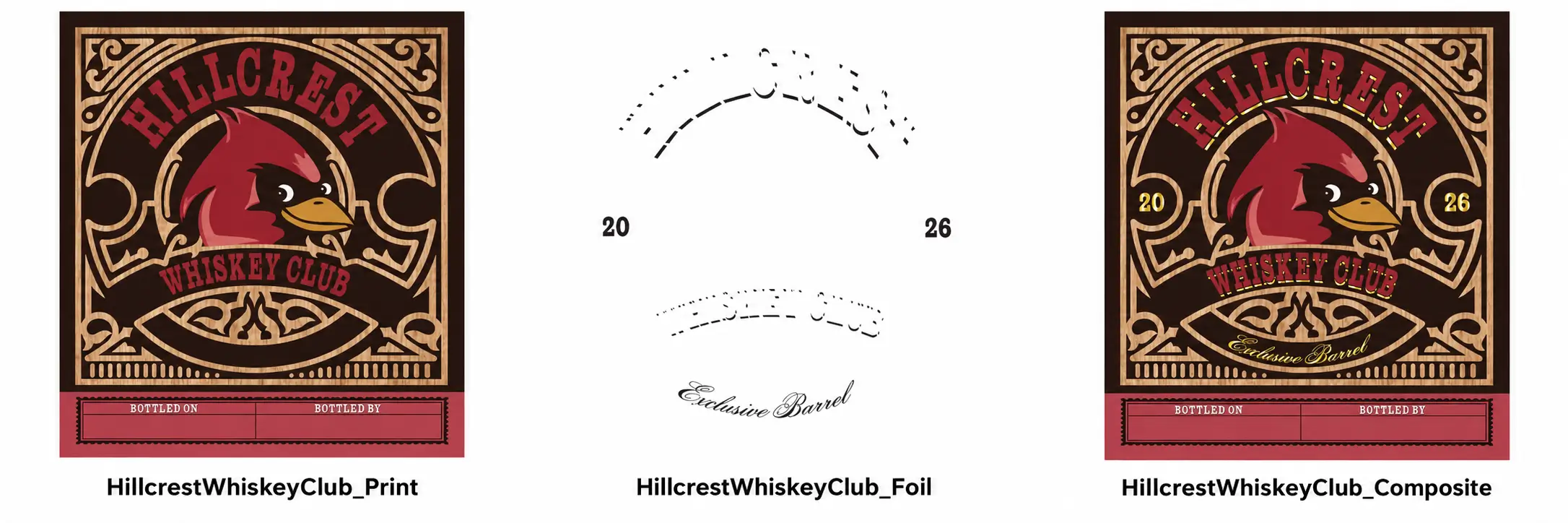
Brand-supplied artwork comparison. These are three views of one design, not three finished production samples.[4]
The gold-brown frame already appears in the Print view. Its color alone therefore does not identify it as foil. Equally, the preview cannot establish the production method or finished durability.
Use matching dimensions, positioning, filenames, and revision numbers across the files. Ask the designer to check the actual separations, not just layer visibility: Adobe documents how Separations Preview can isolate inks and preview overprinting.[3] A screen preview does not establish physical foil performance.
What if the upload accepts only one image?
Send the additional foil artwork directly to customer service and identify the matching project or order. LabelsAgent reports that its online ordering workflow accepts one image at a time and that foil customers should send the foil-only artwork to customer service before or after ordering.[1] Treat that transfer as a required handoff item.
Include:
- the order number, or project name if you have not ordered;
- the matching print, foil, and composite filenames;
- the current revision;
- a short note identifying the intended foil tone and areas.
Ask for confirmation that the files have been associated with the same job. Do not approve production while the foil separation is missing or its revision is unclear.
Should you specify hot foil or cold foil?
Specify the method when it is a firm project requirement. Otherwise, describe the appearance and application you need, and ask the supplier to name the recommended process in the quote. If alternatives are offered, request separate specifications and prices so you can see what changes.
A website calculator does not necessarily show the supplier’s full capability. Inkable Label’s foil-label page states that its calculator prices sizes up to 3 inches, while larger sizes can be quoted separately, up to 12 × 18 inches.[5] An unavailable preset is a reason to inquire.
For supplier comparisons, hold dimensions, material, quantity, artwork, foil scope, additional finishes, and delivery conditions constant. Record any remaining differences. A price comparison cannot establish equivalent construction when the processes or materials are unspecified.
How should quantity, minimum spend, and shipping appear?
Ask for both the minimum quantity and the minimum order value. They answer different questions: whether the supplier accepts your required count, and whether that count satisfies its spending requirement. Request the label subtotal and freight separately, with discounts, taxes, and any additional charges clearly identified.
LabelsAgent’s brand-supplied policy for this article states no minimum label quantity—even one label can be customized—but a US$50 minimum order value.[1] Confirm how discounts and shipping affect that threshold before checkout.
A whiskey-label example
LabelsAgent supplied a single order summary for 240 cold-foil labels measuring 3 × 3.46 inches. It reports a US$104.02 price after a 5% discount, a US$29 air-shipping option selected by the buyer, and 10 complimentary labels.[4]
If US$104.02 is the label subtotal and US$29 is additional freight:
| Calculation | Amount |
|---|---|
| Discounted label subtotal | US$104.02 |
| Additional air freight | US$29.00 |
| Subtotal including freight | US$133.02 |
| US$133.02 ÷ 240 ordered labels | About US$0.554 per ordered label |
| US$133.02 ÷ 250 labels, if all supplied and usable | About US$0.532 per label |
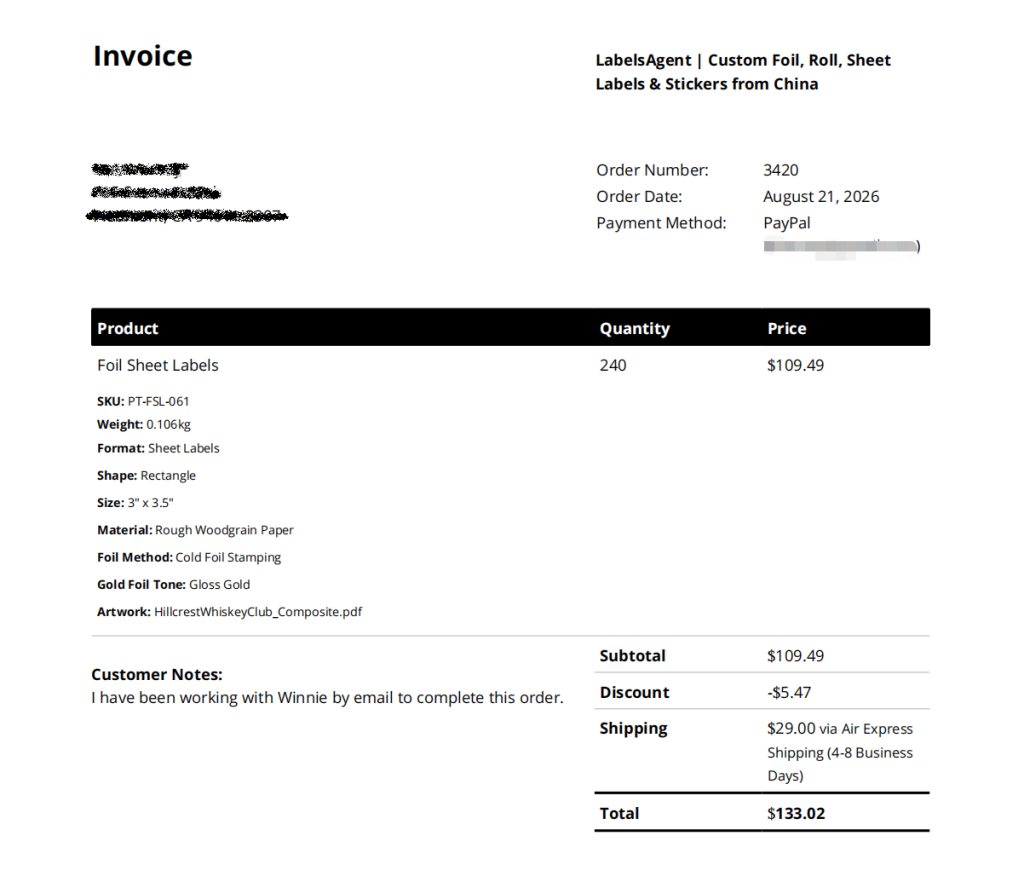
Source: Brand-supplied, redacted order record.
This example reflects one cold-foil label order and is not a standard price, delivery guarantee, or universal quote.
These are conditional calculations, not a verified invoice total. The order date, material, destination, tax treatment, and original invoice were not supplied. If US$104.02 already includes freight, adding US$29 again would be incorrect.
Use the ordered quantity when comparing quotes. Treat complimentary extras separately unless they are part of the written offer. This example shows why freight and quantity definitions matter; it does not establish a standard price or a supplier savings claim.
What deadline information does the supplier need?
Give the required arrival date, destination country, and postal code. Ask for artwork review, production, and transit to be distinguished in the schedule. A production estimate alone cannot tell you whether the labels will arrive before a bottling run, launch, or packaging appointment.
Use the shipping policy to compare the currently published transit options before setting the required arrival date.
For planning, LabelsAgent supplied these estimates on 8 September 2026:[1]
| Stage or option | Brand-supplied estimate or condition |
|---|---|
| Standalone foil production | 6–8 business days |
| Foil plus embossing | Adds 1–2 business days |
| Foil plus spot UV | Adds 1–2 business days |
| Sea shipping | 25–40 business days; free for qualifying orders of US$70 or more |
| DHL or FedEx air shipping | 4–8 business days |
These are separate production and shipping estimates, not guaranteed arrival dates. Confirm when production starts, destination eligibility, and the minimum-value calculation for free sea shipping.
If both embossing and spot UV are requested, ask for the combined schedule. The individual additions do not establish how the combination will be scheduled. The US$29 freight charge in the whiskey example is specific to that supplied order summary.
When is the project ready for a firm quote or production approval?
Use different checkpoints for estimating, quoting, and approving production. An early discussion can proceed with open material choices, provided they are identified. Before accepting a production commitment, the chosen specification, price basis, artwork revision, and unresolved technical questions should be recorded together.
| Current information | Appropriate next action |
|---|---|
| Size, quantity, packaging, and appearance known; material undecided | Request recommendations and a provisional estimate |
| Material, foil scope, format, quantity, and destination defined | Request an itemized quote with explicit exclusions |
| Quote and final artwork match; technical questions resolved | Review the final proof for written approval |
| Foil appearance, package fit, or physical performance remains uncertain | Agree an appropriate sample or verification step |
Before approving the proof, confirm:
- dimensions, shape, material, format, quantities, and versions match the quote;
- text, numbers, and variable information are correct;
- the foil-only view contains exactly the intended elements;
- print, foil, and cutting geometry have been reviewed together;
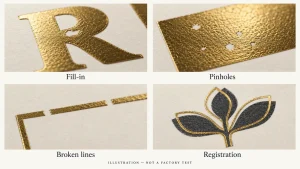
- the supplier has addressed flagged fine-detail questions;
- the approved file revision is identified in writing.
For the detailed review, use the existing foil label proof approval checklist. A composite design preview alone cannot demonstrate adhesion, durability, or the exact physical foil appearance.
What can you copy into a quote request?
Use the following brief to make unknowns visible and keep supplier responses comparable. Replace undecided fields with “Please recommend,” then ask the supplier to state its assumptions. The useful result is a written specification and itemized offer that you can reconcile with the eventual proof.
Project / product:
Finished label size and shape:
Quantity per design / SKU:
Container surface and packaging photo:
Application and use conditions:
Material preference, or advice needed:
Foil tone, marked areas, and required process:
Other finishes:
Roll / sheet / individual format:
Machine specifications, if applicable:
Print, foil, and composite files with revision:
Delivery country and postal code:
Required arrival date:
Please itemize: label production, any setup or additional services, discounts, freight, and known destination charges. Identify exclusions, quote validity, proof requirements, and unresolved assumptions.
Send the completed brief through the LabelsAgent quote request page, and confirm receipt of any artwork supplied separately. When the specifications are ready, discuss a custom foil label project.
Frequently asked questions
Can I request a foil label quote without finished artwork?
Yes, you can request an initial discussion or estimate. Describe the size, quantity, packaging, desired finish, and approximate foil placement. Make clear that the artwork remains unfinished, and ask which assumptions could change the price. Confirm the final files and specification before accepting a production commitment.
Is a gold-colored logo enough to identify the foil area?
No. Gold-colored artwork can represent printed color, a texture, or intended foil. Supply an explicit foil-only view and follow the printer’s production-file requirements. LabelsAgent’s artwork guide calls for a separate vector foil layer.[2] A composite image helps communicate appearance but does not replace that separation.
Does no MOQ mean I can place an order of any value?
No. Minimum quantity and minimum spending requirements are separate. LabelsAgent supplied a no-minimum-quantity policy together with a US$50 minimum order value for this article.[1] Confirm the applicable subtotal and treatment of discounts and shipping; accepting one label does not mean the order can cost less than the minimum.
Does approving a digital proof confirm the finished foil effect?
A digital proof can help confirm content, dimensions, and intended foil placement. It cannot establish the exact physical shine, texture, adhesion, or handling performance of the finished label. If those properties determine acceptance, agree an appropriate physical sample or verification method and document what remains to be approved.
References / Source List
[1] LabelsAgent — Brand brief supplied for this article
- Source Type: Brand-Supplied Data.
- Used For: Minimum quantity and spending requirement; production and shipping estimates; separate foil-artwork submission workflow.
- Published / Updated Date: Not publicly established; received 8 September 2026.
- Date Checked: September 2026, against the supplied brief.
- URL: Not Publicly Available.
- Limitation: Not an independently audited policy record.
[2] LabelsAgent — Foil Label Artwork Guide: How to Prepare Files for Custom Foil Printing
- Source Type: Brand / First-Party Technical Source.
- Used For: Separate vector foil layer; raster images as references.
- Published / Updated Date: Page displays 13 July 2026.
- Date Checked: 8 September 2026.
- URL: Foil Label Artwork Guide.
- Limitation: Its other numerical specifications and commercial statements were not adopted automatically.
[3] Adobe — Print color separations
- Source Type: Official Software Documentation.
- Used For: Separations Preview, isolating inks, and previewing overprinting.
- Published / Updated Date: 17 July 2024.
- Date Checked: 8 September 2026.
- URL: Print color separations in Illustrator.
[4] LabelsAgent — Supplied whiskey-label order summary and Hillcrest artwork comparison
- Source Type: First-Party / Brand-Supplied Data.
- Used For: Three-view artwork explanation; reported order specification and conditional cost calculations.
- Data Received: 8 September 2026.
- Original Order Date: Not supplied.
- Method: Review of the owner’s narrative and supplied comparison image; arithmetic from stated amounts.
- Sample Size: One reported order and one comparison graphic.
- URL: Not Publicly Available.
- Limitations: No invoice, original vector files, shipment record, or physical inspection results supplied.
[5] Inkable Label Co. — Custom Foil Stamped Labels
- Source Type: Competitor / First-Party Product Source.
- Used For: Distinction between the calculator’s 3-inch pricing range and larger sizes available by quotation.
- Published / Updated Date: Not stated.
- Date Checked: 8 September 2026.
- URL: Custom Foil Stamped Labels.
- Limitation: No specified 250-label price was reproduced.
[6] LabelsAgent — Request a Custom Label Quote
- Source Type: Brand / First-Party Public Source.
- Used For: Inquiry destination and review of conflicting retrieved timing statements.
- Published / Updated Date: Not stated.
- Date Checked: 8 September 2026.
- URL: Request a Custom Label Quote.
- Limitation: Retrieved content contained older terms; it does not substantiate the revised terms supplied for this draft.