
Hot Foil vs Cold Foil Labels: What’s the Difference and Which Should You Choose?
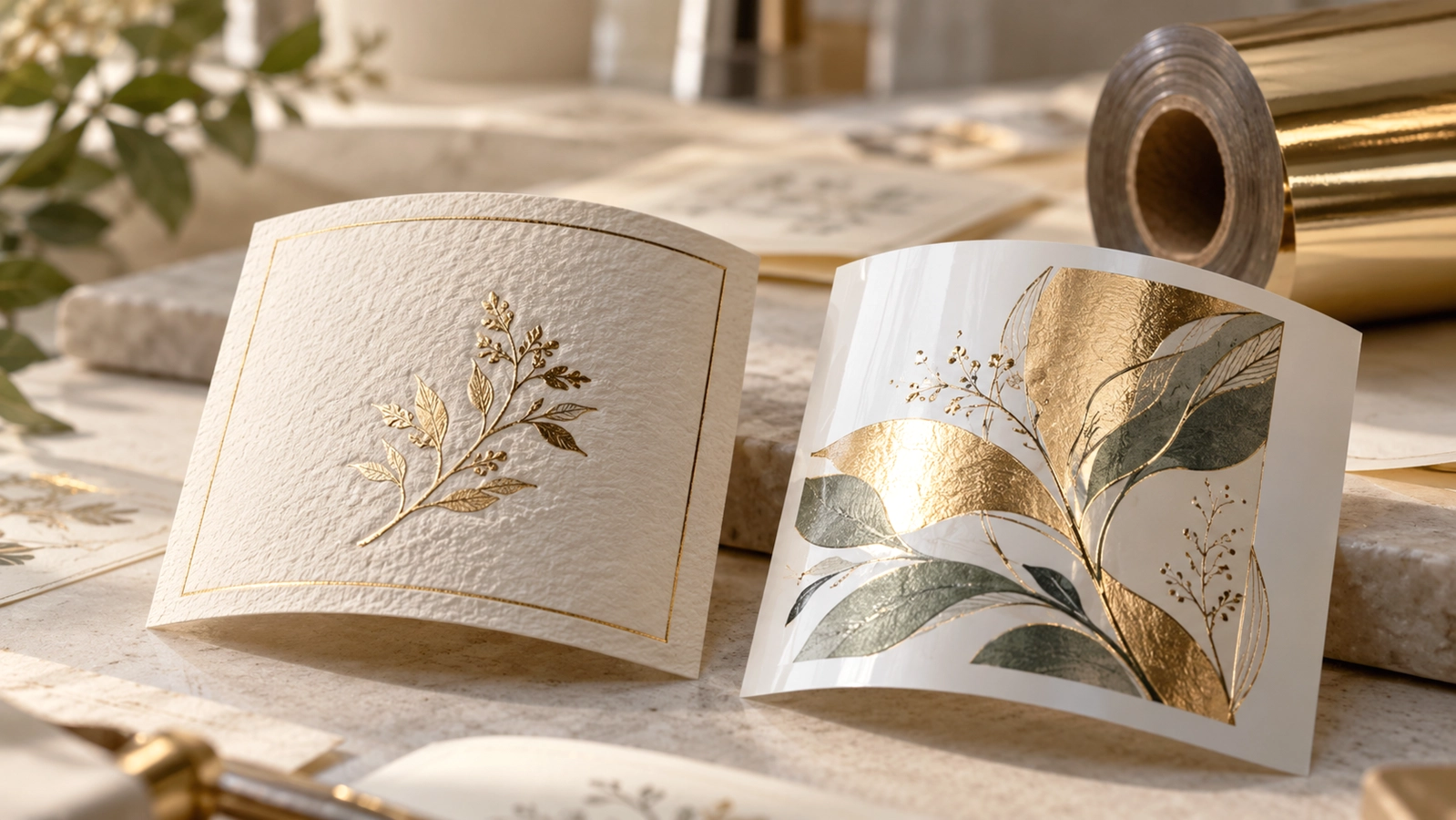
Hot foil stamping uses a heated die and pressure to transfer foil onto selected areas of a label. Cold foil uses an adhesive-based transfer process and, in common narrow-web label workflows, does not require a traditional hot-stamping die. Neither method is universally better. The right choice depends on your label material, artwork, foil coverage, tactile requirements, production setup, and the finished look you want. [4]
For a brand owner or packaging buyer, “gold foil” is not a complete production specification.
A small metallic logo on textured wine paper, a broad gold panel on a cosmetic label, and a foil-and-embossed crest on a candle label may all look metallic—but they can require very different production routes.
So the useful question is not:
Which process is better?
It is:
Which process is better suited to this material, this artwork, and this finished package?
Scope note: This guide compares traditional hot foil stamping with conventional cold-foil transfer used in label production. Digital foil and toner-based embellishment systems use different production technologies and are outside the scope of this comparison.
That distinction matters because process choice can affect tooling, artwork preparation, material compatibility, tactile appearance, production cost, and what should be checked before approving the job.
Hot Foil vs Cold Foil Labels: Quick Comparison
| Decision factor | Hot foil stamping | Cold foil |
|---|---|---|
| How foil is transferred | Heat + pressure + stamping die | Printed adhesive + foil transfer |
| Traditional metal stamping die | Heated stamping die | Printed adhesive image; no traditional hot-stamping die |
| Common label workflow | Separate or inline finishing depending on equipment | Often integrated into narrow-web printing |
| Textured / porous paper | Often a strong starting option | Requires more careful substrate evaluation |
| Smooth coated paper / film | Suitable with the right foil system | Often well suited |
| Large metallic areas | Possible | Often attractive for broader coverage |
| Overprinted metallic effects | Possible with suitable hot foils | A major design advantage of many cold-foil systems |
| Embossing | Can be combined with hot stamping | Usually a separate finishing step |
| Tactile appearance | Can be combined with embossed relief | Normally flatter unless separately embossed |
| Best decision basis | Stock + artwork + foil area + tactile goal | Stock + artwork + foil coverage + print workflow |
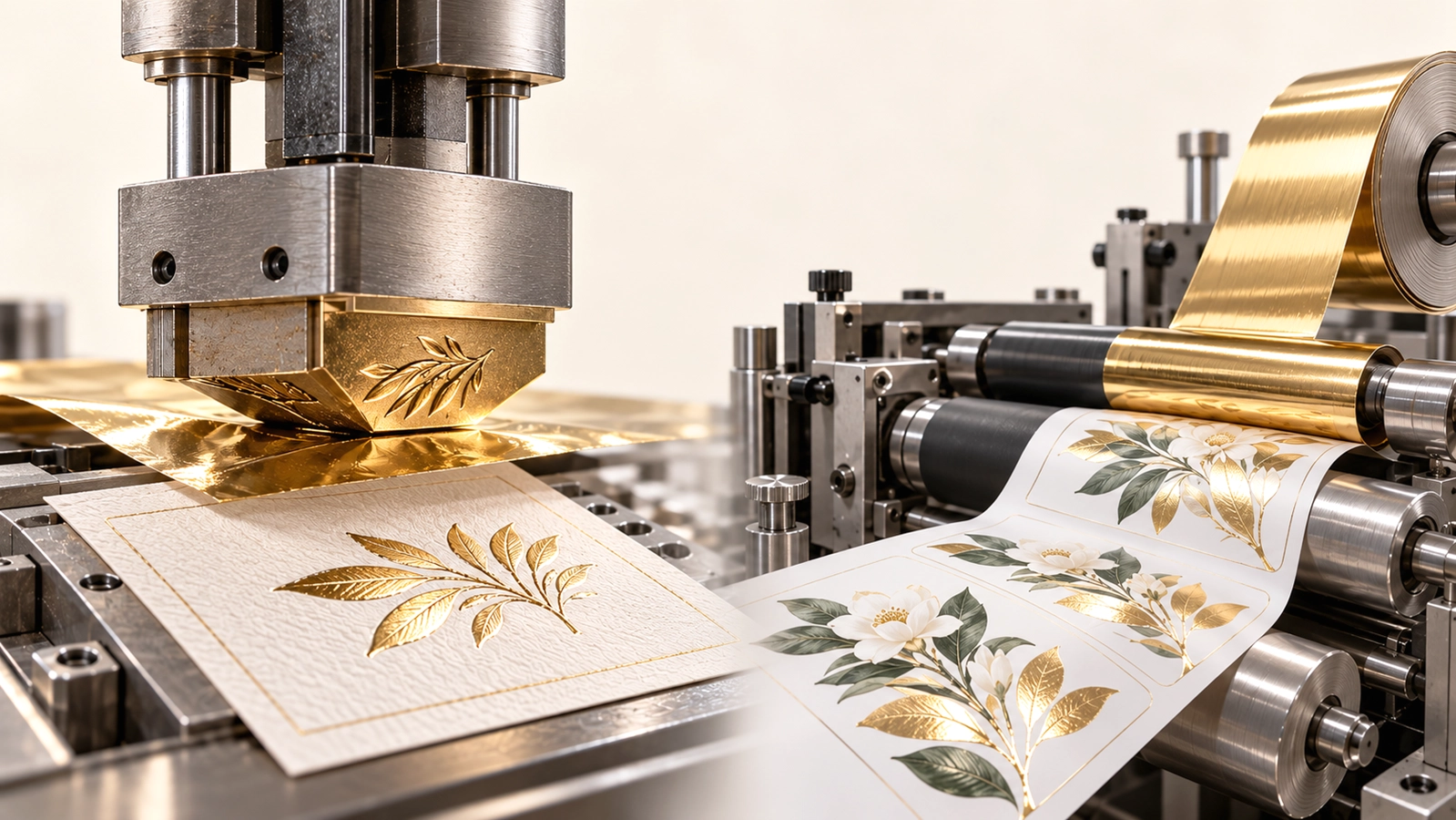
This table is a decision starting point, not a universal compatibility chart. Foil grade, adhesive, coating, press configuration, substrate, artwork, and production conditions can all change the result. KURZ, for example, emphasizes that successful cold transfer depends on matching the adhesive, substrate, and transfer product to one another. [3]
What Is Hot Foil Stamping?
Hot foil stamping is a physical transfer process that uses a heated die and pressure to apply a decorative foil layer to selected parts of a label.
The die carries the artwork that will receive foil. During production, heat and pressure help release the foil from its carrier and transfer the selected design onto the substrate.
For hot stamping, temperature, pressure, and dwell time are important production variables, while the foil grade also needs to match the substrate and artwork. Foilco specifically identifies pressure, dwell time, and temperature as core machine controls and notes that foil selection changes with substrate structure, artwork complexity, and production requirements. [1]
Hot foil is often worth evaluating first when the design uses:
- textured or uncoated premium paper;
- a selective metallic logo or border;
- wine, whisky, candle, or heritage-style branding;
- a metallic detail that should feel separate from the normal printed artwork;
- foil combined with embossing or debossing;
- small areas where the metallic accent is intended to be visually dominant.
Hot foil should not, however, be reduced to “the luxury option.”
Different hot-foil grades are designed for different substrates and levels of artwork detail. Some are intended for fine definition, others for medium or broad solid areas, and textured or uncoated materials may require different adhesive characteristics. [1]
What Is Cold Foil?
Cold foil—often called cold transfer—uses an adhesive image rather than a heated stamping die to define where the metallic layer transfers.
For pressure-sensitive labels, one common system is narrow-web flexographic cold transfer. In the process described by KURZ, a UV adhesive is printed onto the label material, the foil carrier contacts that adhesive, pressure is applied, the adhesive is cured, and the carrier is removed. The metallic layer remains where the adhesive was printed. [4]
Because the image is created through the printing process, cold transfer usually does not require the traditional metal hot-stamping die. KURZ also notes that cold transfer can be integrated with narrow-web label printing and that the transferred metallic layer can subsequently be overprinted. [3]
Cold foil is especially worth discussing when the job involves:
- smooth coated paper;
- PE, PP, PET, or similar film-based constructions;
- larger metallic graphics;
- fine metallic artwork;
- metallic areas that will be overprinted with other colors;
- modern cosmetic or personal-care designs;
- an inline production workflow.
It is important to note that “cold foil” is not one single universal machine configuration. Cold transfer is also used in sheet-fed applications, and the process, substrates, adhesives, and transfer products differ between systems. KURZ Graphics
Which Materials Suit Hot Foil and Cold Foil?
Choose the exact label stock before treating a process recommendation as final.
Terms such as:
- paper;
- textured paper;
- BOPP;
- PET;
- clear film;
- kraft;
are useful purchasing categories, but they are not complete technical specifications.
Two materials that both appear to be “paper” may have very different surface structures, coatings, absorption behavior, and foil response.
Textured and uncoated papers
Hot foil is generally the stronger starting conversation for textured, dry, or porous premium paper.
Foilco notes that textured and uncoated substrates require particular attention to foil adhesive characteristics, while its hot-stamping range includes grades designed for different paper structures and detail levels. [1]
For cold transfer, surface absorption matters more. KURZ lists PE, PP, PET, and papers with non-absorbent surfaces among the substrates for its narrow-web systems and notes that smooth coated papers and plastic substrates are particularly suitable. [3]
So for a visibly textured estate-style wine stock, hot foil would usually be the first process to investigate—but the final recommendation should still be based on the actual stock and actual artwork.

Smooth coated paper and film
This is where both technologies may be viable.
For:
- coated papers;
- white BOPP;
- clear BOPP;
- PET;
- smooth film;
the decision often shifts away from “Can foil be applied?” toward:
- how much foil area is required;
- whether the metallic effect is overprinted;
- whether tactile relief matters;
- how the label will look on the container;
- what process the converter is equipped to run efficiently.
For clear labels in particular, also consider the container background, product color, and white-ink strategy. A metallic effect that looks good on a white proof sheet may read differently on an amber bottle, clear jar, or dark cosmetic container.
Which Process Fits Your Artwork Better?
The answer depends less on the words “hot” or “cold” and more on what the artwork is asking the process to reproduce.
Fine text and small gaps
Small lettering, reversed spaces, counters inside letters, narrow borders, and closely aligned foil-and-print elements should be identified before production.
Foilco’s design guidance notes that intricate artwork and small internal spaces can become important considerations in hot-foil work, and that different foil grades and production settings may be appropriate for fine, medium, or solid areas. [1]
That does not mean there is one universal minimum font size for every foil label.
Minimum achievable detail can change with:
- foil grade;
- die;
- stock;
- press;
- surrounding artwork;
- finishing sequence.
This is why the final artwork should be reviewed at actual size rather than relying on generic online limits.
Larger metallic graphics
If the metallic decoration covers a large portion of the label, cold foil deserves stronger consideration.
Cold-transfer systems are designed to handle both fine decoration and broad metallic areas, and the ability to integrate the metallic layer with the normal print process can be useful for larger graphics. [3]
This does not automatically make cold foil cheaper. It simply means foil coverage changes the production equation.
Overprinted metallic colors
Cold foil has a particularly useful design capability here.
A silver metallic base can be transferred and then printed over with colored inks, creating multiple metallic-looking shades without needing a separate physical foil shade for each final color. KURZ specifically highlights overprintability as a design capability of its narrow-web cold-transfer systems. [3]
But overprinting is not exclusive to cold foil.
KURZ also publishes hot-stamping products designed for overprinting with suitable inks. That is another reason not to make process decisions from simplified rules such as “cold foil can be overprinted, hot foil cannot.” [5] 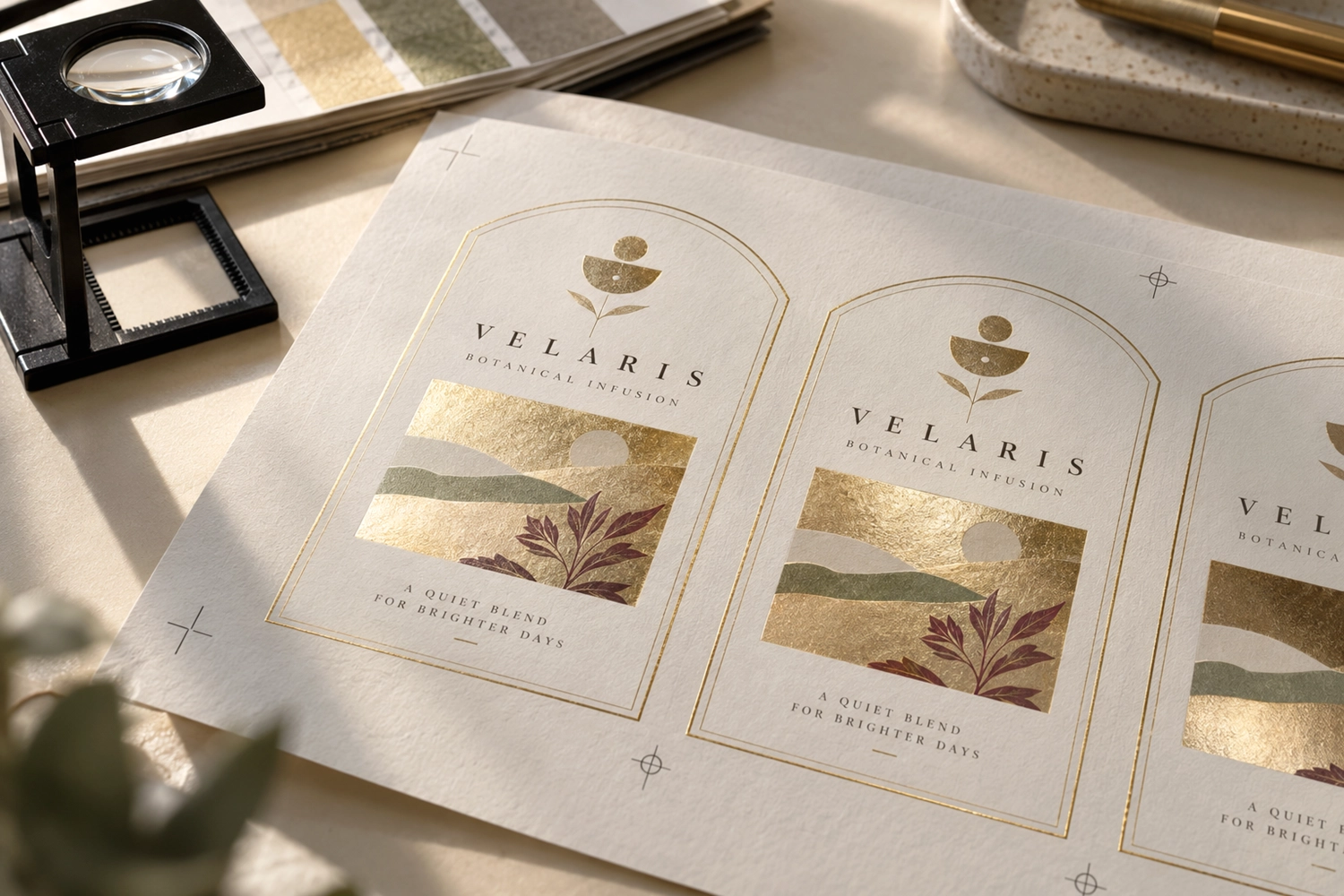
What About Foil + Embossing?
If raised tactile detail matters, specify embossing separately.
Hot foil stamping and embossing can be combined, but a hot-foiled label is not automatically embossed.
Combination stamping uses appropriate tooling to transfer foil while forming dimensional relief. Hot foil can also be applied and embossed through separate finishing operations depending on the design and production method. ITW ShineMark
So instead of telling your supplier:
“I want a gold foil logo.”
say:
“I want a gold metallic logo with visible raised relief.”
That extra sentence may materially change the recommended tooling and production route.
Cold foil can also be followed by embossing, but the tactile operation is normally treated as a separate finishing decision rather than being inherent to the cold-transfer process.
Which Looks More Premium?
Neither process owns the word “premium.”
Premium perception comes from the combination of:
- label material;
- metallic finish;
- artwork restraint;
- typography;
- foil coverage;
- contrast;
- tactile detail;
- container;
- lighting and viewing conditions.
Hot foil can be particularly effective when the design calls for a clearly defined metallic accent on premium paper—such as a small crest on a wine bottle or a restrained logo on a candle label.
Cold foil can look equally sophisticated when the design uses smooth films, broader metallic graphics, fine detail, or colored overprinting.
Modern cold-transfer systems can produce sharp, brilliant metallization and fine-to-broad decorative areas. [3]
The better design question is therefore:
What role should the metallic element play in the package?
If foil is the single visual highlight on a tactile paper label, hot foil may fit the design language naturally.
If metallic color is integrated into a larger printed illustration on a smooth film label, cold foil may offer more flexibility.

Which Costs Less: Hot Foil or Cold Foil?
Do not compare the processes using an isolated “price per label” unless the finished specifications are actually the same.
A useful purchasing comparison is:
Comparable finished-label cost = label quote + separately charged setup/tooling + additional finishing + packing + shipping + applicable taxes or duties
Only include items that are not already part of the quoted total.
A valid comparison should keep the following variables as consistent as possible:
- finished dimensions;
- quantity;
- label stock;
- artwork;
- foil coverage;
- foil appearance;
- number of SKUs;
- embossing or other finishing;
- packing;
- delivery scope.
Cold foil avoids the traditional hot-stamping die in common narrow-web workflows, which changes the setup structure. But that fact alone does not prove that the finished order will cost less. [3]
Similarly, hot foil tooling does not automatically make hot foil uneconomical.
For a small selective metallic logo, the complete hot-foil route may still make commercial sense.
For larger metallic coverage or a design integrated into the print workflow, cold foil may become more efficient.
For repeat orders, ask one more question
Do not compare only the first order.
Ask suppliers what happens when:
- quantity changes;
- artwork stays unchanged;
- a new SKU is added;
- the foil area stays the same;
- the material changes;
- existing setup or tooling can be reused.
Initial-order cost and reorder cost can tell different stories. If cost is a major part of your decision, our Custom Foil Label Cost Guide explains how quantity, material, foil coverage, tooling, finishing, and shipping can affect the total cost of a custom foil label order.
Hot vs Cold Foil by Packaging Application
Candle labels
For a premium candle using textured paper, minimal typography, and a small metallic logo, hot foil is a logical process to investigate first.
If the design uses a smooth film or a much larger metallic graphic, compare both routes.
If the logo also needs raised relief, specify foil + embossing, not simply “gold foil.”
Wine and spirits
Wine and spirits labels often combine tactile papers with selective metallic branding, crests, borders, or vintage details.
That makes hot foil highly relevant.
However, a modern spirits label using a smooth film and large metallic graphics may justify a different production route.
The bottle, stock, artwork, foil area, and embossing requirement should be reviewed together.
Cosmetics and perfume
Beauty packaging often uses:
- clear films;
- white films;
- smooth coated papers;
- metallic graphics;
- fine typography.
That makes this category particularly suitable for comparing both hot and cold foil.
Cold foil can be attractive when metallic artwork will be integrated with printed color. Hot foil can work very well when a more isolated metallic brand mark or tactile finishing sequence is desired.
Honey and gourmet food
Premium honey and artisan food brands often use kraft, textured paper, clear film, or premium paper constructions.
For paper-led designs with selective gold, bronze, or copper accents, hot foil may be the natural starting point.
For film-based constructions or broader metallic effects, compare the full production options rather than choosing from the product category alone.
Hot Foil or Cold Foil? Use This Decision Matrix
| If your priority is… | Discuss first | Why |
|---|---|---|
| Textured premium paper | Hot foil | Hot-foil grades can be selected for different paper structures |
| Foil + embossing | Hot foil | Combination stamping and separate embossing workflows are established options |
| Small selective logo or crest | Hot foil | Well suited to defined metallic accents |
| Smooth film label | Compare both | Material alone does not decide the process |
| Large metallic graphic | Cold foil | Inline transfer can be attractive for broader coverage |
| Multiple metallic-looking colors | Cold foil | Overprinting provides strong design flexibility |
| Intricate fine detail | Compare both | Actual stock, artwork, foil, and press setup matter |
| Heat-sensitive construction | Ask about cold foil | No heated stamping die is used in the transfer step |
| Uncertain material + finish | Supplier review + physical sample | Avoid specifying the wrong route before artwork review |
The wording “Discuss first” is deliberate.
This table is not saying:
You must use hot foil.
or:
You must use cold foil.
It identifies the most useful starting point for technical discussion.
What Should You Send Before Asking for a Foil Recommendation?
To receive a meaningful recommendation or comparable quotation, provide:
- finished label dimensions;
- shape;
- quantity;
- container or packaging type;
- preferred label stock, if known;
- final-size artwork;
- a separate indication of the foil area;
- preferred metallic color;
- number of SKUs;
- whether embossing is required;
- expected storage or handling conditions;
- delivery destination.
If appearance matters more than the production method, say that.
For example:
“We want a selective gold metallic logo on textured paper, approximately 25 × 12 mm, with subtle raised relief.”
The more specific the brief, the easier it is for a label supplier to evaluate the right material, foil process, and production route. A request such as “Quote gold foil labels” leaves too many important variables undefined.
Once you have narrowed down the likely foil process, use our Foil Label Quote Requirements to prepare the dimensions, quantity, packaging details, artwork, foil areas, and delivery information needed for a more accurate quotation.
If your artwork is not yet production-ready, see our Foil Label Artwork Guide for guidance on separating foil areas, preparing files, and identifying details that may need production review.
If you are still deciding which label stock to use, our Foil Label Material Guide explains how different papers and films can affect the appearance, tactile character, and production considerations of a foil label.
What Should a Physical Proof Confirm?

For finish-sensitive packaging, a physical sample or proof can answer questions that a screen cannot.
You do not need an elaborate laboratory protocol. You need a clear acceptance checklist.
Check the construction
Record:
- exact stock;
- foil reference or shade;
- transfer method;
- coating or lamination;
- embossing or other finishes.
Check the critical artwork
Look specifically at:
- small text;
- reversed spaces;
- narrow borders;
- fine logos;
- solid metallic areas;
- print-to-foil alignment.
Check the actual package
Apply the label to the intended:
- bottle;
- jar;
- box;
- tube;
- pouch;
where practical.
Clear labels in particular should be reviewed against the real container and product color.
Check tactile expectations
If embossing matters, verify the relief itself.
Do not approve a flat foil sample when the final brief requires a raised logo.
Check the commercial specification
The quote should match the approved:
- material;
- artwork;
- foil method;
- finish;
- quantity;
- SKU count.
If one of those changes, you may no longer be comparing the same product. For a more detailed pre-production review workflow, use our Foil Label Proof Approval Checklist to review content, foil placement, fine details, materials, and physical appearance before production
The Bottom Line
Choose hot foil as the first process to investigate when your design centers on selective metallic decoration, textured premium paper, or foil combined with embossing. Consider cold foil when you have smooth materials, broader metallic graphics, integrated printing, or overprinted metallic effects.
But process choice should never be based on a single variable.
The most reliable decision combines:
material + artwork + foil coverage + tactile requirement + production route + finished-order cost
If those details are not yet fixed, do not guess.
Send the actual artwork and material requirements to the label supplier and ask them to recommend the production route that best matches the finished result you need.
If you are ready to move from process comparison to production planning, explore our custom foil label options to compare foil colors, materials, formats, artwork requirements, and application considerations in one place.
If you already have your artwork, label dimensions, quantity, packaging type, and preferred metallic finish, include those details with your inquiry. They give the production team a much better basis for recommending the appropriate foil process for the actual job.
FAQ
Is hot foil better than cold foil?
No process is universally better. Hot foil is often a strong starting point for textured paper, selective metallic accents, and foil combined with embossing. Cold foil can be particularly useful on smooth stocks, for broader metallic graphics, and for designs that use metallic overprinting. The exact stock, artwork, and production setup should determine the final choice.
Does cold foil require a metal stamping die?
In common narrow-web cold-transfer label production, a traditional hot-stamping die is not required. The image is defined by a printed adhesive layer, with foil transferring where that adhesive has been applied. Printing plates and other production setup are still required. [3]
Is cold foil real foil or just metallic ink?
Cold transfer uses a decorative transfer layer rather than simply printing a metallic-colored ink. In KURZ’s narrow-web process, the metallic layer remains on the areas where UV adhesive was printed after the carrier is removed. [4]
Can hot foil and embossing be combined?
Yes. Hot foil can be combined with embossing using appropriate tooling or finishing sequences. However, hot foil does not automatically mean an embossed or raised result, so tactile relief should be specified separately in the artwork and quote request. ITW ShineMark
Which process is better for textured paper?
Hot foil is usually the first process worth evaluating for strongly textured or porous premium papers. Cold-transfer systems commonly favor smooth, coated or non-absorbent surfaces. The actual material and foil system should still be sampled before treating the recommendation as final.
References / Source List
[1] Foilco — Foil Academy:hot stamping variables、substrate structure、fine/medium/solid artwork、die considerations. Foilco Foil Academy
[2]Foilco — Hot Foil:hot-foil grades、substrate/application variation. Foilco Hot Foil
[3]KURZ — Cold Transfer for Web-Fed Printing:cold transfer workflow、no traditional stamping die、substrates、overprinting. KURZ Cold Transfer for Web-Fed Printing
[4]KURZ — Cold Transfer FAQ:UV adhesive process、substrates、fine/broad areas、overprinting. KURZ Cold Transfer FAQ
[5]KURZ — Hot Stamping / Overprinting:hot-foil products that support overprinting. KURZ Hot Stamping and Overprinting