
U.S. Small-Batch Custom Foil Candle Labels Market: No-MOQ Demand, Pricing, and the 2026–2031 Outlook
Abstract
The U.S. market for custom foil candle labels is being reshaped by two related changes. Independent candle brands are launching more scents, seasonal collections, and limited editions, while label-printing technologies are making premium metallic decoration available in smaller production runs.
This does not mean that every candle business is moving to genuine foil stamping or that the niche is expanding without constraints. No authoritative public source currently measures small-batch foil candle labels as an independent U.S. market. The most reliable indicators come from the larger candle industry, the luxury-candle segment, label-production technology, and the ordering policies published by individual suppliers.
Grand View Research estimated the U.S. candle market at approximately $3.56 billion in 2025 and forecasts a 6.5% compound annual growth rate from 2026 to 2033. It separately estimated the U.S. luxury-candle market at $183.2 million in 2025, with a projected CAGR of 10.2%. These are third-party forecasts for downstream candle markets, not direct measurements of label demand.
The most credible commercial opportunity is therefore not simply selling gold decoration. It is reducing the financial and operational risk of ordering premium labels in small quantities. Businesses that provide genuine no-minimum options, transparent tooling costs, multi-SKU ordering, material testing, and a clear distinction between foil stamping and metallic printing are best positioned to serve growing candle brands.
1. Market Definition and Research Scope
This report covers pressure-sensitive decorative labels used on candle jars, tins, lids, cartons, sleeves, and gift packaging sold in the United States.
The primary customer groups include:
- Independent candle brands;
- Home-based candle makers;
- Etsy and Shopify sellers;
- Growing direct-to-consumer candle companies;
- Private-label candle manufacturers;
- Packaging designers and print brokers;
- Corporate gifting and event businesses.
The market includes three related but technically different product categories.
Genuine foil-stamped candle labels
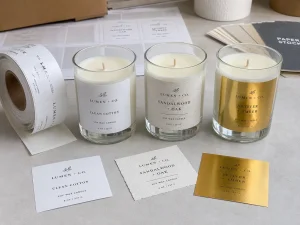
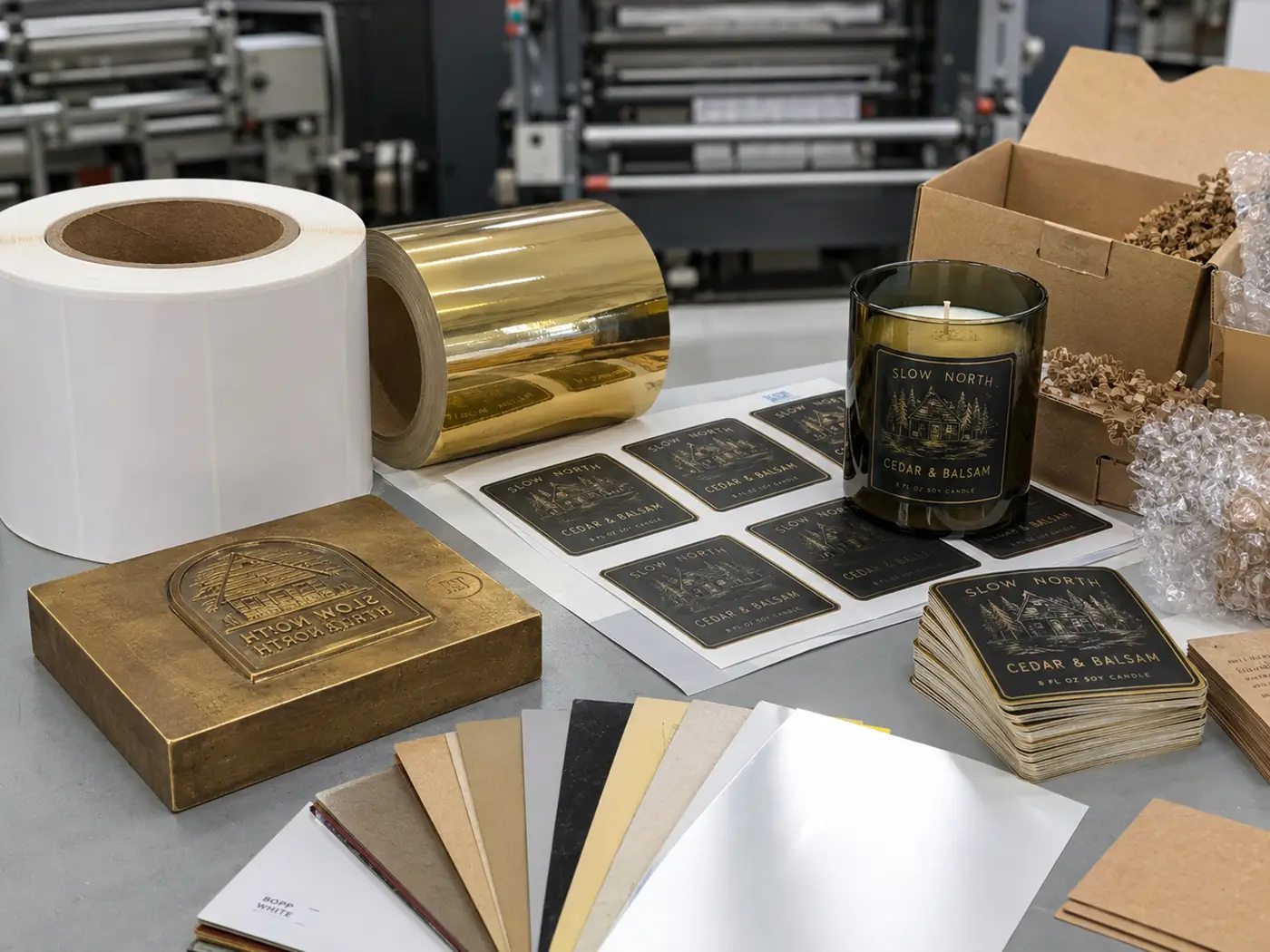
Hot foil stamping transfers metallic foil to selected parts of a label using a heated die and pressure. Cold foil uses an adhesive and curing process to transfer foil. These methods can create highly reflective metallic areas and may be combined with embossing, debossing, varnish, or conventional printing.
Digitally embellished foil labels
Digital embellishment systems can apply foil or raised decorative effects with less traditional setup. These technologies are increasingly relevant to shorter runs and frequently changing artwork.
Metallic-effect labels
Metallic-effect labels are printed on silver, gold, holographic, or other metallized substrates. White ink is used to control which areas remain reflective.
They can produce an attractive metallic appearance, but they are not necessarily foil stamped candle labels. Inkable Label, for example, describes its metallic-substrate product as a lower-cost alternative to traditional foil stamping, while offering genuine hot foil, cold foil, and embossing as separately quoted special effects.
This study does not include:
- Blank labels printed at home;
- Generic candle warning labels without branding;
- Fully printed candle cartons without pressure-sensitive labels;
- Decorative stickers unrelated to candle packaging;
- High-volume private contracts used by multinational candle companies.
These adjacent products remain commercially relevant because they compete for the same packaging budget.
2. Current Market Conditions
The downstream candle market is large enough to support specialized packaging
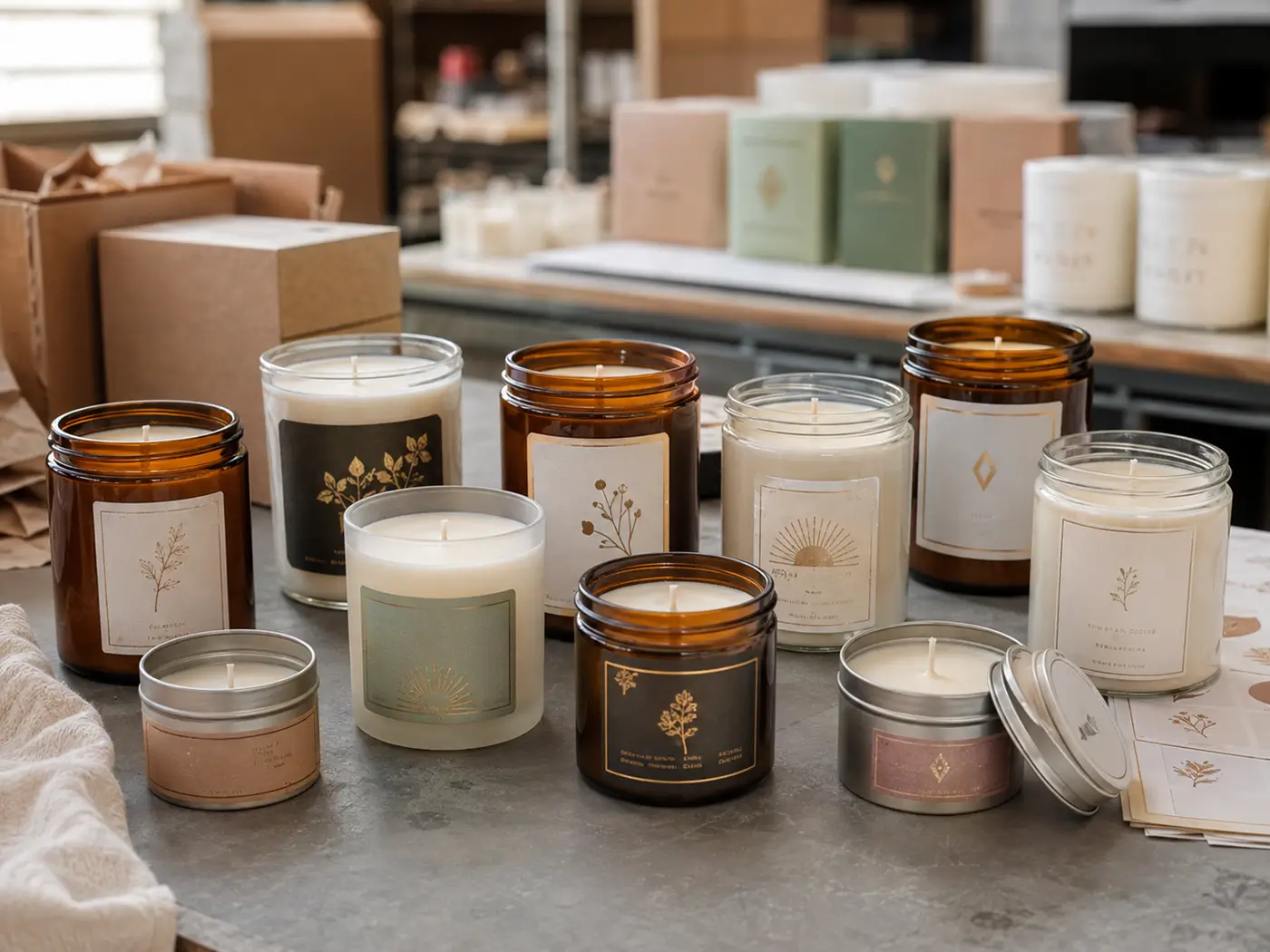
Grand View Research estimated that the U.S. candle market generated approximately $3.56 billion in 2025. It forecasts revenue of approximately $5.82 billion by 2033, representing a projected CAGR of 6.5% from 2026 through 2033. Container candles were identified as the largest U.S. product segment in 2025.
The same research provider estimated that the U.S. luxury-candle market generated approximately $183.2 million in 2025 and could reach $400.5 million by 2033, with a projected CAGR of 10.2%.
These figures have clear commercial relevance. Container and luxury candles are among the applications most likely to use decorative jars, premium papers, metallic accents, and coordinated packaging.
However, they do not establish the size of the foil-label market.
There is no verified public dataset showing:
- How many U.S. candle brands use foil;
- How many labels they purchase annually;
- The percentage using genuine foil rather than metallic film;
- The percentage of orders below 500 or 1,000 labels;
- Average foil-label expenditure per candle brand.
Any precise estimate of the small-batch foil candle label market would therefore depend on unverified assumptions.
Author assessment
The segment should be treated as a specialized packaging and sourcing opportunity within the wider candle market—not as a separately proven multimillion-dollar category.
This distinction matters for investment decisions. The available data may justify developing products, content, samples, and sales channels. It does not by itself justify building a dedicated production facility based solely on expected U.S. candle-label demand.
The market is fragmented by customer size and SKU structure
A buyer ordering 50 labels for a launch test is purchasing a different service from a brand ordering 2,000 labels divided among eight fragrances.
The main differences include:
- Total packaging budget;
- Number of artwork versions;
- Requirement for sheet or roll format;
- Manual versus machine application;
- Tolerance for tooling charges;
- Need for fast replenishment;
- Quality expectations for reorders;
- Inventory risk.
This fragmentation creates a valuable service opportunity. Suppliers do not only compete on printing cost. They compete on how efficiently they can manage small quantities, multiple designs, proofs, material selection, and repeat production.
3. Major Drivers of Market Development
3.1 Packaging helps communicate candle positioning
Independent candle brands often sell products with similar functional components: wax, fragrance, wick, and a glass or metal container.
Packaging therefore performs an important commercial role. It can communicate:
- Fragrance identity;
- Brand personality;
- Gift suitability;
- Product tier;
- Seasonal relevance;
- Collection consistency.
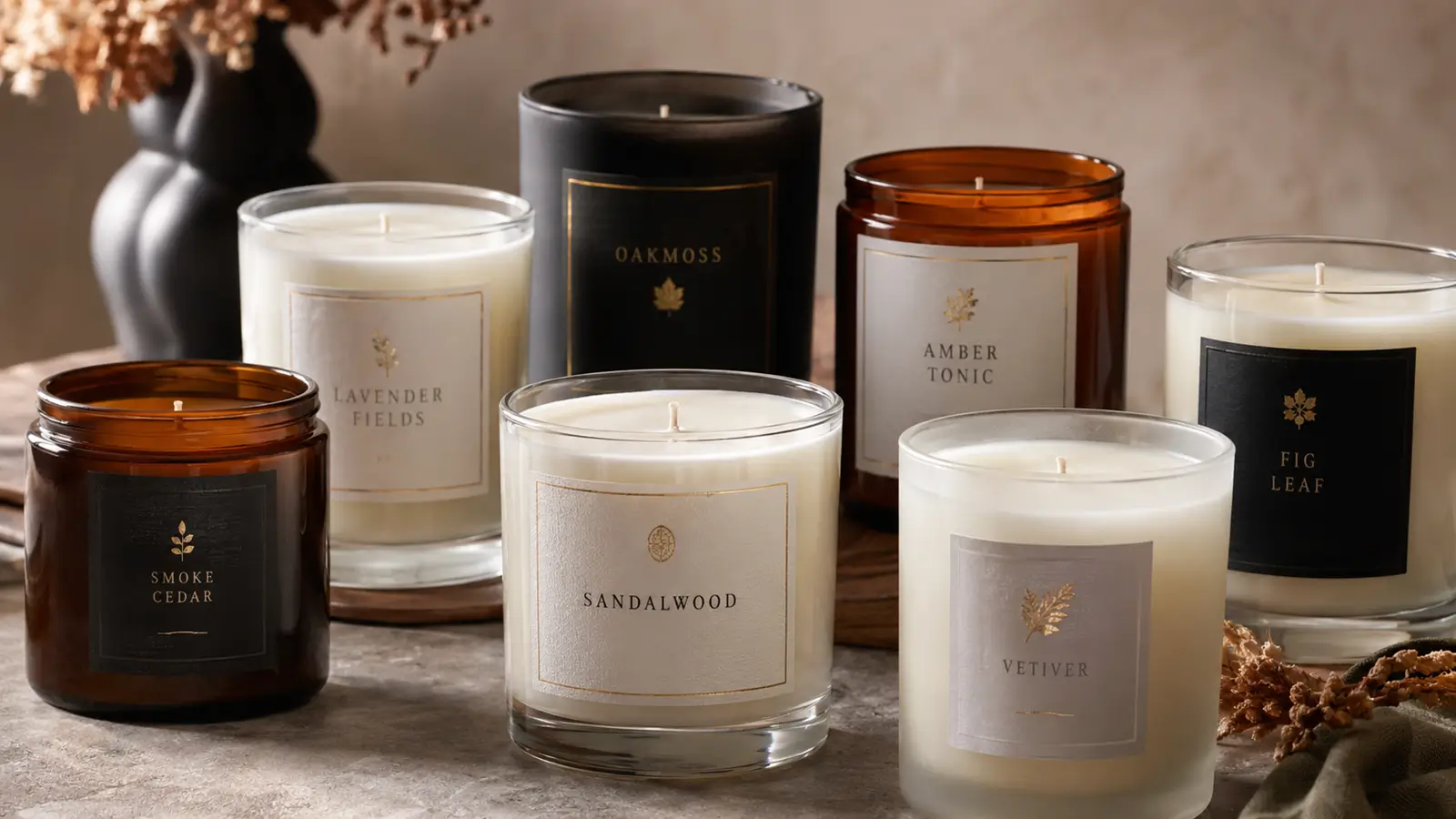
A limited gold-foil accent on a logo, border, fragrance name, or emblem can create a premium cue without requiring a fully custom container.
This does not prove that foil automatically increases conversion or permits a specific price increase. Publicly available evidence does not provide a reliable percentage uplift for candle sales caused by foil labels.
The more defensible conclusion is that foil gives brands an additional visual tool for differentiating products in image-led environments such as online stores, social media, gift displays, and craft markets.
3.2 Candle brands naturally generate multiple label versions
Candle businesses frequently organize products around:
- Different scents;
- Seasonal launches;
- Holiday collections;
- Limited editions;
- Collaborations;
- Gift sets;
- Container sizes.
A brand may need only 100 labels for a new scent while needing 1,000 labels for an established bestseller.
This creates a mismatch with traditional printing models that require each design to meet a separate minimum quantity or minimum order charge.
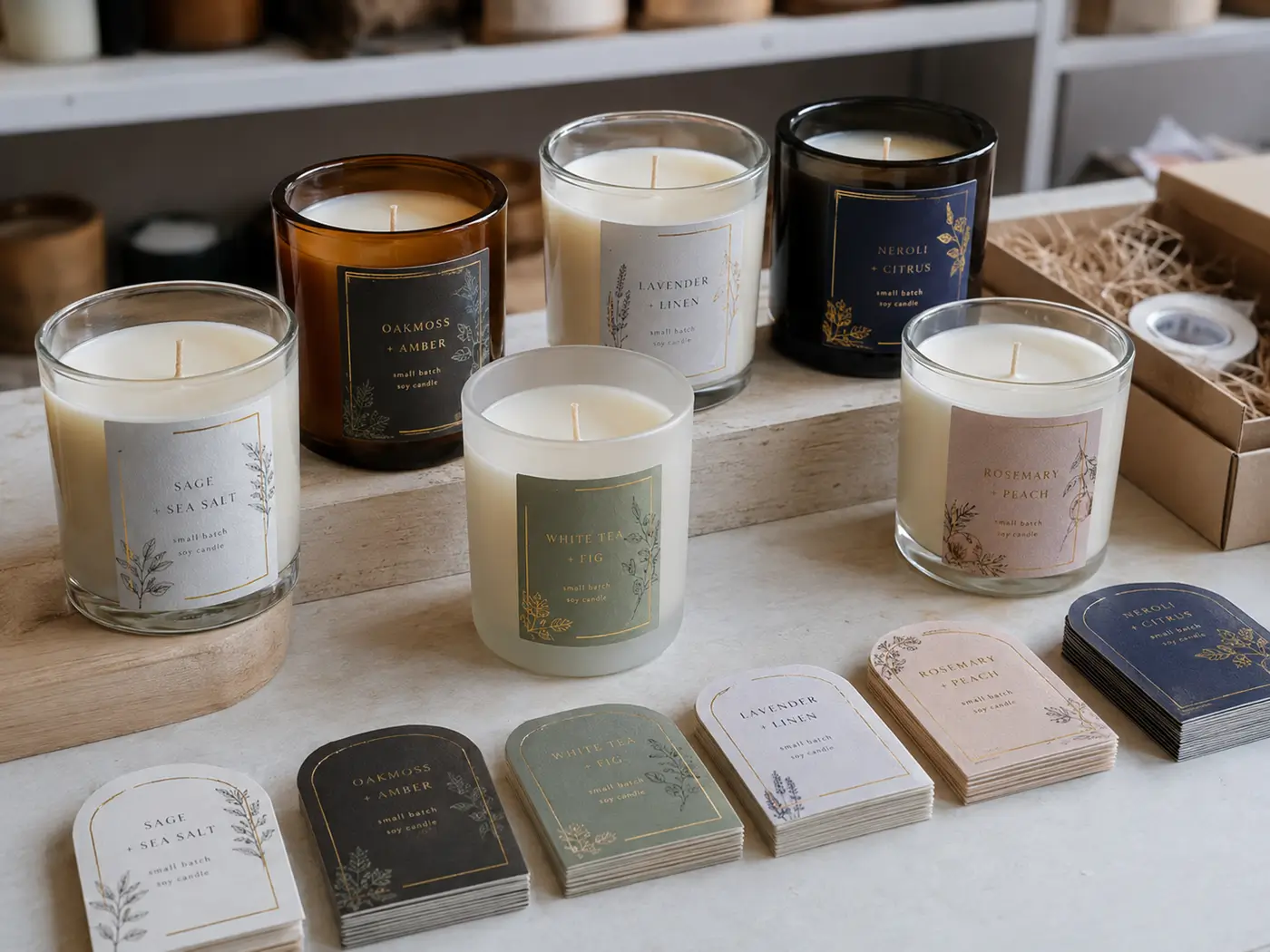
Digital production can reduce some of this friction. Blue Label Packaging states that its digital process allows different scent designs to be combined within the same order, although version charges may vary by project.
The commercial implication is significant: multi-design flexibility can be more valuable to a candle brand than the lowest possible unit price.
3.3 Label technology is becoming more suitable for short runs
FINAT reports that label converters are responding to demand for shorter runs, rapid turnaround, high quality, color consistency, and more automated inline production.
Digital printing and digital embellishment can support:
- Faster artwork changes;
- Multiple versions;
- Reduced waste during changeovers;
- Shorter production planning cycles;
- More frequent seasonal releases;
- Better integration of printing and finishing.
Traditional hot foil remains valuable, especially for premium paper, tactile effects, and authentic metallic accents. But metallic substrates and digital embellishment are expanding the number of small brands that can purchase a premium-looking label.
3.4 E-commerce enables more small candle brands to launch
Online marketplaces, independent websites, social commerce, local markets, and small wholesale accounts allow candle entrepreneurs to test products without first winning national retail distribution.
These businesses still need packaging that looks professional in:
- Product photography;
- Social-media videos;
- Gift boxes;
- Retail displays;
- Influencer content;
- Wholesale presentations.
Their first orders may be small, but successful brands can develop into recurring buyers with multiple fragrances and packaging formats.
The long-term value is therefore not the first 50- or 100-label order. It is the possibility that the buyer later purchases jar labels, warning labels, lid seals, carton labels, and repeated seasonal versions.
3.5 Inventory risk is increasing the appeal of no-MOQ ordering
Small candle companies frequently change:
- Fragrance names;
- Ingredient statements;
- Container sizes;
- warning information;
- Brand designs;
- Retail positioning.
A large label purchase can become obsolete before it is fully used.
No-minimum ordering can reduce that risk, but the phrase “no MOQ” must be interpreted carefully.
A supplier may have:
- No minimum label quantity but a minimum dollar value;
- No minimum quantity but a tooling fee;
- No minimum quantity only for standard materials;
- No minimum quantity but high unit prices;
- Different minimums for each artwork version.
The real buyer question is not simply, “What is the MOQ?”
It is:
What is the minimum total financial commitment required to receive the exact label I need?
4. Customer Demand and Purchasing Behavior
The following order ranges are planning estimates based on observable buying patterns, not audited U.S. market averages.
| Customer type | Indicative order pattern | Main priority | Common concern |
|---|---|---|---|
| New home-based maker | 24–200 per design | Low total commitment | Paying too much before demand is proven |
| Established craft seller | 100–500 per design | Better appearance and flexible reorders | Too many fragrance versions |
| Growing independent brand | 250–2,000 per design | Consistency and multi-SKU production | Inventory and cash-flow risk |
| Private-label manufacturer | 1,000 to tens of thousands across clients | Repeatability and production control | Coordinating many artworks |
| Designer or packaging agency | Project-based | Samples and technical reliability | Supplier errors affecting client trust |
New candle entrepreneurs
New entrepreneurs are usually still testing:
- Brand identity;
- Fragrance range;
- Jar dimensions;
- Label size;
- Retail price;
- Sales channel.
Their most important needs are:
- Small quantities;
- Low total spending;
- Easy artwork preparation;
- Templates;
- Digital proofs;
- Physical samples;
- Clear explanations of materials and processes.
These buyers may like genuine foil but ultimately choose metallic film or ordinary printing if the foil setup cost is too high relative to the launch size.
Growing independent brands
Growing brands are likely to be the most commercially attractive segment.
They have usually moved beyond home printing, but their order volumes may still be too low to receive ideal pricing or service from large converters.
They are more likely to value:
- Genuine foil rather than simulated gold;
- Multiple scents in one order;
- Stable foil color across reorders;
- Premium textured paper;
- Accurate application to jars or tins;
- Short seasonal runs;
- Fast replenishment;
- Dedicated artwork support.
These customers are also more likely to understand that the lowest unit price is not always the lowest total cost.
A slightly more expensive label can create better value if it reduces:
- Obsolete inventory;
- Artwork errors;
- lifting edges;
- Misregistration;
- Reprints;
- Product-launch delays.
Private-label candle manufacturers
Private-label manufacturers purchase packaging for several clients and may require:
- Roll direction specifications;
- Core sizes;
- Maximum roll diameters;
- Machine-application compatibility;
- Version control;
- Color standards;
- Barcode verification;
- Repeat production records.
These accounts are more difficult to win but can generate greater lifetime value.
Designers and packaging agencies
Designers frequently influence the material and finishing decision before the candle brand contacts a printer.
They need:
- Sample books;
- Foil color references;
- Artwork guidelines;
- Minimum line-width rules;
- Material recommendations;
- Reliable quoting;
- Clear responsibility for production problems.
Suppliers that support designers effectively can acquire several brands through one relationship.
5. Product and Technology Trends: Foil Stamped Labels vs Metallic Labels
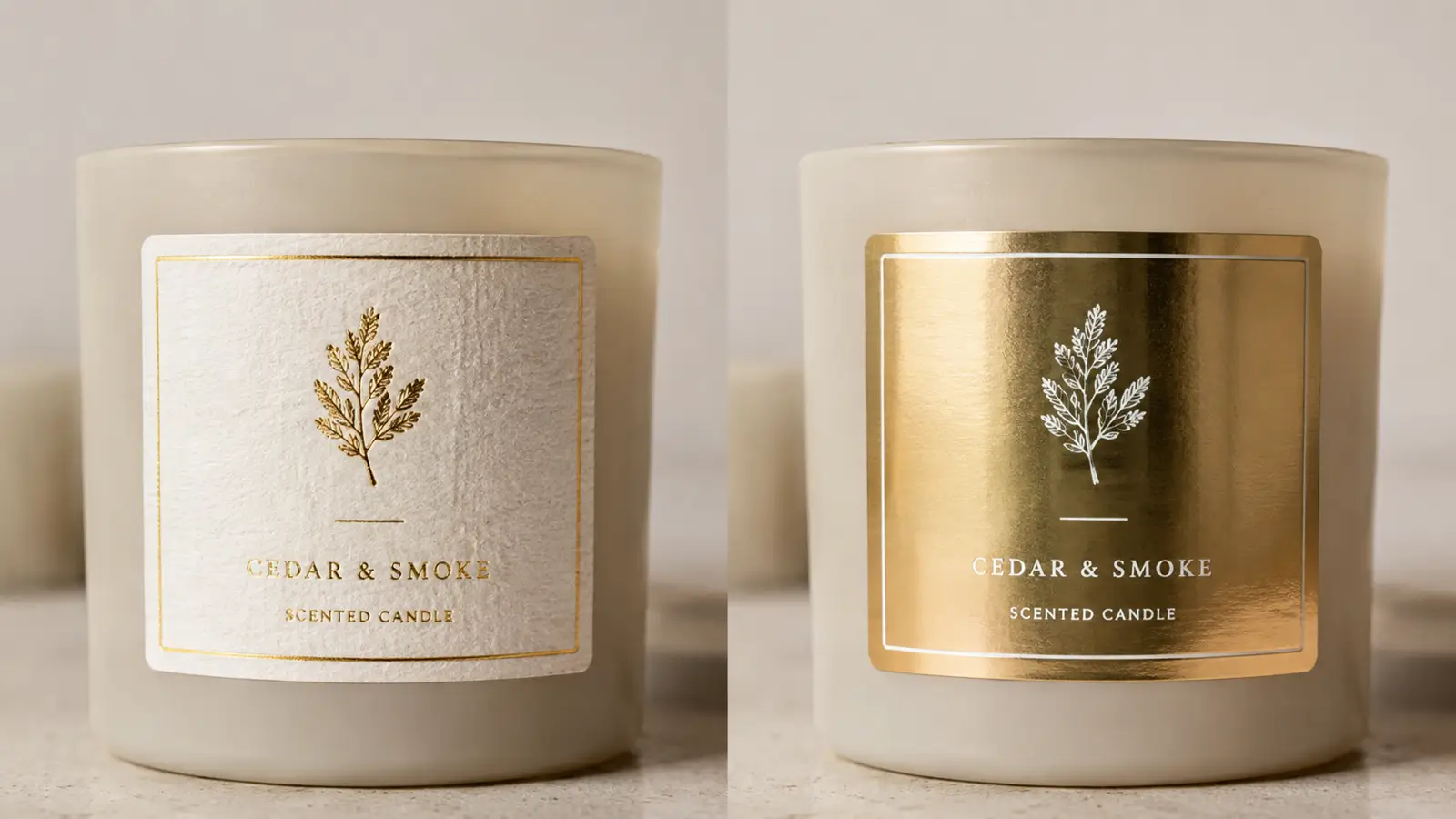
The distinction between foil stamped labels vs metallic labels is one of the most important educational issues in this market.
Genuine hot foil stamping
Hot foil uses heat, pressure, a metal die, and a foil carrier to place foil on selected areas.
It is generally suited to:
- Premium logos;
- Borders;
- Crests;
- Fragrance names;
- Luxury seals;
- Textured papers;
- Embossed designs.
Its potential disadvantages include:
- Tooling costs;
- More demanding artwork;
- Minimum line-width limitations;
- Longer setup;
- Higher cost for very small quantities.
Cold foil stamping
Cold foil can be suited to finer details and inline label production. The commercial suitability depends on the printer’s equipment, substrate, artwork, quantity, and finishing requirements.
It remains genuine transferred foil, but the visual and tactile result may differ from traditional hot foil.
Metallic-substrate printing
Metallic PET, BOPP, paper, or other reflective stock can be printed with white ink and CMYK.
Its advantages include:
- Lower setup cost;
- Fine registration;
- Multiple metallic colors;
- Gradients;
- Short-run suitability;
- Faster design changes.
Inkable describes this type of label as a more economical alternative to traditional foil stamping and separately requires custom quotations for genuine hot foil, cold foil, and embossing. Its online system also notes different requirements for small multi-design orders and, for certain configurations, a minimum of 500 labels per design.
Commercial meaning for candle brands
A startup should not automatically purchase genuine foil if:
- The design is still changing;
- The fragrance has not been tested;
- The required quantity is extremely low;
- The visual objective can be achieved with metallic material.
Conversely, a premium brand should not accept a metallic simulation when:
- Authentic foil is part of the brand promise;
- The label uses textured paper;
- Embossing is required;
- The foil must have a particular reflectivity or tactile character;
- Consistency across a luxury range is essential.
The best supplier does not always recommend the most expensive process. It recommends the process that matches the brand, quantity, design, and financial risk.
6. Competitive Landscape
The market includes self-service printing platforms, specialist U.S. converters, international sourcing companies, marketplace sellers, and local print shops.
| Supplier example | Publicly stated ordering model | Relevant capability | Commercial interpretation |
|---|---|---|---|
| Avery | Sheet-label orders can begin at 24 labels; a reviewed configuration showed $15 for 24 labels | Metallic films, papers, templates and online design | Very accessible for testing, but metallic material should not be confused with genuine foil stamping |
| Blue Label Packaging | No minimum label quantity, but a typical minimum order amount of approximately $200 | Candle labels, multiple versions, hot foil, embossing and specialist materials | Suitable for professional short runs, although “no MOQ” does not mean no financial threshold |
| Sttark | No minimum quantity; average minimum order cost stated at approximately $250–$260 | Digital roll labels, design support and fast production | Flexible quantity, but the total-order threshold may remain high for new makers |
| UPrinting | Foil stickers offered in increments beginning at 500; a reviewed configuration showed $334.12 for 500 | Multiple foil colors and roll or individually cut formats | Standardized true-foil ordering, but less suitable for very small tests |
| Inkable Label | Metallic labels positioned as an alternative to traditional foil; genuine foil quoted separately | Metallic printing, hot foil, cold foil, embossing and multiple designs | Broad technical range, but buyers must distinguish metallic stock from actual foil stamping |
| LabelsAgent | No stated minimum label quantity; a one-time $50–$100 foil die fee may apply below 500 labels | Hot foil, cold foil, foil with embossing, sheet, roll and sticker formats | Uses a tooling-based no-MOQ model rather than a minimum-dollar-order model |
Avery’s current candle-label configurator displays sheet quantities beginning at 24 labels, with pricing changing by material, size, and quantity. The cited configuration should not be interpreted as a universal quote.
Blue Label states that it has no minimum label quantity, but its FAQ reports a typical minimum order amount of approximately $200. Its standard turnaround is five working days after approved proof and purchase order, with additional time possible for custom dies or special materials.
Sttark states that it has no minimum order quantity, while also reporting that the minimum cost of an average custom-label order starts at approximately $250–$260.
UPrinting’s reviewed foil-sticker configuration began at 500 units, with a displayed price of $334.12 and a seven-business-day printing time. Specifications and prices can change.

How LabelsAgent can be integrated credibly
LabelsAgent’s custom gold foil labels offering represents a different small-order structure.
The page states that gold foil labels can be ordered without a minimum label quantity. It also discloses that a one-time foil die charge of approximately $50–$100 may apply to custom orders below 500 labels. Standard production is stated as two to three business days after proof approval, with economy and express shipping offered separately.
This is a more credible way to communicate “no MOQ” than presenting it as an unconditional promise.
For a candle startup, the practical trade-off is clear:
- The brand does not have to purchase 500 identical labels;
- The brand may still need to pay for the tooling required to produce genuine foil;
- The tooling cost can become more economical if the same design is reordered;
- Production time must be separated from international shipping time.
This disclosure makes the offer commercially understandable without implying that genuine foil stamping has no setup cost.
7. Pricing and Supply-Chain Economics
There is no reliable universal price per foil candle label.
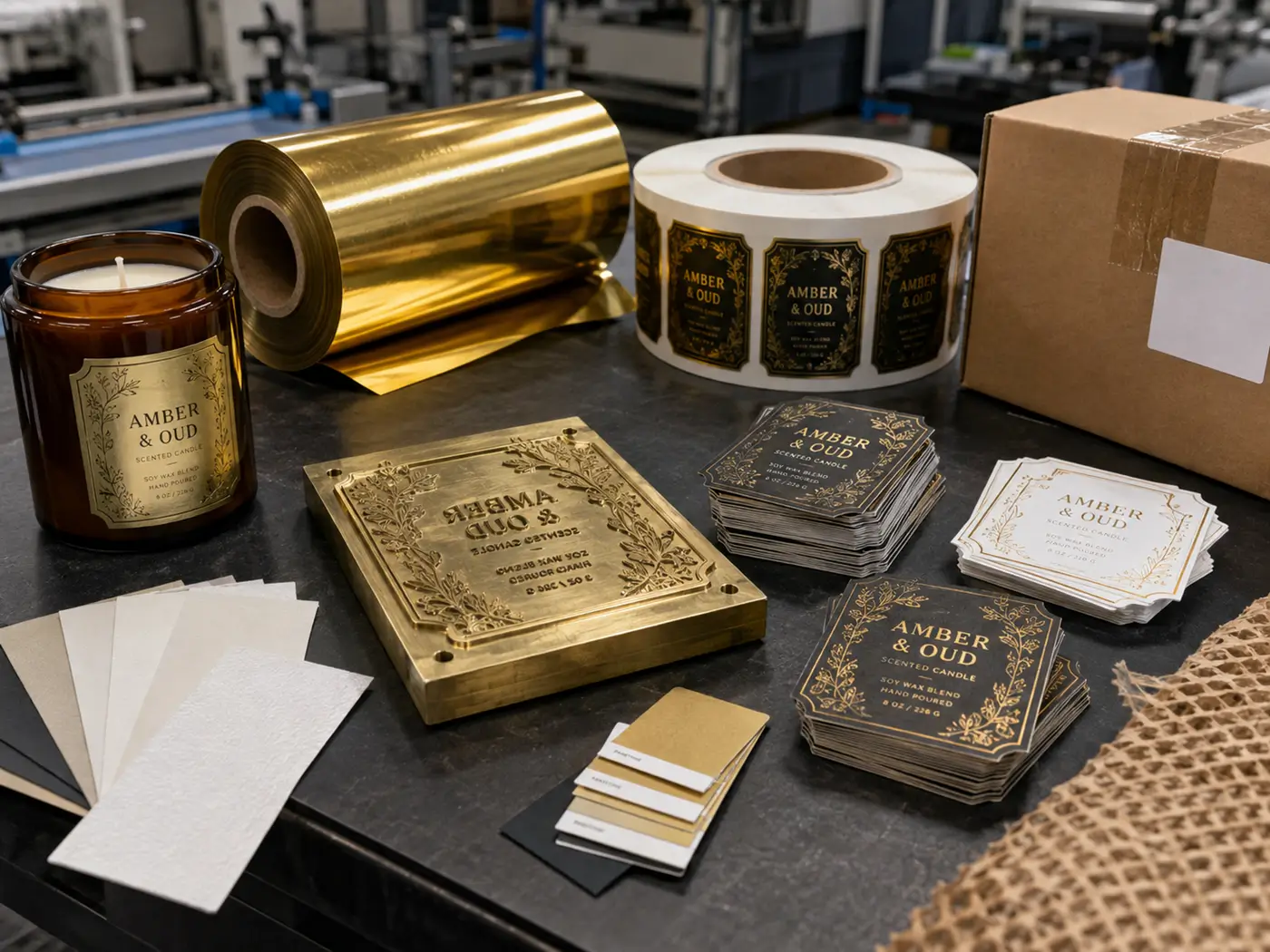
Pricing depends on:
- Label size;
- Shape;
- Material;
- Adhesive;
- Quantity;
- Quantity per artwork;
- Foil coverage;
- Hot or cold foil;
- Tooling;
- Embossing;
- Lamination;
- Varnish;
- Sheet or roll format;
- Roll direction;
- Proofing;
- Production speed;
- Freight;
- Duties and processing fees.
Four common no-MOQ business models
“No MOQ” can be implemented in several ways.
1. Minimum dollar order
The printer accepts any label quantity but requires the order to reach a minimum value.
Blue Label’s approximately $200 minimum order amount is an example.
2. Tooling-based minimum
The supplier accepts a very small quantity, but the customer pays a die, plate, or setup charge.
LabelsAgent’s disclosure of a possible $50–$100 foil die fee below 500 labels is an example of this structure.
3. Higher unit-price model
The customer can order a small quantity, but the unit price is substantially higher than it would be at wholesale volume.
Avery’s reviewed configuration decreased from $0.625 per label at 24 units to $0.297 at 240 units, illustrating how short-run convenience is reflected in unit pricing. This example uses a specific sheet-label configuration and is not a true-foil industry benchmark.
4. Standardized minimum increment
The supplier offers online ordering only in predetermined quantities, such as 500, 1,000, or 2,000 labels.
UPrinting’s foil-sticker product begins at 500 units in the reviewed configuration.
What buyers should compare
A candle brand should request a total quote that includes:
- Printing;
- Foil;
- Die or tooling;
- Artwork separation;
- Multiple-design fees;
- Proofing;
- Cutting;
- Packing;
- Freight;
- Duties;
- Taxes;
- Estimated delivery date.
Comparing only the price per label can be misleading.
A $0.30 label with a $250 minimum order may be less suitable for a startup than a $0.70 label with a lower total commitment.
Production time is not delivery time
Most suppliers calculate production time after:
- Artwork is approved;
- Payment or purchase order is received;
- Materials are confirmed;
- Tooling is prepared.
LabelsAgent states a standard production time of two to three business days after proof approval. It separately lists economy shipping of 15–25 days and DHL Express shipping of four to seven business days.
Blue Label states that its five-working-day turnaround begins after approved proof and purchase order.
The commercial lesson is that suppliers should publish production and transit times separately.
U.S. import conditions must be included in small-order economics
CBP states that, effective August 29, 2025, broad duty-free de minimis treatment is no longer available for shipments valued at or below $800, except where another legal exemption applies. Imported shipments may therefore be subject to applicable duties, taxes, fees, and entry requirements.
For imported labels, buyers should not assume that a low product value automatically means a duty-free delivery.
International suppliers should therefore provide:
- Clear shipping terms;
- Country of origin;
- Customs documentation;
- Estimated duty responsibility;
- Landed-cost guidance;
- Express and economy options.
8. Market Opportunities
Opportunity 1: Genuine low-quantity foil rather than simulated no-MOQ marketing
Many small businesses want genuine foil but cannot justify 500 identical labels.
A tooling-based no-MOQ model can address this gap when:
- The die fee is disclosed;
- The customer owns or can reuse the die;
- Reorder terms are clear;
- The distinction between foil and gold ink is explicit;
- The total delivered price is known before production.
This is one area where LabelsAgent can be introduced naturally. The relevant benefit is not that foil stamping becomes free at low quantities. It is that the buyer can choose a smaller production quantity and pay a visible tooling cost instead of purchasing unnecessary inventory.
Opportunity 2: Multi-scent order consolidation
A growing candle brand may need labels for four, eight, or twelve fragrances.
Suppliers can reduce risk by allowing:
- One material;
- One label size;
- One foil tone;
- Several printed scent versions;
- A shared total quantity.
The supplier must still disclose whether separate foil dies or version fees are required.
Opportunity 3: A two-tier product architecture
The market is well suited to two product levels.
Accessible metallic tier
- Metallic PET or BOPP;
- White ink and CMYK;
- Smaller quantities;
- Lower setup;
- Faster artwork changes.
Genuine foil tier
- Hot or cold foil;
- Textured paper or premium film;
- Optional embossing;
- Physical proofing;
- Higher setup but stronger premium differentiation.
This structure allows brands to test a fragrance using metallic-effect labels and later upgrade to genuine foil once sales are proven.
Opportunity 4: Candle-container application testing
Many suppliers describe materials as durable, water-resistant, or heat-resistant without publishing detailed test conditions.
A more defensible service would test labels on:
- Smooth glass;
- Frosted glass;
- Painted glass;
- Metal tins;
- Powder-coated surfaces;
- Small-radius jars;
- Textured boxes.
Testing should consider:
- Adhesion;
- Edge lifting;
- Wax exposure;
- Fragrance-oil exposure;
- Moisture;
- Scuffing;
- Storage temperature;
- Application pressure.
Suppliers should report the conditions tested rather than make universal “heatproof” or “fireproof” claims.
Opportunity 5: Better samples and artwork support
Foil cannot be accurately evaluated through a PDF alone.
Useful sample programs should show:
- Shiny gold;
- Matte gold;
- Champagne gold;
- Rose gold;
- Hot foil;
- Cold foil;
- Metallic film;
- Textured paper;
- Clear film;
- Embossing.
LabelsAgent’s page currently offers a material sample pack with foil colors available on request, while stating that the shipping charge can be credited toward a first order. This type of sample-to-order mechanism can reduce buyer uncertainty when the conditions are clearly communicated.
Opportunity 6: Educational SEO content
High-intent buyers need more than a product page.
Useful topics include:
- Hot foil vs cold foil for candle labels;
- Foil stamped labels vs metallic labels;
- Best labels for frosted candle jars;
- Gold foil on textured paper;
- How to prepare foil artwork;
- Minimum line width for foil stamping;
- Small-batch labels for multiple candle scents;
- How much custom candle labels cost;
- Why candle labels lift or discolor;
- No MOQ vs minimum order value.
Content that explains trade-offs is more credible than content built only around claims such as “best quality” or “lowest price.”
9. Three-to-Five-Year Outlook
High-probability trends
Short-run production will remain important
Candle brands will continue to manage multiple scents, launches, and seasonal versions. This supports demand for flexible digital production and short-run finishing.
Metallic printing will take part of the traditional foil market
Some buyers want visual shine rather than a specific manufacturing process.
Metallic substrates are likely to capture budget-conscious and experimental projects, while genuine foil remains focused on high-value products, textured materials, and tactile finishes.
No-MOQ claims will require more transparency
As more suppliers advertise no minimum quantity, buyers will become more aware of:
- Minimum dollar amounts;
- Tooling fees;
- Version charges;
- Freight;
- Duties;
- Setup conditions.
The strongest suppliers will explain these costs before the customer uploads final artwork.
Multi-version ordering will become a standard expectation
Digital workflow makes multi-SKU production more practical. Candle brands will increasingly expect several fragrance designs to be handled within one coordinated project.
Online proofing and prepress automation will improve
AI and automated preflight systems may help identify:
- Missing bleeds;
- Rasterized foil layers;
- Lines that are too thin;
- Small text;
- Incorrect overprint;
- Low-resolution artwork;
- Incorrect label dimensions.
The near-term value of AI is likely to be reducing production errors rather than replacing professional packaging design.
Potential developments
- Greater demand for traceable paper and material certifications;
- More local sample distribution by international suppliers;
- Hybrid U.S.–Asia production models;
- Online landed-cost estimates;
- Reorder portals storing artwork and tooling records;
- More digitally applied foil and raised decoration.
Main risks
- Weak discretionary spending;
- Price competition from ordinary metallic stickers;
- Misleading use of “foil” terminology;
- Poor material adhesion;
- Import delays;
- Customs-cost uncertainty;
- Unsupported sustainability claims;
- High acquisition costs for very small customers;
- Low repeat rates among hobby buyers;
- Investment in equipment before repeat demand is proven.
The forecast should therefore be understood as a scenario, not a guaranteed growth path.
10. Recommended Actions for Businesses
Product strategy
Create two clearly named product tiers.
Metallic Effect Labels
- Lower setup;
- Suitable for market testing;
- Multiple metallic colors;
- Small-batch friendly;
- Clearly described as metallic-substrate printing.
Genuine Foil-Stamped Labels
- Hot or cold foil;
- Premium materials;
- Optional embossing;
- Physical samples;
- Tooling disclosure;
- Designed for established or premium-positioned brands.
Pricing strategy
Publish or clearly explain:
- Minimum label quantity;
- Minimum total order value;
- Tooling fees;
- Per-design charges;
- Sample costs;
- Standard production time;
- Express production;
- Shipping;
- Duties and taxes.
For LabelsAgent, “No Minimum Orders” should remain the primary advantage, but it should be consistently supported by the more precise statement:
No minimum label quantity. A one-time foil die fee may apply to orders below 500 labels.
This is more persuasive than hiding the fee because it explains why genuine foil remains accessible without pretending that small-run tooling has no cost.
Customer targeting
Prioritize:
- Growing independent candle brands;
- Multi-scent Etsy and Shopify businesses;
- Private-label manufacturers;
- Packaging designers;
- Corporate gifting companies.
First-time hobby makers can still be served through samples, standard sizes, metallic alternatives, and very small paid test orders.
Internal-link strategy for LabelsAgent
The product page should be linked where the reader is already evaluating a purchasing decision.
Recommended natural anchor placements include:
- custom gold foil labels
- no-minimum gold foil labels
- genuine hot foil labels
- small-batch gold foil label options
Avoid inserting the link repeatedly into general market statistics or unrelated trend paragraphs.
The strongest contextual sentence is:
For brands that need genuine foil without committing to 500 identical labels, LabelsAgent offers custom gold foil labels with no minimum label quantity, although a one-time foil die fee may apply to orders below 500.
This sentence communicates:
- The customer problem;
- The product solution;
- The commercial limitation;
- The reason to click.
Content marketing strategy
Develop supporting pages and articles around:
- Foil candle labels;
- Gold foil candle labels;
- Foil roll labels;
- Foil sheet labels;
- Foil stickers;
- Candle-label materials;
- Hot foil vs cold foil;
- Foil artwork preparation;
- Labels for frosted jars;
- Multi-scent small-batch ordering.
The objective should be to help the buyer choose correctly before requesting a quote.
Supply-chain strategy
Maintain records for:
- Approved artwork;
- Foil die;
- Foil tone;
- Material;
- Adhesive;
- Label size;
- Cutting format;
- Roll direction;
- Color reference;
- Previous quality approvals.
This improves reorder consistency and makes the initial tooling cost easier to justify.
Conclusion
The U.S. market for small-batch custom foil candle labels is worth entering as a specialized packaging segment, but it should not be approached as an automatically high-growth or low-risk opportunity.
The broader U.S. candle market is substantial, and third-party forecasts indicate growth in both the general and luxury segments. These figures support the existence of a downstream packaging opportunity, but they do not measure foil-label demand directly.
The most attractive customers are growing candle brands with several fragrances, repeat purchasing needs, and order volumes that remain below traditional high-volume manufacturing thresholds.
The most important unmet need is not simply cheaper foil. It is lower purchasing risk.
Businesses can address that risk through:
- Genuine no-minimum ordering;
- Transparent tooling charges;
- Multi-SKU production;
- Clear differentiation between foil stamped candle labels and metallic labels;
- Physical samples;
- Tested materials;
- Accurate production and shipping timelines;
- Reliable reorder management.
LabelsAgent can be integrated credibly into this analysis as an example of a tooling-based no-MOQ model. Its advantage is that candle brands can order the number of genuine foil labels they currently need rather than purchasing 500 identical units solely to satisfy a production minimum. The disclosed possibility of a one-time die fee below 500 labels should remain visible because it explains the economics of the service and increases buyer trust.
Companies that compete only through vague claims such as “premium quality,” “fast delivery,” or “no MOQ” will struggle to differentiate.
Companies that explain the real cost structure and help brands avoid inventory, artwork, and material mistakes have a more defensible opportunity.
Frequently Asked Questions
1. What are custom foil candle labels?
Custom foil candle labels are labels designed for candle jars, tins, lids, or packaging that use metallic foil on selected elements such as a logo, border, fragrance name, or decorative pattern. Genuine foil may be applied through hot foil, cold foil, or digital embellishment.
2. What is the difference between foil stamped labels and metallic labels?
Foil-stamped labels use transferred metallic foil on selected areas. Metallic labels are generally printed on a reflective substrate. Metallic materials can be more economical for small orders, but they may not provide the same tactile, reflective, or premium effect as genuine foil stamping.
3. Can a candle brand order genuine gold foil labels without an MOQ?
Some suppliers offer no minimum label quantity, but the commercial conditions differ. There may be a minimum order value, higher unit price, or tooling charge. LabelsAgent states that its gold foil labels have no minimum label quantity, although a one-time $50–$100 foil die fee may apply below 500 labels.
4. How much do small-batch foil candle labels cost?
There is no universal price. Cost depends on size, material, quantity, foil method, coverage, number of designs, tooling, finishing, proofing, freight, and duties. Buyers should compare total delivered order cost rather than only the price per label.
5. What should candle brands test before ordering foil labels?
Brands should test label size, adhesion, edge lifting, jar curvature, foil appearance, moisture resistance, scuffing, wax or fragrance-oil exposure, and application method. Physical samples are more reliable than PDF proofs for judging metallic effects.
Data Sources
- Grand View Research — U.S. Candle Market Size & Outlook, 2026–2033 — 2026.
- Grand View Research — U.S. Luxury Candle Market Size & Outlook, 2026–2033 — 2026.
- FINAT — How Digitalization and Automation Are Driving Innovation in Label Production — 2024.
- U.S. Consumer Product Safety Commission — Candles and Candle Accessories — accessed 2026.
- U.S. Consumer Product Safety Commission — Candles Business Guidance — accessed 2026.
- U.S. Customs and Border Protection — Suspending Duty-Free De Minimis Treatment for All Countries — 2025–2026.
- Avery — Custom Candle Labels — accessed August 2026.
- Blue Label Packaging — Custom Candle Labels and Digital Label Printing FAQ — accessed August 2026.
- Sttark — Your Comprehensive Guide to Custom Labels — accessed August 2026.
- Inkable Label Co. — Custom Foil Labels — accessed August 2026.
- UPrinting — Foil Stickers — accessed August 2026.
- LabelsAgent — Custom Gold Foil Labels for Luxury Packaging — accessed August 2026.