

How Much Do Custom Candle Labels Cost in 2026?
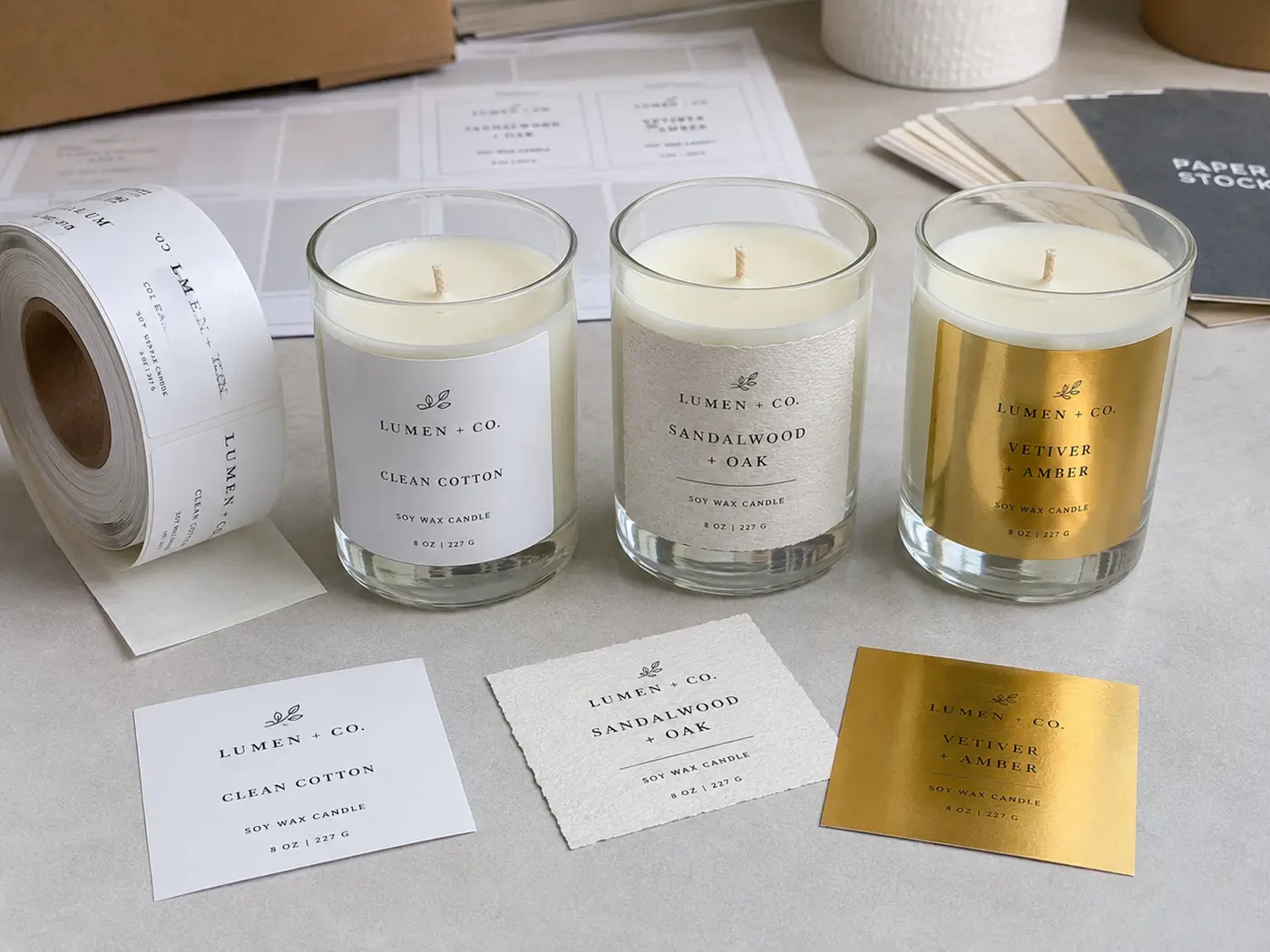
Custom candle labels can cost from a few cents per label in larger roll orders to more than $1 per label for small premium foil runs once tooling is included. In one same-specification 5,000-label price comparison supplied for this article, prices ranged from $238.81 to $465.84, equivalent to approximately $0.048–$0.093 per label.
But the lowest printed unit price is not always the lowest real packaging cost. Quantity, material, finish, foil tooling, shipping, and the number of labels you will actually use all affect what a candle brand ultimately spends.
How Much Do Custom Candle Labels Cost?
There is no single market price for a “custom candle label” because printers price a production specification, not simply a product category.
The main variables are:
- finished size;
- quantity;
- material;
- print method;
- finish;
- roll, sheet, or individually cut format;
- specialty processes such as hot foil or embossing.
For a small-order reference, LabelsAgent currently lists a 2″ × 2″ white BOPP roll label at about $0.42 each for 100 pieces. A 4″ × 5″ gold foil-stamped label is listed at approximately $0.95 each for 100 pieces, before any applicable short-run foil tooling fee. [1]
These examples are useful starting points, but they should not be treated as universal prices. A different size, stock, finish, quantity, or supplier can materially change the quote.
What Can 5,000 Custom Candle Labels Cost?
For a larger-order benchmark, the following comparison uses pricing supplied for this article for the same stated configuration:
2″ × 2″ rectangular labels · white BOPP · gloss lamination · roll format · 5,000 pieces
| Supplier | Quantity | Supplied Price | Approx. Price Per Label |
|---|---|---|---|
| LabelsAgent | 5,000 | $238.81 | $0.0478 |
| Avery | 5,000 | $395.55 | $0.0791 |
| OnlineLabels | 5,000 | $465.84 | $0.0932 |
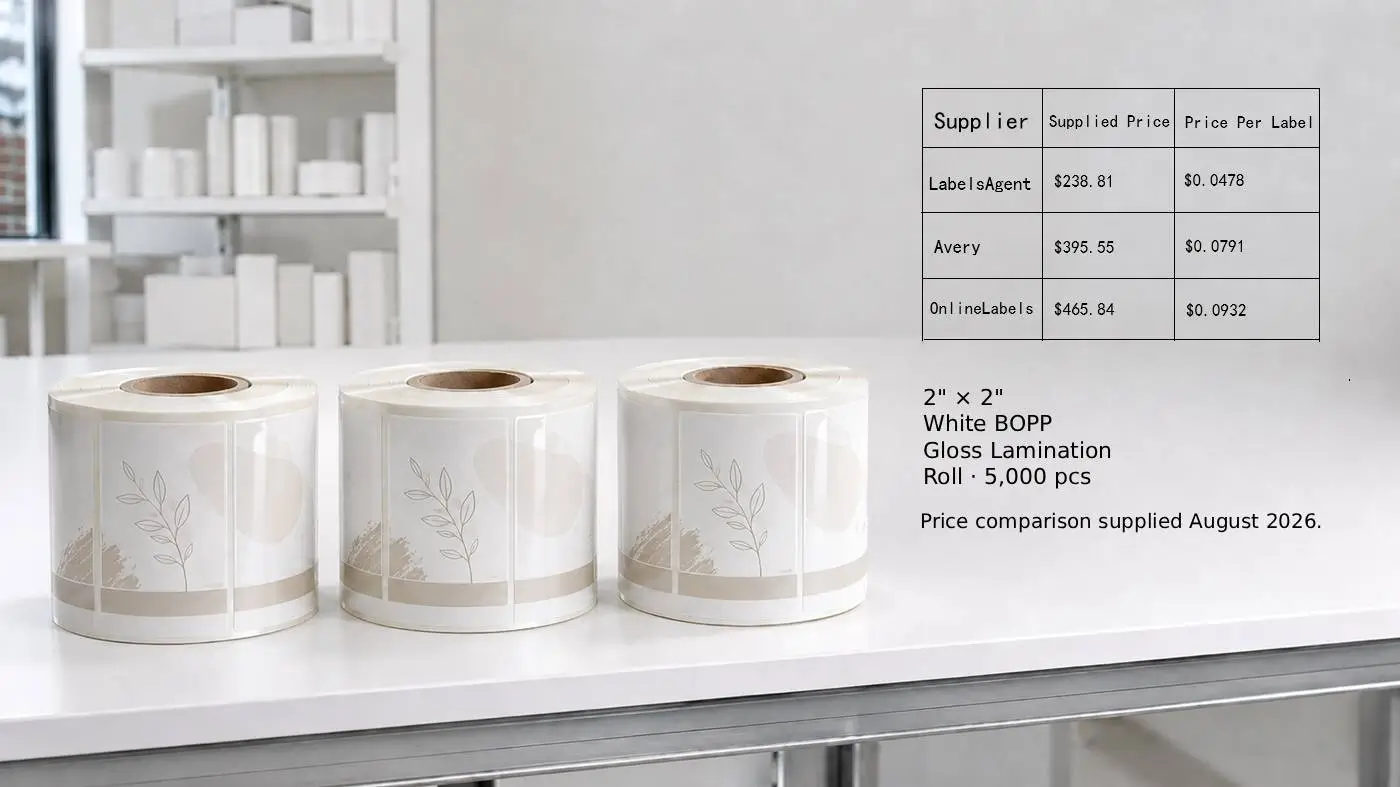
Methodology note: These three prices are first-party comparison data supplied for this article in August 2026. The Avery and OnlineLabels amounts were not independently reproduced from their live pricing configurators during publication research, so this table should be treated as a specific same-specification price check, not permanent market pricing.[9]
Based on the supplied figures, the LabelsAgent price is approximately:
- 39.6% lower than the supplied Avery price
- 48.7% lower than the supplied OnlineLabels price
The defensible conclusion is therefore not that one supplier is “always cheaper.”
It is:
For the specific specification and quotation set used in this comparison, LabelsAgent had the lowest supplied production price.
That distinction matters because online label pricing can change with quantity, material, promotions, freight, production options, and quotation date.
Avery’s current custom roll-label service advertises no minimums, no setup fees, and custom shapes and sizes at no additional cost. [2]
OnlineLabels currently advertises low minimum order sizes and 2–3-business-day turnaround after artwork approval for its custom label service. [3]
Those differences should be evaluated alongside price rather than ignored.
What Factors Have the Biggest Effect on Candle Label Cost?
1. Order Quantity
Quantity affects unit economics because some production costs are spread across the entire run.
LabelsAgent, for example, currently publishes roll-label price breaks at 250, 500, 1,000, 2,500, 5,000, and 10,000 pieces. These are LabelsAgent-specific pricing tiers rather than an industry-wide standard. For current quantity breaks, minimum-order requirements, and setup-cost details, see our custom label pricing and MOQ guide.
Higher quantities can reduce the cost per label, but ordering more is not automatically the better financial decision.
A young candle business must also consider the possibility of changing:
- jar sizes;
- fragrance names;
- regulatory or safety copy;
- brand identity;
- artwork;
- product SKUs.
Unused labels have a real cost.
2. Label Size
Larger labels generally consume more facestock and may affect production efficiency.
A 4″ × 5″ label should therefore not be compared directly with a 2″ × 2″ label simply by looking at price per piece.
3. Material
Paper and film labels serve different packaging needs.
Avery’s current material guidance describes film labels as better suited than ordinary paper to conditions involving moisture, oils, frequent handling, transportation, scuffing, and everyday wear. [4]
For candle packaging, that can matter when jars are handled repeatedly or may encounter fragrance oils, residue, moisture, or abrasion.
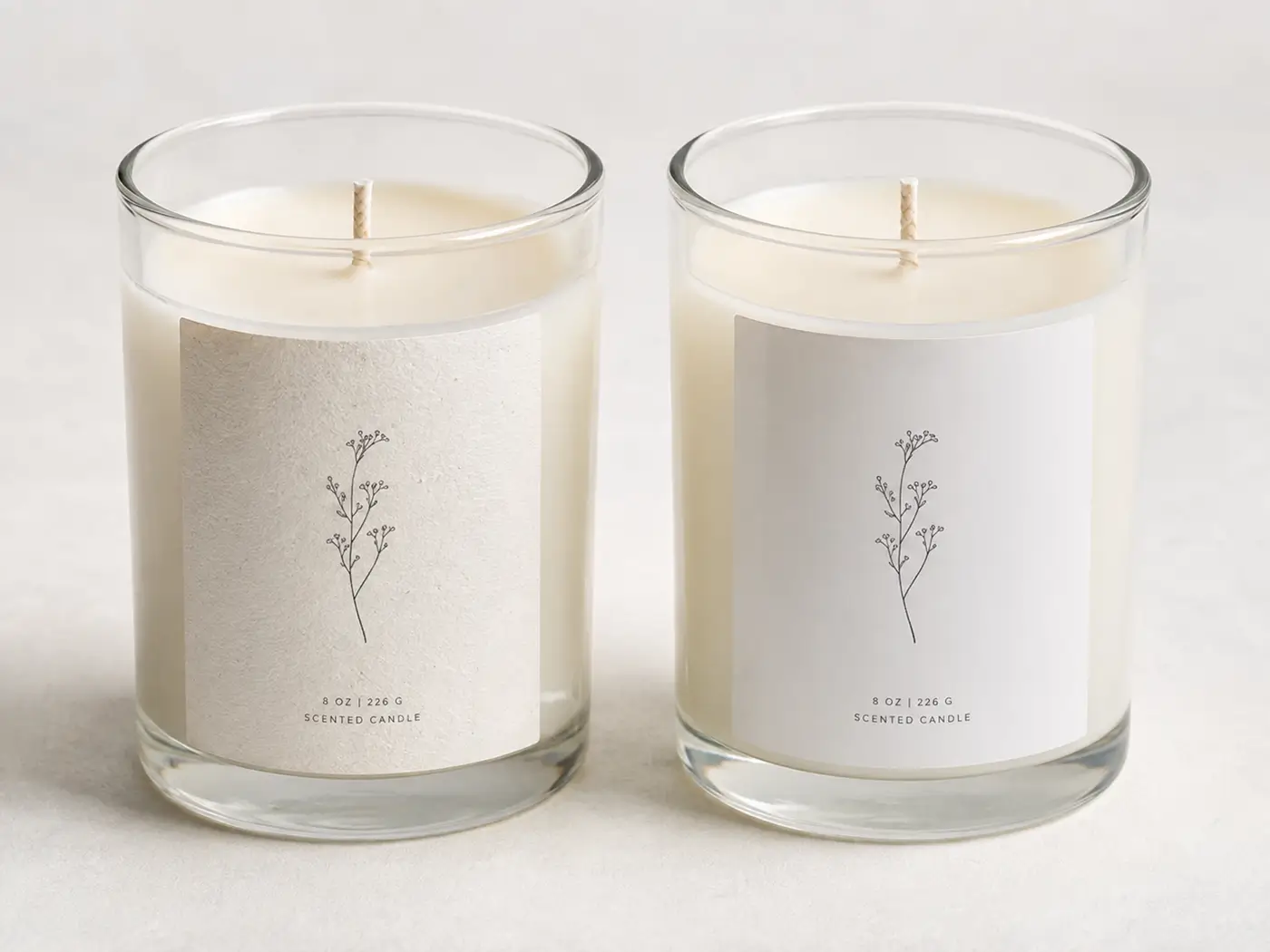
Paper remains valuable when tactile presentation is a priority. Textured or specialty paper can support a handcrafted, boutique, or premium appearance.
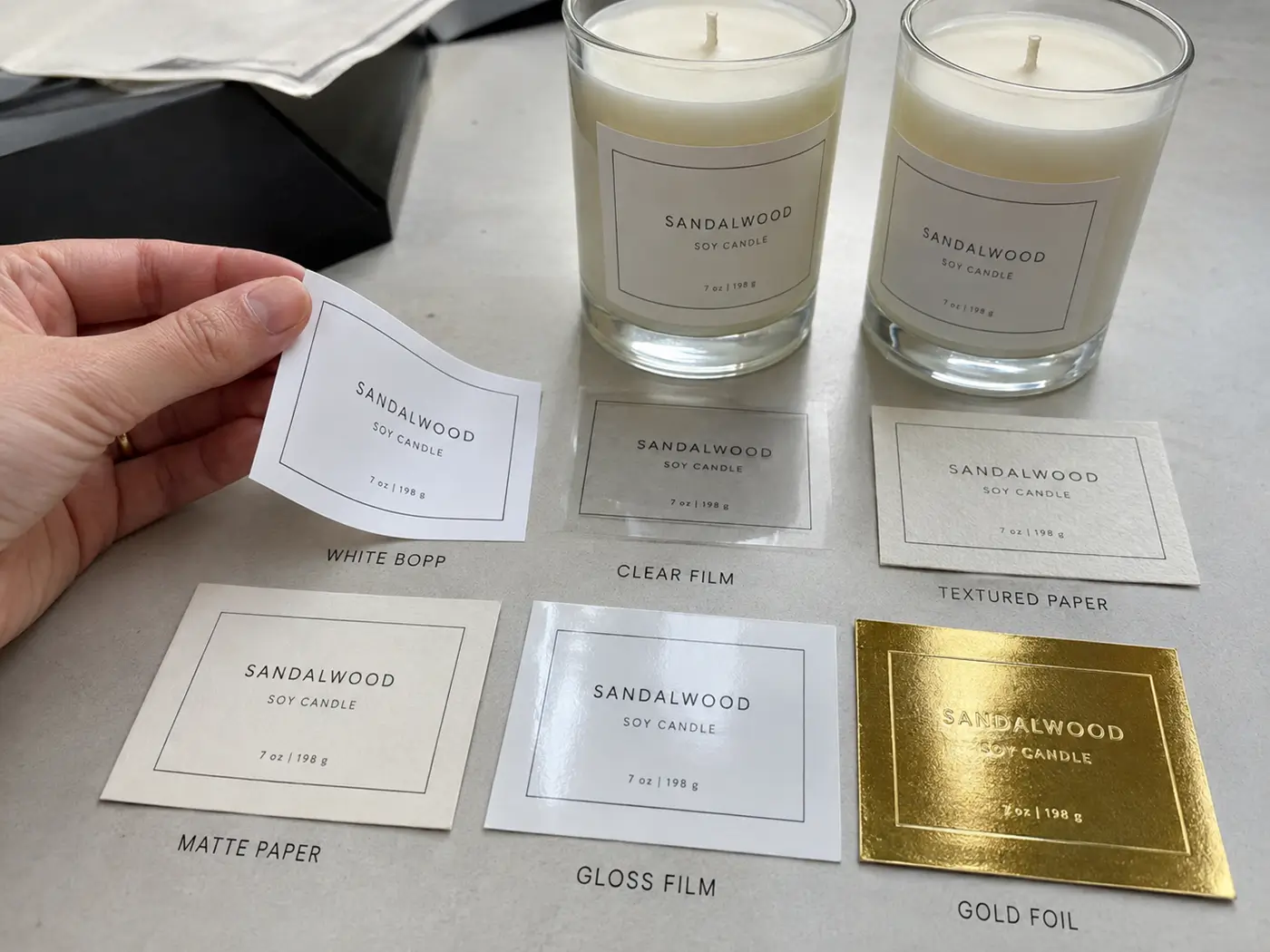
| Material | Strength | Trade-Off | Common Candle Use |
|---|---|---|---|
| White paper | Natural paper look | Lower resistance to moisture and oil than many films | Dry, cost-conscious packaging |
| Textured paper | Premium tactile feel | Performance depends on stock and coating | Boutique or luxury candles |
| White BOPP | Good resistance to moisture, oil, and handling | Less paper-like texture | Everyday jar candles |
| Clear BOPP | Clean “no-label” appearance | Artwork may need white underprinting | Clear glass and modern branding |
OnlineLabels currently offers White Film (BOPP) and Clear Film (BOPP) for roll labels, with gloss and matte roll finishes described as oil- and water-resistant. [5]
The practical rule is:
Do not choose candle-label material on price alone. A cheaper label that stains, scuffs, lifts, or looks worn before the product is sold can create a higher packaging cost than a more durable material.
Material choice can affect both price and real-world label performance. For a deeper comparison of white BOPP, textured paper, clear film, and specialty materials, see our guide to choosing the best label material for candle jars with gold foil.
How Much Extra Do Gold Foil Candle Labels Cost?
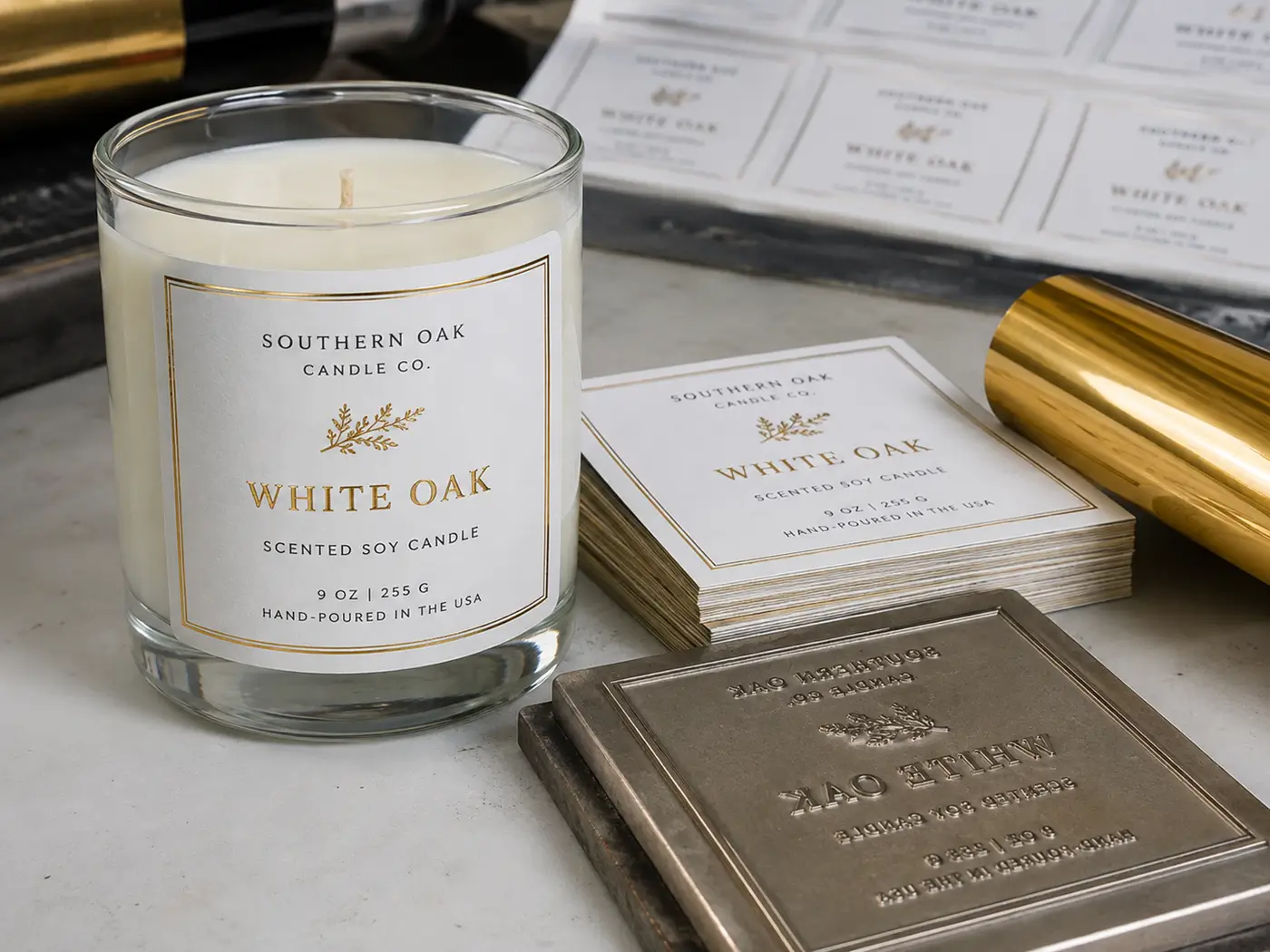
Gold foil candle labels have a different cost structure from standard digitally printed labels because hot foil stamping typically requires dedicated tooling.
LabelsAgent currently states that hot-stamped foil orders below 500 pieces may require a one-time $50–$100 plate-making fee. At 500 pieces or more, that tooling cost is typically absorbed into the production run. [1]
Using its published small-run example:
100 × 4″ × 5″ gold foil labels at approximately $0.95 each
the base production cost would be:
100 × $0.95 = $95
If a $50 plate fee applies:
$95 + $50 = $145 total
Effective cost:
$1.45 per label
If a $100 plate fee applies:
$95 + $100 = $195 total
Effective cost:
$1.95 per label
This illustrates an important purchasing principle:
For very small premium-label runs, fixed tooling can affect effective unit cost more than the printed label itself.
LabelsAgent’s current public tooling policy states that foil dies, flexographic plates, custom dies, and screen-print screens are retained for 18 months from last use. If identical artwork is reordered while the tooling remains active, applicable plate or die fees are waived. [6]
For a candle company testing several new fragrances, this can change the economics of premium packaging.
Instead of applying foil to every experimental SKU immediately, a brand may choose to validate demand first and reserve higher-cost embellishment for products with more predictable sales.
The Lowest Price Per Label May Not Be the Lowest Real Cost
Consider the 5,000-label LabelsAgent benchmark of $238.81.
The printed unit cost is:
$238.81 ÷ 5,000 = approximately $0.0478 per label
That looks extremely economical.
But suppose a candle brand redesigns its packaging after using only 3,500 labels.
The effective cost of the labels actually used becomes:
$238.81 ÷ 3,500 = approximately $0.0682 per usable label
The remaining 1,500 labels have become obsolete inventory.
This leads to a more useful metric than printed unit price:
Effective Usable Label Cost
Total label spend ÷ number of labels actually used
For stable, evergreen products with predictable sales, larger orders may still be the better choice. For stable SKUs produced in larger quantities, custom roll labels can also make production, storage, and application more efficient. If you are still deciding which format fits your order volume and application method, compare roll vs sheet labels before choosing a production format.
For:
- a new fragrance;
- seasonal packaging;
- a rebrand;
- an untested jar size;
- a new regulatory or warning layout;
a smaller order can be economically rational even when the printed cost per label is higher.
You are paying partly for flexibility.
Do Candle Brands Need to Budget for Safety Labels?
Branding is not the only labeling consideration for candle packaging.
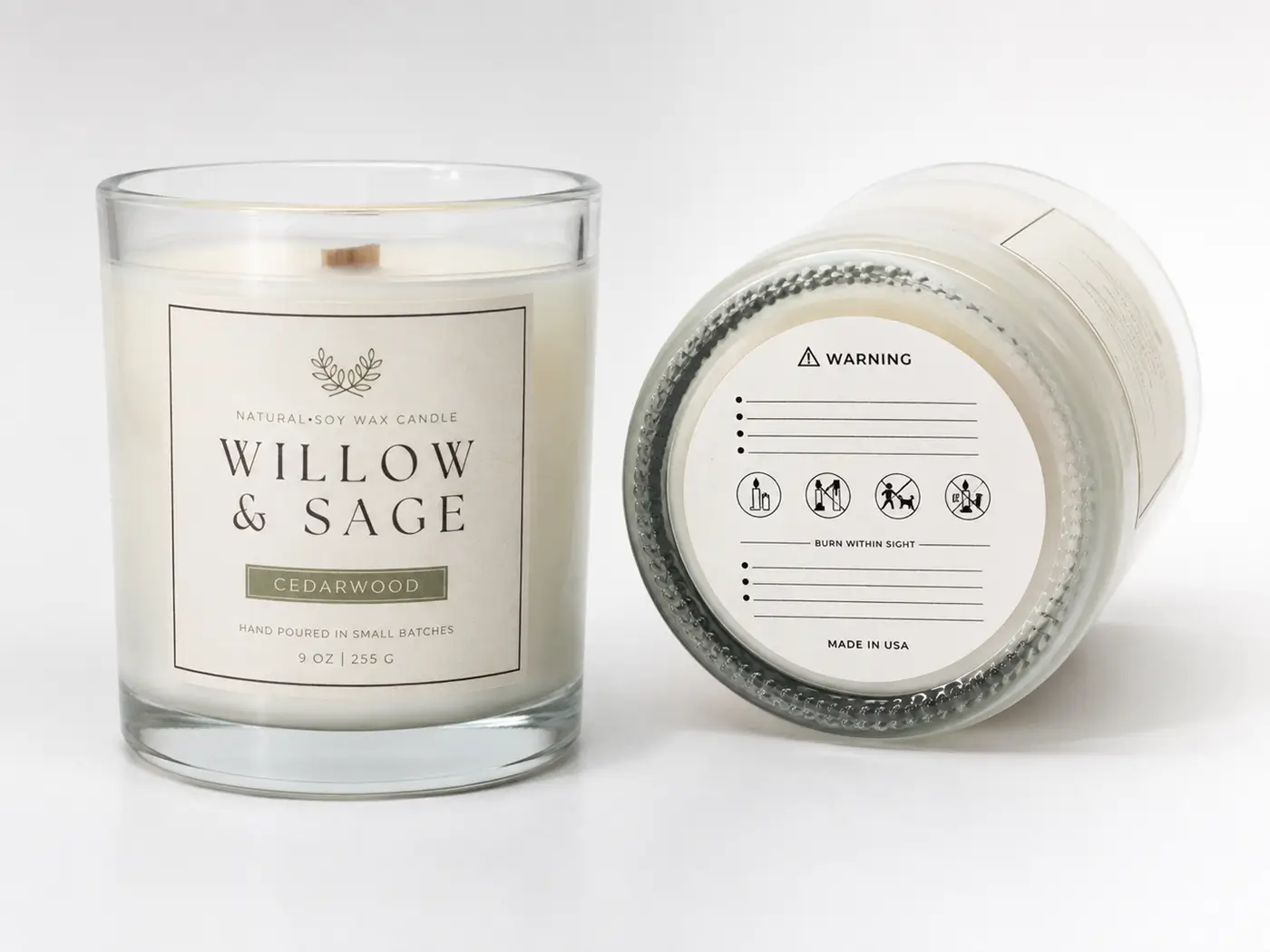
ASTM currently lists ASTM F2058-07(2021), Standard Specification for Candle Fire Safety Labeling, as an active standard. It covers fire-safety information placed on candle units of sale and states that the warning should be visible to the consumer at the point of sale. [7]
The National Candle Association also explains that candle cautionary labeling should communicate three core safety principles:
- Burn Within Sight
- Keep Away from Combustibles
- Keep Away from Children [8]
This creates an additional packaging decision:
Will the safety information be integrated into the main product label, placed on a separate bottom label, or handled with another visible label or tag?
That choice can influence:
- the number of labels required;
- finished dimensions;
- artwork space;
- unit packaging cost.
ASTM F2058 is an industry safety standard. It should not be interpreted as a substitute for market-specific legal or regulatory review.
How Should You Compare Candle Label Suppliers?
The most common mistake is comparing prices that were produced from different specifications.
Before comparing suppliers, standardize as many variables as possible:
- finished dimensions;
- shape;
- quantity;
- material;
- adhesive requirements;
- print method;
- lamination or varnish;
- foil or specialty finish;
- roll or sheet format;
- number of artwork versions;
- delivery destination.
Then check what the headline quote excludes.
Possible additional costs include:
- shipping;
- taxes;
- import duties;
- plate fees;
- custom dies;
- design-split charges;
- physical proofs;
- rush production.
Production time also matters.
LabelsAgent currently publishes standard production times of 2–3 business days for digital printing on BOPP, PET, and vinyl, and 3–5 business days for foil stamping, beginning after proof approval. [10]
Its published shipping options include:
- Sea shipping: approximately 15–25 days
- DHL/FedEx air express: approximately 4–7 business days [10]
OnlineLabels currently advertises standard custom-label turnaround of approximately 2–3 business days. [3]
A low factory price therefore does not automatically mean:
- the lowest landed cost;
- the fastest delivery;
- the lowest-risk purchase.
How Much Should a Small Candle Brand Budget?
There is no single ideal order quantity, but this framework can help:
| Situation | Practical Starting Strategy |
|---|---|
| Testing a new scent or design | Use a smaller initial run |
| Stable evergreen product | Compare 1,000 / 2,500 / 5,000+ pricing |
| Packaging may encounter oil or moisture | Evaluate BOPP or another suitable film |
| Premium launch | Budget separately for foil tooling |
| Multiple fragrance SKUs | Calculate quantity per design, not just total volume |
| Deadline-sensitive launch | Compare production and shipping together |
| New packaging format | Avoid over-ordering before fit is validated |
LabelsAgent currently states that standard custom labels can be ordered from one piece, while short-run hot foil remains subject to the potential tooling fee discussed above. [1]
For a startup, that means the purchasing decision does not have to be:
“Order 5,000 or don’t order at all.”
A more useful question is:
How many labels can I realistically use before there is a meaningful chance that my packaging changes?
Final Buying Recommendation
Before asking which supplier has the cheapest candle labels, define the job.
Send every supplier the same:
- size;
- shape;
- material;
- quantity per design;
- finish;
- artwork;
- label format;
- delivery destination;
- required delivery date.
Then compare:
Production cost + tooling + shipping + expected usable quantity
For high-volume standard roll labels, larger quantities can produce attractive unit economics.
For small hot-foil orders, tooling can dominate the effective unit price.
For an untested product launch, smaller quantities may protect the business from obsolete packaging.
The best label quote is therefore not automatically the quote with the lowest printed price per piece. It is the quote that gives your business the lowest realistic cost for the labels it can actually use.
Frequently Asked Questions
How much do 5,000 custom candle labels cost?
In the same-specification comparison supplied for this article—5,000 2″ × 2″ white BOPP roll labels with gloss lamination—the recorded totals were $238.81, $395.55, and $465.84, equal to approximately $0.048–$0.093 per label.[9] These figures represent one specific price comparison, not universal market pricing.
Is BOPP better than paper for candle labels?
BOPP is generally worth considering when resistance to moisture, oil, scuffing, and frequent handling matters. Paper can be more suitable when tactile texture, a handcrafted appearance, or premium presentation is the priority. The best choice depends on the candle container, environment, and brand presentation. [4]
Why are small foil label orders more expensive?
Hot foil stamping normally requires dedicated tooling. LabelsAgent currently states that foil orders below 500 pieces may require a $50–$100 one-time plate-making fee, which can significantly increase the effective cost per label on a 50- or 100-piece order. [1]
Do candle products need safety information?
ASTM F2058 covers candle fire-safety labeling, while the National Candle Association identifies three key cautionary messages: burn within sight, keep away from combustibles, and keep away from children. Candle brands should therefore account for safety information when planning the complete packaging system. [7] [8]
References
[1] LabelsAgent — Custom Label Pricing, MOQ & Ordering Guide
Used for: no-MOQ policy, small-run price examples, quantity breaks, foil-order threshold, and $50–$100 short-run foil tooling information.
Accessed: August 2026.
https://www.labelsagent.com/faqs/pricing-ordering/
[2] Avery WePrint — Custom Labels & Stickers on Rolls
Used for: no minimum orders, no setup fees, custom shapes and sizes.
Accessed: August 2026.
https://www.avery.com/custom-printing/roll-labels/
[3] OnlineLabels — Custom Labels
Used for: low minimum quantities and current standard turnaround.
Accessed: August 2026.
https://www.onlinelabels.com/custom-labels
[4] Avery — Film, Paper, or Vinyl Labels: What Works Best and When?
Used for: film-label durability, moisture/oil/scuff resistance, and paper-versus-film selection.
Published: June 23, 2026.
Accessed: August 2026.
https://www.avery.com/blog/film-paper-vinyl-labels/
[5] OnlineLabels — Custom Labels / Roll Label Materials
Used for: White Film (BOPP), Clear Film (BOPP), laminated roll finishes, and oil/water resistance.
Accessed: August 2026.
https://www.onlinelabels.com/custom-labels
[6] LabelsAgent — Custom Label Quality, Defects & Reprint Policy
Used for: 18-month tooling retention and repeat-order plate/die fee policy.
Accessed: August 2026.
https://www.labelsagent.com/faqs/quality-reprints/
[7] ASTM International — ASTM F2058-07(2021), Standard Specification for Candle Fire Safety Labeling
Used for: candle fire-safety labeling scope and point-of-sale visibility.
Accessed: August 2026.
https://store.astm.org/f2058-07r21.html
[8] National Candle Association — Understanding the Label
Used for: the three principal candle cautionary-label safety messages.
Accessed: August 2026.
https://candles.org/understanding-the-label/
[9] First-Party Price Comparison Data Supplied for This Article
Specification: 2″ × 2″ rectangular, white BOPP, gloss lamination, roll format, 5,000 pieces.
Recorded prices supplied in August 2026: LabelsAgent $238.81; Avery $395.55; OnlineLabels $465.84.
This source is intentionally labeled as first-party research because the two competitor prices were not independently reproduced from live public configurators during publication research.
[10] LabelsAgent — Label Production & International Shipping
Used for: digital-print production time, foil-stamping production time, sea freight, and air-express delivery estimates.
Accessed: August 2026.
https://www.labelsagent.com/faqs/production-shipping/