
Foil Stamped Labels vs Metallic Labels: Which Is Better for Candle Packaging?
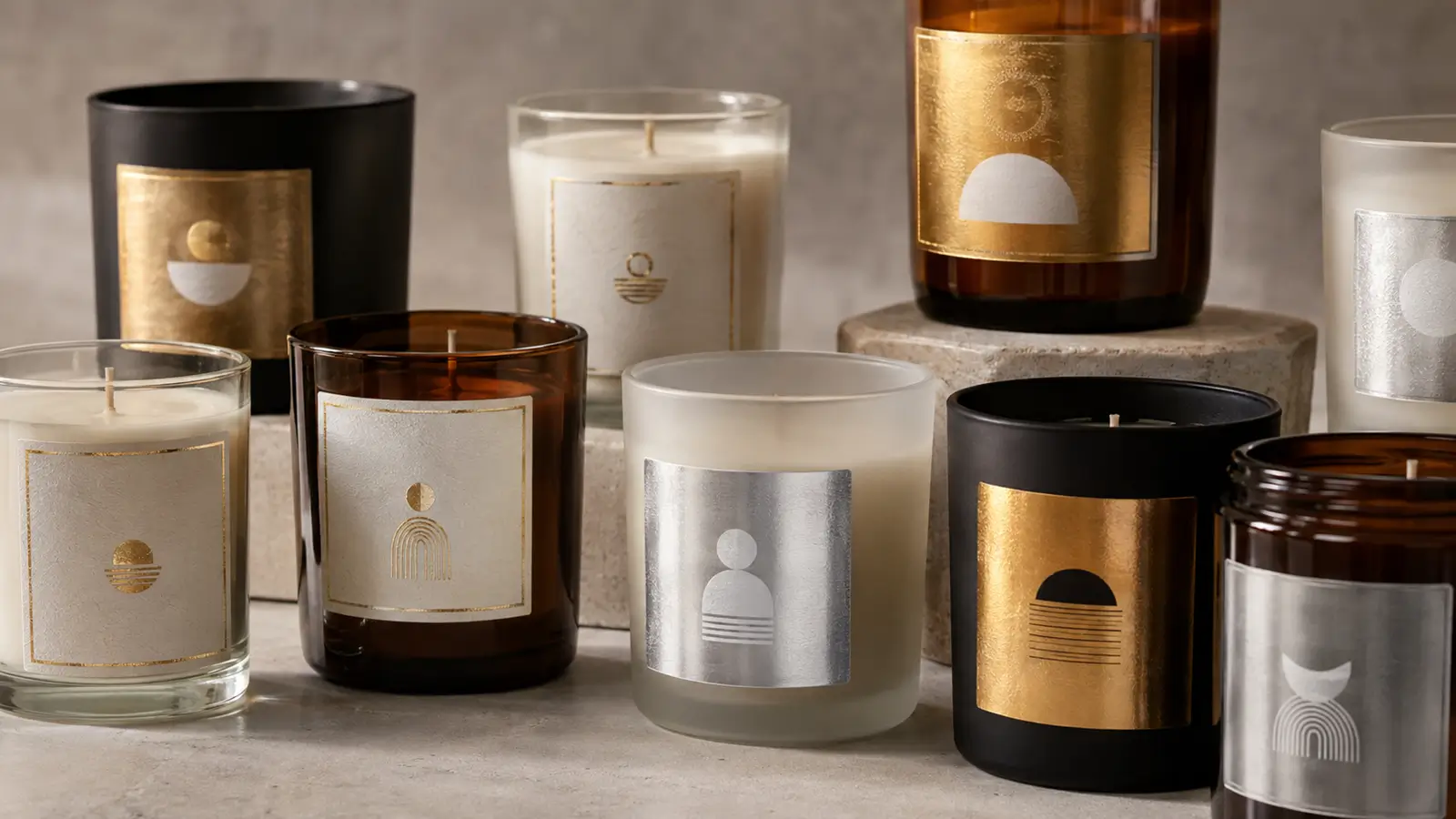
Foil Stamped Labels vs Metallic Labels: Which Is Better for Candle Packaging?
Quick answer: Choose foil stamped labels or custom foil candle labels when genuine metallic reflection, textured paper, embossing, or a premium brand cue is central to your candle packaging. Choose metallic labels when you need lower setup costs, larger metallic areas, multiple metallic colors, frequent artwork changes, or many short-run scent variations. For small candle brands, compare the minimum total financial commitment, not MOQ or unit price alone.
The distinction matters because candle packaging is serving a sizeable downstream market. Grand View Research estimates that the U.S. candle market generated $3.56 billion in 2025, with container candles representing the largest product segment, and forecasts a 6.5% CAGR from 2026 to 2033. That figure measures candles—not foil labels—but it explains why packaging decisions around jars, tins, and premium labels have meaningful commercial value.
For a candle maker comparing foil stamped labels vs metallic labels, the real decision is therefore not simply, “Which looks more expensive?” It is:
Which process gives the brand the required visual effect while creating the least unnecessary setup cost, inventory risk, and production complexity?
That question leads to a different answer depending on the material, order size, number of scents, and maturity of the brand.
What Is the Difference Between Foil Stamped Labels and Metallic Labels?
The two products can look similar in online photographs, but the metallic effect is created in fundamentally different ways.
Foil stamping transfers a separate metallic layer onto selected areas
Hot foil stamping uses a die, heat, pressure, and foil carrier to transfer metallic foil onto a specific part of the label.
Labels & Labeling’s Label Academy explains that hot-foil image transfer relies on both heat and pressure, with dies commonly made from materials such as magnesium, brass, steel, or copper.
For candle labels, hot foil is normally used selectively on:
- Logos;
- Brand names;
- Fragrance names;
- Borders;
- Crests;
- Limited-edition details.
Cold foil works differently. A printing unit applies adhesive only where the metallic image is required, and the foil bonds to that adhesive. According to Labels & Labeling, filmic and gloss substrates are especially suitable for cold foil, and cold foil can run faster than traditional hot stamping.
The same technical source also identifies an important visual difference: hot foil generally produces a brighter, more reflective result, while cold foil offers lower setup requirements, faster production, and accurate inline registration.
Metallic labels use the label material itself to create shine
Metallic labels usually start with a reflective facestock, such as silver metallic film.
Printing is then used to control which parts of the metallic substrate remain visible.
White ink is particularly important. Avery explains that white underprint creates an opaque base layer. On metallic materials, areas covered with white ink lose the metallic effect and retain more accurate printed colors, while areas without white remain reflective.
This means one silver substrate can visually produce:
- Gold;
- Copper;
- Bronze;
- Colored metallic effects;
- Metallic gradients;
- Large reflective backgrounds.
So metallic labels can offer much more color flexibility without requiring a separate foil for every metallic shade.
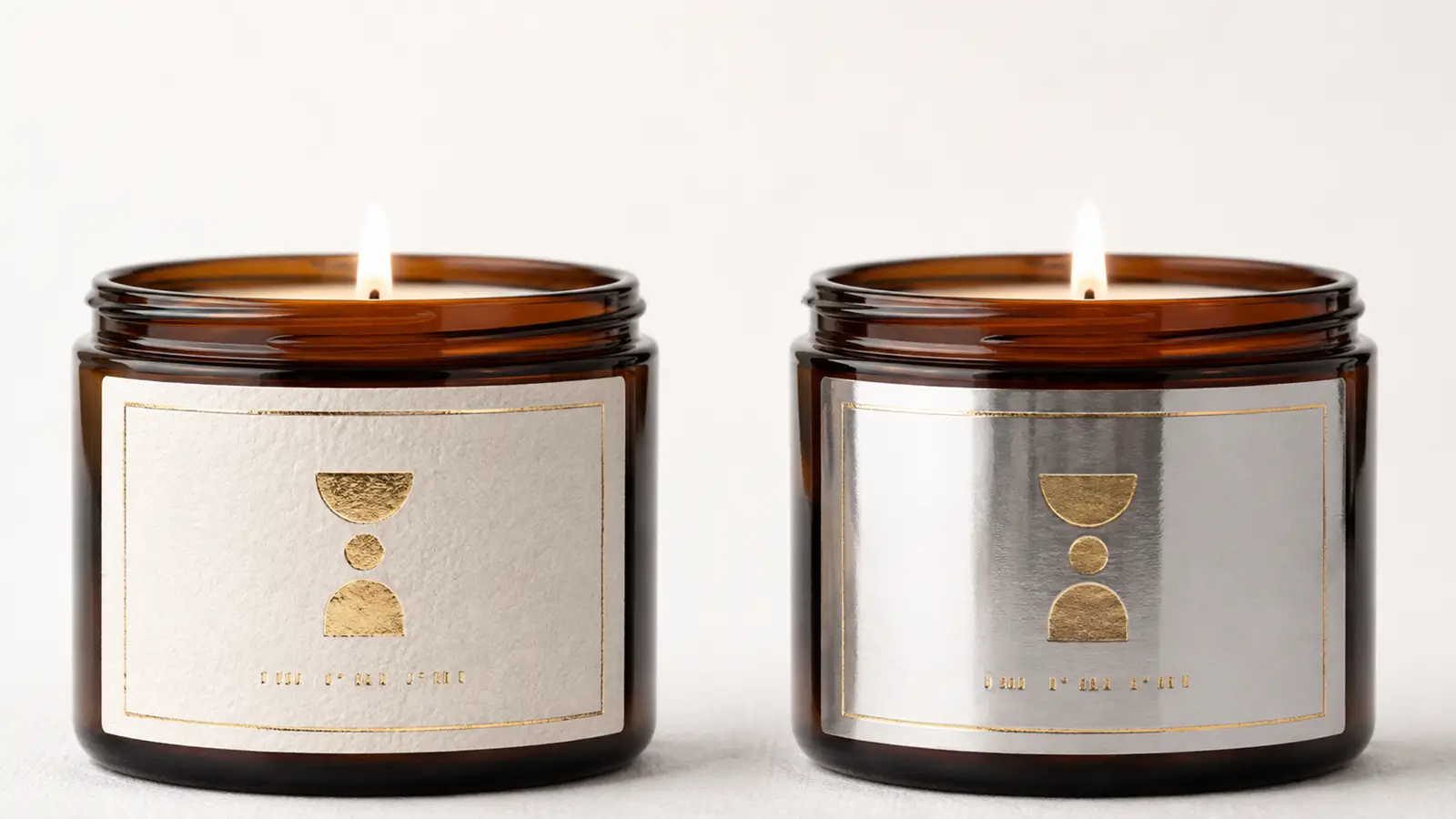
Foil Stamped Labels vs Metallic Labels: Quick Comparison
| Decision Factor | Foil Stamped Labels | Metallic Labels |
|---|---|---|
| Metallic effect | Separate metallic foil transferred to selected areas | Reflective label substrate |
| Best visual use | Logos, borders, premium accents | Metallic backgrounds, gradients, multi-color effects |
| Reflection | Hot foil can be highly mirror-like | Depends on substrate and printed color |
| Tactile options | Can combine with embossing | Usually flat |
| Setup | Hot foil normally requires tooling | Generally lower setup |
| Very small runs | Possible, but tooling can dominate cost | Usually easier economically |
| Multi-SKU changes | Easy if foil artwork stays common; cost rises if foil area changes | Generally highly flexible |
| Textured paper | Excellent use case for hot foil | Limited by available metallic facestock |
| Smooth films | Hot or cold foil possible | Very suitable |
| Artwork | Separate solid foil layer | Print artwork plus white-underprint control |
| Typical use | Premium or established packaging | Testing, seasonal, multi-SKU or design-heavy packaging |
The simplest decision rule
Choose foil because you value the foil itself. Choose metallic material because you value design flexibility and metallic appearance.
That distinction prevents one of the most common buying mistakes: paying for genuine foil when the design only requires a metallic-looking background—or accepting metallic printing when authentic foil is part of the brand identity.
Which Looks Better on Candle Packaging?
There is no universal winner because the container and label material matter as much as the decoration method.
Textured paper usually gives hot foil its strongest advantage
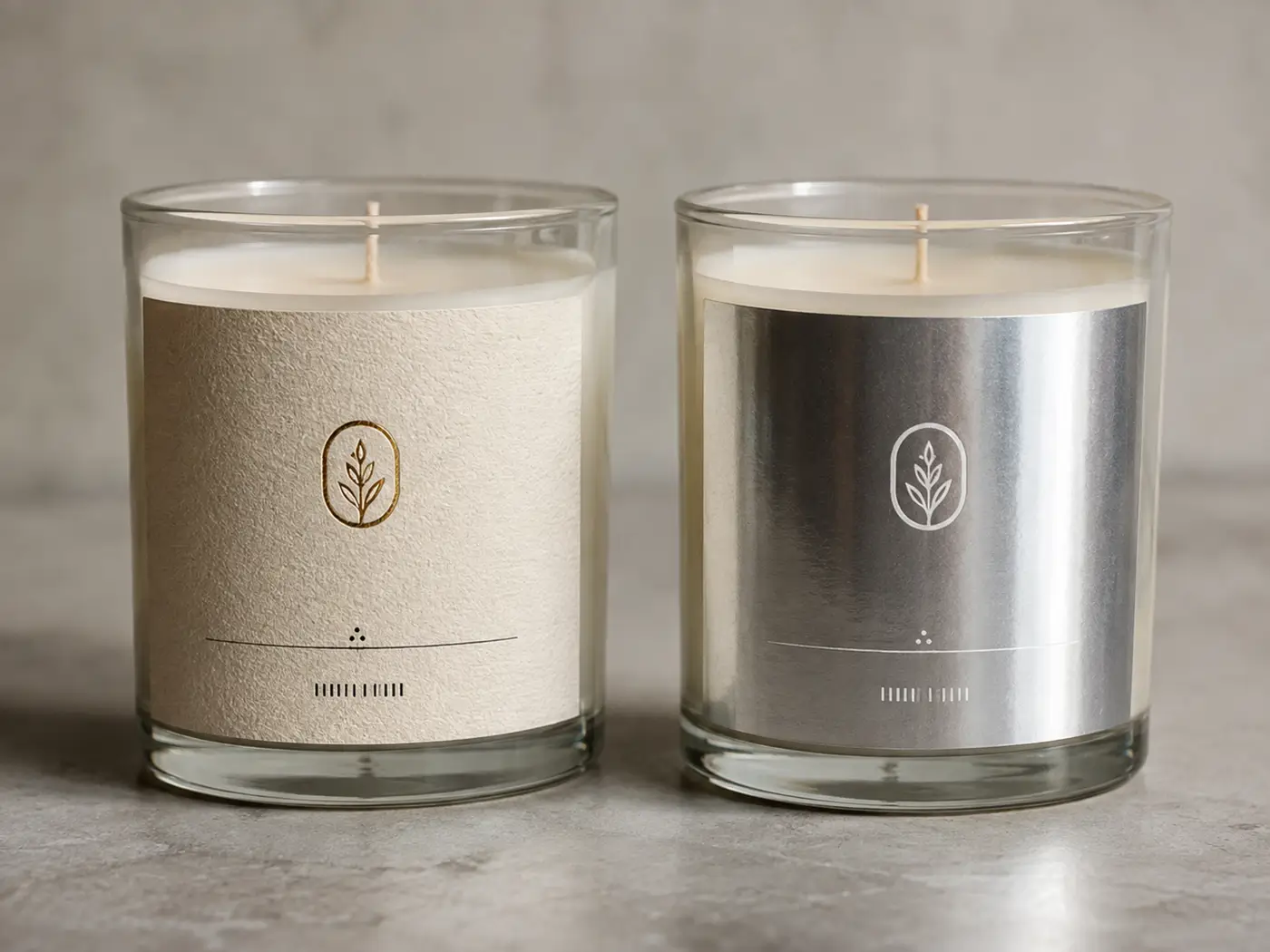
Hot foil works particularly well when the candle brand wants contrast between tactile paper and a sharply reflective logo or border.
However, premium paper is not automatically compatible with every foil.
Labels & Labeling recommends testing the actual stock with the selected foil because porous materials can sometimes require a topcoat or primer for better foil adhesion.
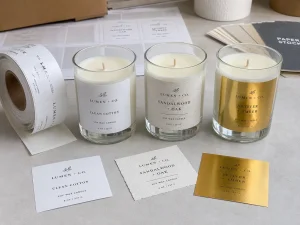
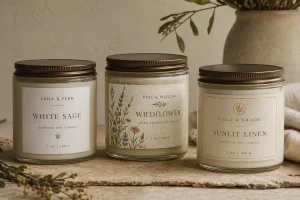
For a premium candle using a cream textured label, for example, a small hot-foil logo may communicate more craftsmanship than turning the entire label into a reflective gold surface.
Smooth jars and tins can use either process
On smooth glass and metal candle tins, both technologies can work.
At this point, another system becomes more important:
facestock + adhesive + container surface.
The metallic decoration determines how the label looks.
The adhesive system determines whether that label stays attached.
Frosted and coated candle jars should always be tested
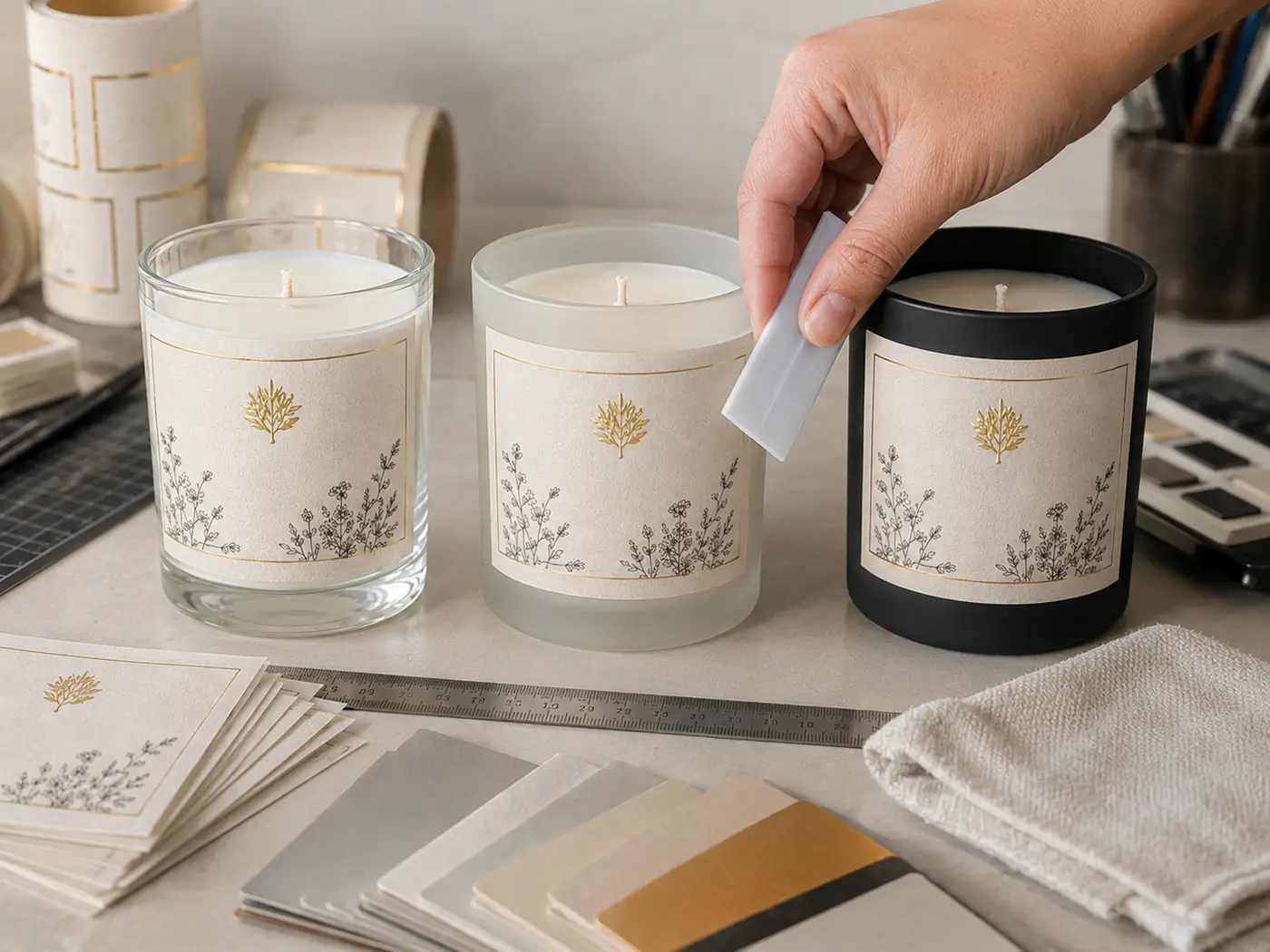
A visually impressive foil label has little commercial value if the edge begins lifting from a frosted jar.
Neither the term “foil stamped” nor “metallic” proves that a label is suitable for:
- Frosted glass;
- Painted glass;
- Powder-coated tins;
- Strongly curved jars;
- Surfaces exposed to fragrance oil.
For these applications, a physical material test is more valuable than a digital mockup.
Packaging insight #1: The finishing process creates the visual effect; the material-and-adhesive system determines whether the visual effect survives on the product.
Which Option Is Better for Small-Batch Candle Brands?
Metallic labels often have easier economics at very small quantities, but genuine foil no longer automatically requires a large production run.
This is where looking only at MOQ becomes misleading.
No MOQ Does Not Mean No Setup Cost
There are at least three different ways suppliers can structure a “small-order” label service.
Model 1: No quantity MOQ, but a minimum dollar order
Blue Label Packaging states that it has no minimum label quantity, but its typical minimum order value is approximately $200. Its normal turnaround is five working days after approved proof and purchase order.
For a buyer needing only 75 or 100 labels, the quantity may technically be allowed, but the financial threshold remains.
Model 2: Standardized quantity increments
UPrinting’s current metallic-label configuration lists quantities beginning at 500 labels. A reviewed 2 × 2 inch configuration showed 500 labels at $78.19, with six business days of printing time. These are supplier-specific terms for that metallic product, not an industry-wide price benchmark.
Model 3: No label-quantity minimum, but tooling applies to small foil orders
For candle makers sourcing small-batch gold foil labels, LabelsAgent currently offers custom gold foil labels with no minimum label quantity. Orders below 500 labels may still require a one-time $50–$100 foil die fee.
That represents a different purchasing model.
A candle startup needing 100 genuine foil labels does not necessarily have to purchase 500 identical labels. Instead, it can evaluate whether paying the tooling cost makes more sense than carrying 400 unnecessary labels.
This leads to a more useful purchasing equation:
Minimum practical commitment = usable labels + tooling + version charges + freight + expected obsolete inventory.
For startups, this number may matter more than either the nominal MOQ or the lowest unit price.
Why Multi-Scent Candle Brands Should Think About Inventory Differently
Candle brands naturally produce multiple versions.
One collection may contain:
- Lavender;
- Vanilla;
- Sandalwood;
- Sea Salt;
- Pumpkin;
- Holiday Pine.
These products may share the same gold-foil logo while changing only the fragrance name and printed artwork.
That makes version management commercially important.
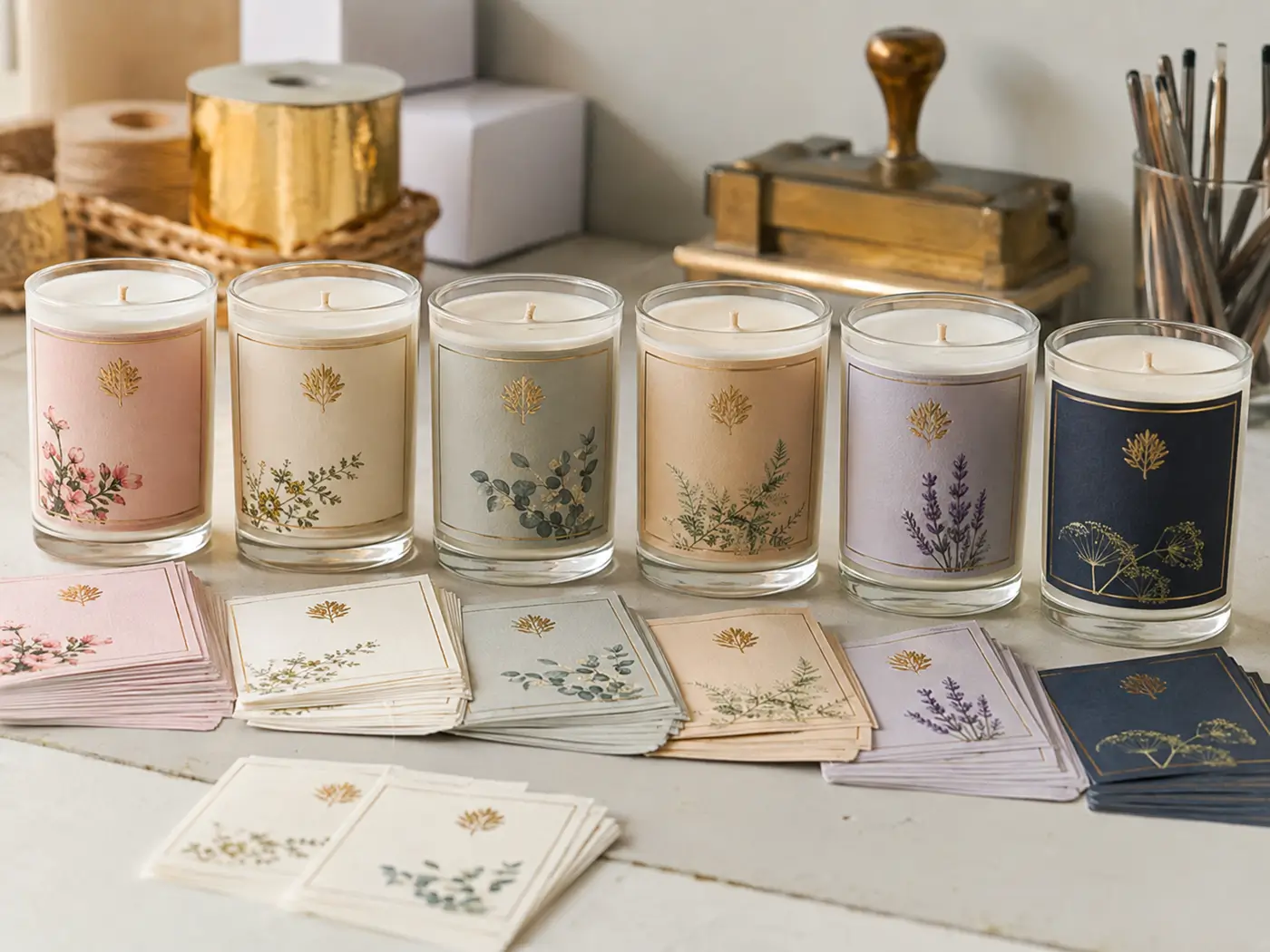
FINAT identifies shorter runs as a major reason brands request digital printing, driven partly by growth in the number and variability of SKUs. It also reports industry conversations suggesting that historically more than 30% of printed labels can be discarded after regulatory or ingredient changes make the artwork obsolete. This is broader label-industry evidence, not candle-specific waste data, but it illustrates the financial cost of over-ordering labels.
Packaging insight #2: For a multi-SKU candle business, version flexibility can have more economic value than the lowest unit price.
A $0.20 label is not necessarily cheaper if the brand must purchase 1,000 copies of every slow-moving fragrance.
A higher unit price can produce a lower real packaging cost if it reduces obsolete inventory.
When Should You Choose Foil Stamped Candle Labels?
Genuine foil is usually the stronger choice when:
- Your candle is positioned as premium, boutique, giftable, or luxury;
- Metallic accents are a recognizable part of the brand identity;
- You want strong mirror-like reflection;
- You use textured or premium paper;
- You want embossing with foil;
- Your main logo will remain stable across future reorders;
- Multiple fragrances share the same foil artwork.
LabelsAgent’s current Gold Foil Labels configuration illustrates the range possible within genuine foil production: it lists hot foil, cold foil, and hot foil with embossing, along with BOPP, PET, kraft, estate paper, and other substrates. It also offers several foil tones. These are LabelsAgent-specific capabilities rather than universal industry specifications.
For its own hot-foil artwork, LabelsAgent recommends a minimum line weight of 0.5 pt and minimum text size of 6 pt. Again, these are supplier-specific prepress guidelines and should not be assumed to apply to every foil printer.
Its current standard production time is stated as 2–3 business days after proof approval, with shipping time listed separately.
That separation matters when comparing overseas and domestic suppliers.
When Should You Choose Metallic Labels?
Metallic labels are generally a stronger choice when:
- You are testing a new candle collection;
- The artwork may change soon;
- You want large metallic backgrounds;
- The design includes several metallic colors;
- You need gradients;
- You have many fragrance SKUs;
- A traditional hot-foil die represents too much of the first-order budget;
- The appearance matters more than using a traditional foil process.
Metallic labels can be particularly effective for modern, cosmetic-style candle packaging where a large part of the label is silver, champagne, copper, or colored metallic rather than a small foil accent.
Candle Label Decision Matrix
Use this framework before requesting a quote.
| Your Situation | Better Starting Option |
|---|---|
| New fragrance test with uncertain demand | Metallic label |
| Luxury candle on textured paper | Hot foil |
| Gold logo reused across 6 scents | Foil can make strong economic sense |
| Artwork changes every season | Metallic label |
| Large metallic background | Metallic label |
| Logo + embossing on premium carton | Hot foil |
| Smooth film and inline production | Consider cold foil |
| Under 500 genuine foil labels | Compare tooling-based small-run options |
| Frosted jar | Test substrate and adhesive before choosing finish |
The most important question is not simply “foil or metallic?”
Ask:
- Is genuine foil part of the brand story?
- Will the artwork remain stable?
- How many scent versions are required?
- What is the total first-order budget?
- What surface will the label be applied to?
- How much unused inventory could the brand tolerate?
Conclusion: Which Is Better for Candle Packaging?
Neither process is universally better.
Foil stamped candle labels are the stronger choice when authentic metallic reflection, premium paper, embossing, or a stable luxury identity justifies the additional setup.
Metallic labels are usually the more flexible choice when the brand is testing products, managing many SKUs, changing artwork frequently, or using large metallic design areas.
For small candle businesses, the most useful comparison is not simply:
MOQ vs MOQ
or:
price per label vs price per label.
Compare:
total financial commitment + inventory risk + artwork flexibility + material performance.
LabelsAgent provides one example of how genuine custom foil candle labels can be structured for smaller buyers: its current Gold Foil Labels product has no stated minimum label quantity, while orders below 500 labels may incur a one-time $50–$100 foil die fee. This does not eliminate the setup cost of true foil stamping; it gives the buyer the option to pay for tooling without purchasing more labels than currently needed.
Before requesting a quote or sample, prepare your:
- Final label dimensions;
- Container material and surface;
- Quantity per scent;
- Number of artwork versions;
- Preferred label material;
- Foil areas;
- Editable vector artwork.
And when adhesion or metallic appearance matters, request a physical sample before committing to the full run.
Frequently Asked Questions
What is the main difference between foil stamped labels and metallic labels?
Foil stamped labels transfer a separate metallic foil onto selected design areas using hot or cold foil processes. Metallic labels use a reflective substrate and control the shine through printed inks, often including white underprint. Foil is better for authentic spot-metallic accents; metallic substrates generally offer greater color and design flexibility.
Which type is better for a small handmade candle business?
Metallic labels are often easier for early product testing because they usually involve less traditional tooling. Genuine foil can still make sense at low quantities if the supplier accepts small runs. Compare the complete first-order cost—including tooling, freight, and unused inventory—rather than choosing solely by MOQ.
Can I order genuine foil candle labels in fewer than 500 pieces?
Yes, depending on the supplier. LabelsAgent currently states that its Gold Foil Labels have no minimum label quantity, although a one-time $50–$100 foil die fee may apply below 500 labels. Other printers may instead use a minimum dollar value or fixed quantity increments.
Are metallic labels suitable for frosted candle jars?
Potentially, but the metallic printing method does not determine adhesion. Frosted and coated surfaces should be tested with the actual label facestock and adhesive. Apply a physical sample to the production jar before ordering a large quantity.
Is hot foil better for textured candle-label paper?
Often, yes. Hot foil can create strong visual contrast against tactile paper, but the foil and stock still need to be compatible. Labels & Labeling recommends testing porous label materials because some stocks may require a coating or primer for reliable foil transfer.
Sources
Grand View Research — U.S. Candle Market Size & Outlook, 2026–2033 — updated February 2026.
U.S. candle revenue, container-candle segment, and third-party growth forecast. U.S. Candle Market Size & Outlook
Labels & Labeling, Label Academy — Reviewing the Hot Foiling Process — accessed August 2026.
Hot-foil dies, heat and pressure, foil selection, and substrate testing. Reviewing the Hot Foiling Process
Labels & Labeling, Label Academy — Embellishments: Foil Stamping Processes — accessed August 2026.
Cold-foil principles and comparison of hot and cold foil. Foil Stamping Processes
FINAT — Understanding the Hidden ROI of Digital Label Printing — 2025.
Short-run demand, SKU variability, and label-obsolescence discussion. Understanding the Hidden ROI of Digital Label Printing
Avery — White Underprint: How to Make Vibrant Clear Stickers — updated July 2026.
White ink behavior on metallic label materials. Avery White Underprint Guide
Blue Label Packaging — Resources / Digital Printing FAQ — accessed August 2026.
No label-quantity minimum, typical $200 minimum order amount, and turnaround conditions. Blue Label Packaging FAQ
UPrinting — Custom Metallic Labels — accessed August 2026.
Supplier-specific metallic-label quantity, pricing, and production-time example. UPrinting Metallic Labels
LabelsAgent — Custom Gold Foil Labels for Luxury Packaging — accessed August 2026.
No minimum order quantity, possible $50–$100 foil-die fee below 500 labels, available foil methods, materials, artwork specifications, and production terms. LabelsAgent Gold Foil Labels
Supplier prices, minimum-order policies, production times, and product specifications were checked in August 2026 and may change. Industry data and supplier-specific commercial terms should not be interpreted as universal label-industry standards.