
What Is the Best Label Material for Candle Jars with Gold Foil?
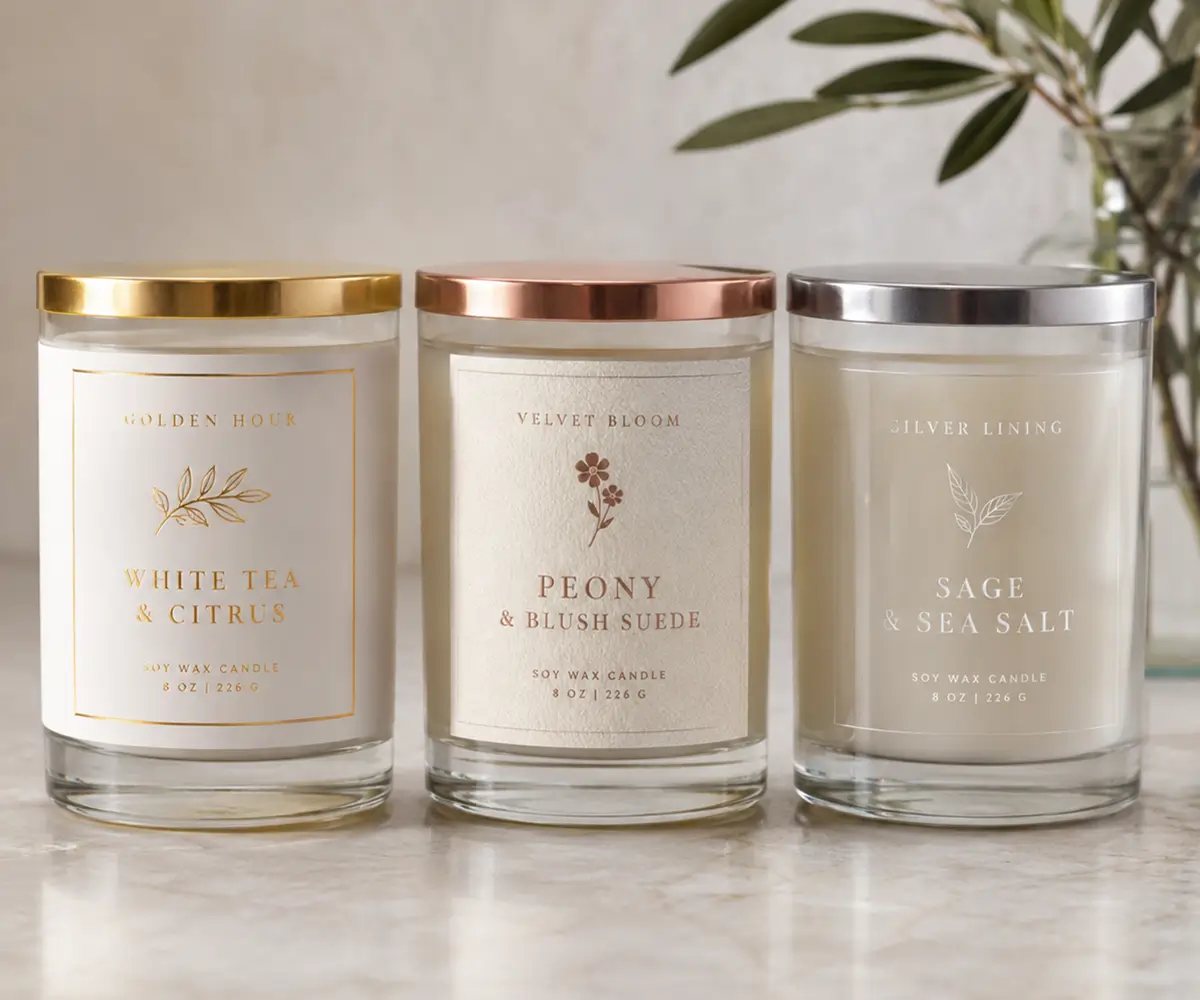
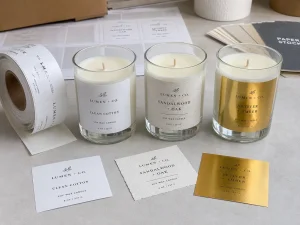
For most candle jars, the best all-around label material for gold foil is a foil-compatible white BOPP film paired with a permanent adhesive designed for glass. It offers a smooth surface for sharp metallic details, resists moisture better than ordinary paper, and performs well on the flat or gently curved walls of common candle vessels. Choose wet-strength textured paper when tactile luxury matters more than maximum durability, or clear BOPP when you want the jar and wax color to remain visually dominant. Before placing a production order, test the complete label construction on the exact filled jar. LabelsAgent produces custom foil labels for candle jars in gold, rose gold, and silver with no minimum order quantity. Orders of fewer than 500 labels are subject to a setup fee of US$50–$100.
Current material specifications show how different these choices can be: a clear BOPP label film may be only 2 mil thick, while one wet-strength textured paper construction is 123 gsm and 157 microns thick. These physical differences affect foil definition, flexibility, moisture performance, and how well the label conforms to a candle jar.
Source: label.averydennison.com
A candle label is a system made from the facestock, adhesive, foil process, coating, dimensions, and container geometry. If one element is mismatched, the label may bubble, lift, lose fine foil detail, or become difficult to read.
Why White BOPP Is the Best Overall Choice
BOPP stands for biaxially oriented polypropylene. Film labels are widely used where moisture resistance, dimensional stability, and a clean visual finish are required. Avery Dennison describes film materials as moisture-resistant and commonly used for a clear “no-label” appearance. One current clear BOPP construction uses a 2 mil top-coated film and specifies excellent moisture resistance and improved ink adhesion. Source: label.averydennison.com
White BOPP is usually the safest starting point for a straight-sided tumbler, apothecary jar, or candle tin because it offers four useful advantages:
- Clean foil definition: Smooth film supports fine logos, thin borders, serif lettering, and small decorative elements more consistently than deeply textured paper.
- Moisture resistance: The film does not absorb humidity in the same way as ordinary uncoated paper.
- Stable appearance: White BOPP is less likely to wrinkle or visibly expand when environmental humidity changes.
- Reliable opacity: The white base keeps printed colors predictable on clear, amber, black, or colored vessels.
However, “BOPP” alone is not a complete specification. The printer must confirm compatibility among the film, ink, coating, adhesive, and metallic transfer method. KURZ identifies hot stamping, cold transfer, and digital finishing as distinct decoration processes.
Best overall decision: Use foil-compatible white BOPP when you need a dependable balance of fine metallic detail, moisture resistance, repeatable color, and everyday handling durability.
Compare White BOPP, Textured Paper, and Clear BOPP
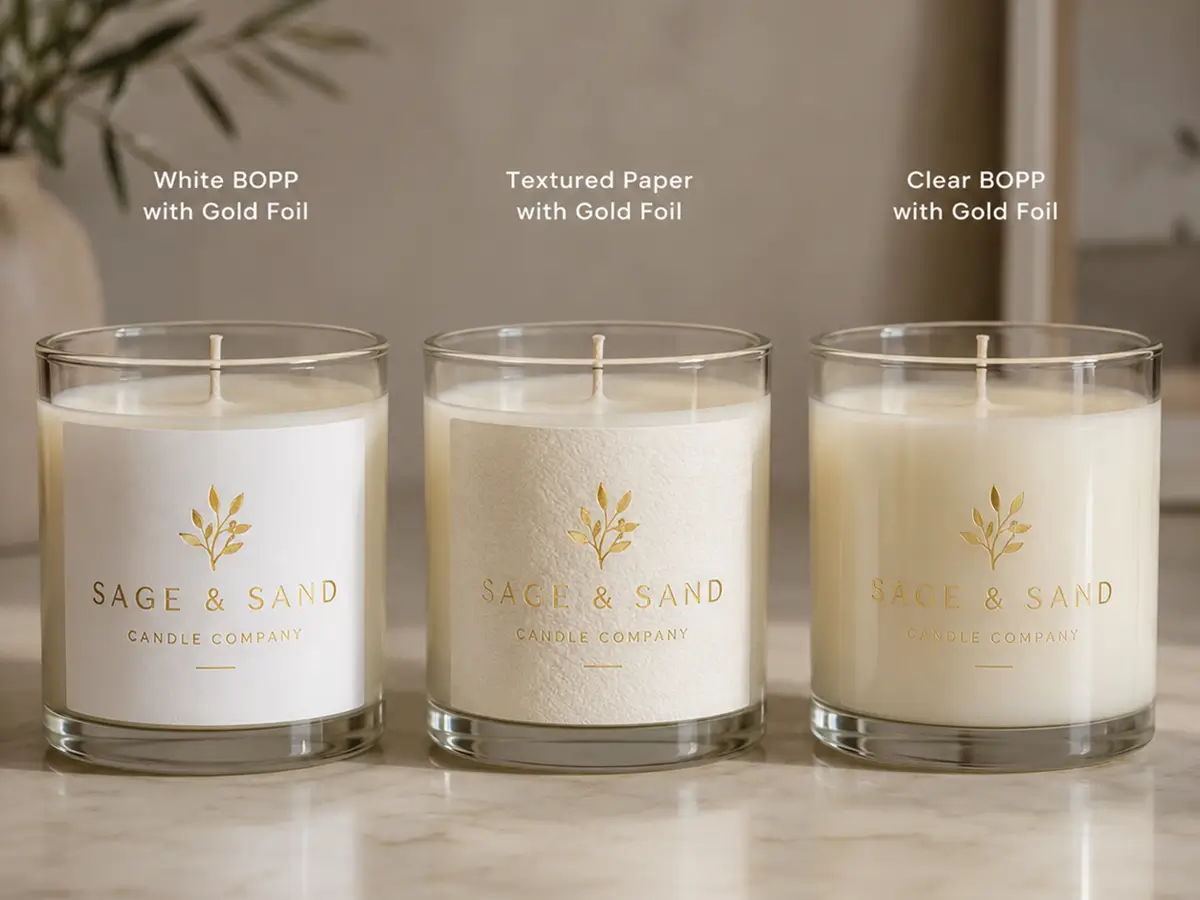
The best material changes when the brand’s primary goal changes. A luxury collection may benefit from tactile paper, while a minimalist vessel may look better with transparent film.
| Material | Foil detail | Moisture performance | Brand character | Best use |
|---|---|---|---|---|
| White BOPP | Excellent | High | Clean and versatile | Most candle collections |
| Wet-strength textured paper | Good to very good | Medium to high, depending on construction | Artisan and premium | Luxury or gift candles |
| Clear BOPP | Excellent | High | Minimalist and transparent | Clear, amber, or colored jars |
| Coated paper | Good | Medium | Familiar and economical | Short-run indoor products |
| Kraft paper | Moderate | Low to medium | Rustic and natural | Dry environments and simple artwork |
| Metallized BOPP | Strong reflective effect | High | Bold and contemporary | Full metallic backgrounds |
Choose Wet-Strength Textured Paper for Tactile Luxury
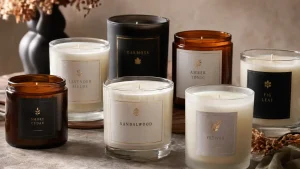
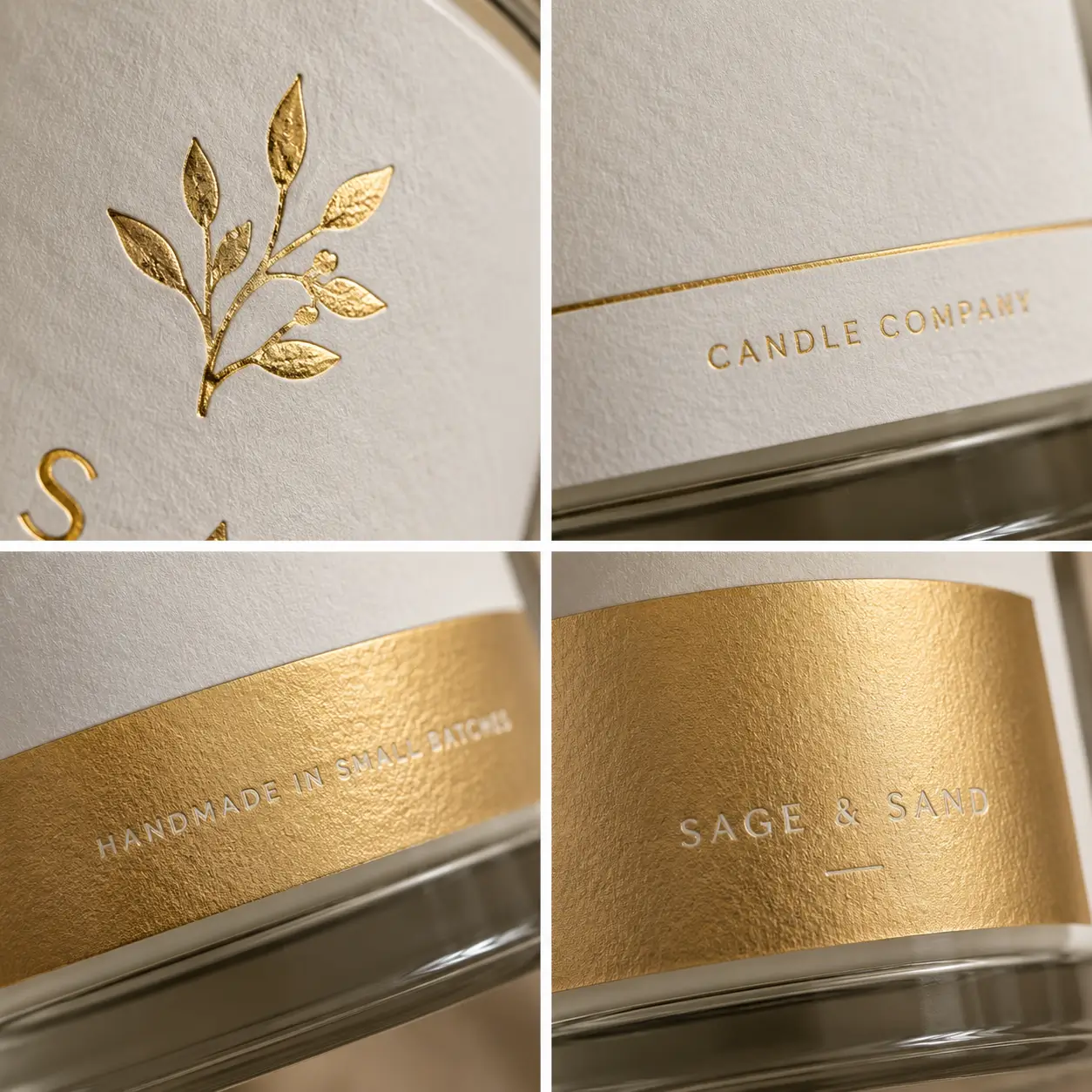
Textured papers can communicate craftsmanship more strongly than film. Felt-marked, vellum, estate, or cotton-like surfaces work particularly well for botanical fragrances, wedding favors, limited editions, and premium gift collections.
The critical distinction is between ordinary decorative paper and a wet-strength pressure-sensitive construction engineered for glass.
One current Fedrigoni Casablanca construction uses a 123 gsm, 157-micron felt-textured paper with a permanent acrylic adhesive. Its published specification lists 9 N glass tack, a minimum labeling temperature of +5°C, and a service range from −40°C to +80°C. These values apply to that construction, not every textured paper label. Source:myselfadhesives.fedrigoni.com
Texture also creates a production trade-off. Surface peaks and valleys can interrupt very fine foil coverage. Large logos, confident typography, and simple borders may look elegant, while hairline rules, tiny reversed letters, or dense micro-details can show pinholes or inconsistent transfer.
Practical insight: The more tactile the paper, the simpler and bolder the foil artwork should usually become.
Textured paper exchanges some technical uniformity for touch, depth, and handcrafted character.
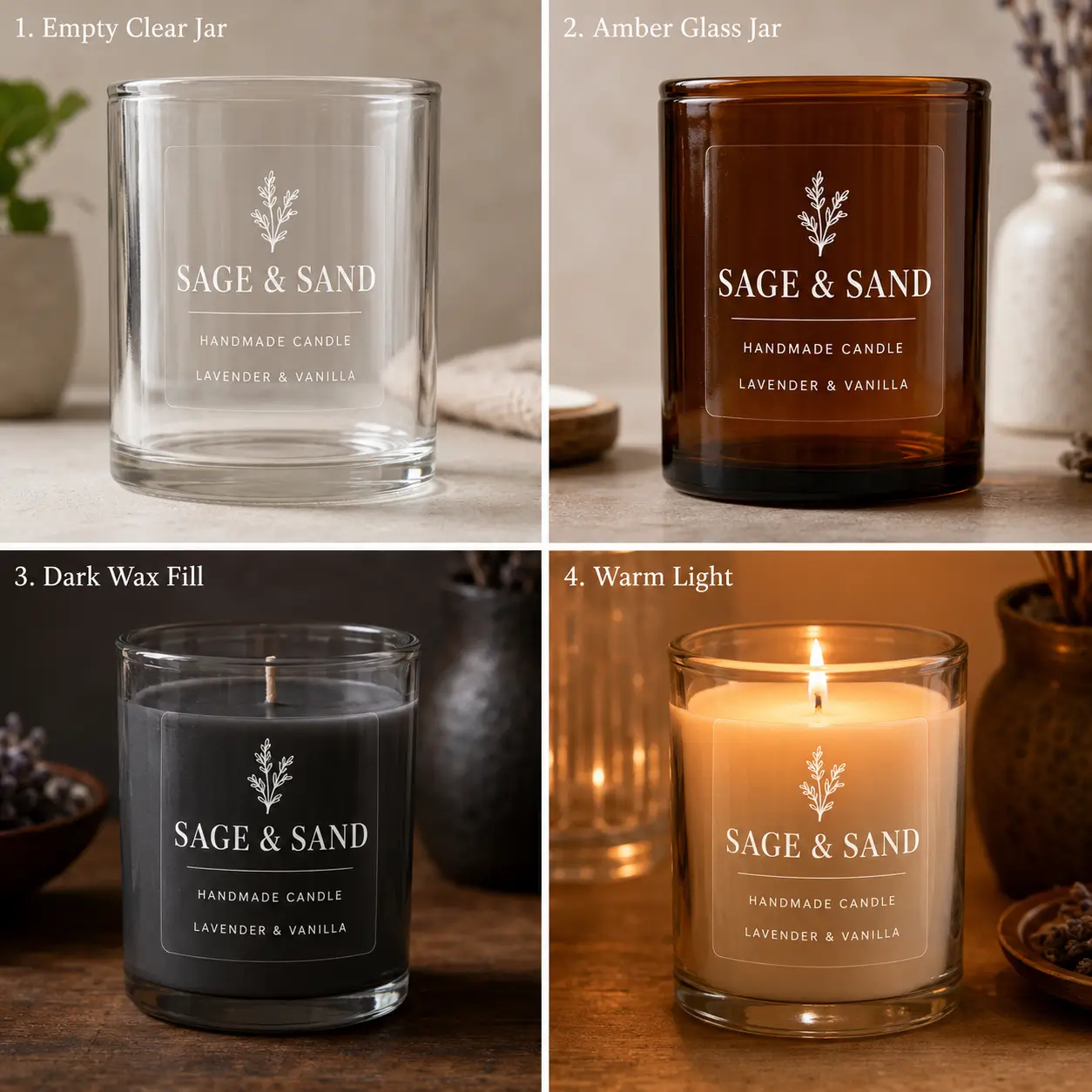
Choose Clear BOPP for a No-Label Look
Clear BOPP works best when the vessel, wax color, or printed glass is part of the visual identity. It can make a gold logo appear almost directly applied to the jar.
Avery Dennison describes film as a go-to option for the clear “no-label” effect. Clear labels still require careful testing because dust, fingerprints, trapped air, and incomplete adhesive wet-out are easier to see.
Contrast is another issue. Fine text that looks readable on an empty clear jar may disappear after the container is filled with dark wax or placed under warm retail lighting. White ink may be required beneath colored text or small mandatory information.
Always approve a clear label on the finished vessel rather than only on a digital mockup or empty glass sample.
Match the Foil Color and Coverage to the Candle Brand
Metallic foil should guide attention, not cover every available area. KURZ notes that label finishing can use hot stamping, cold transfer, or digital processes to create high-gloss metallic details, patterns, holographic elements, and other decorative effects. Source: kurz-world.com
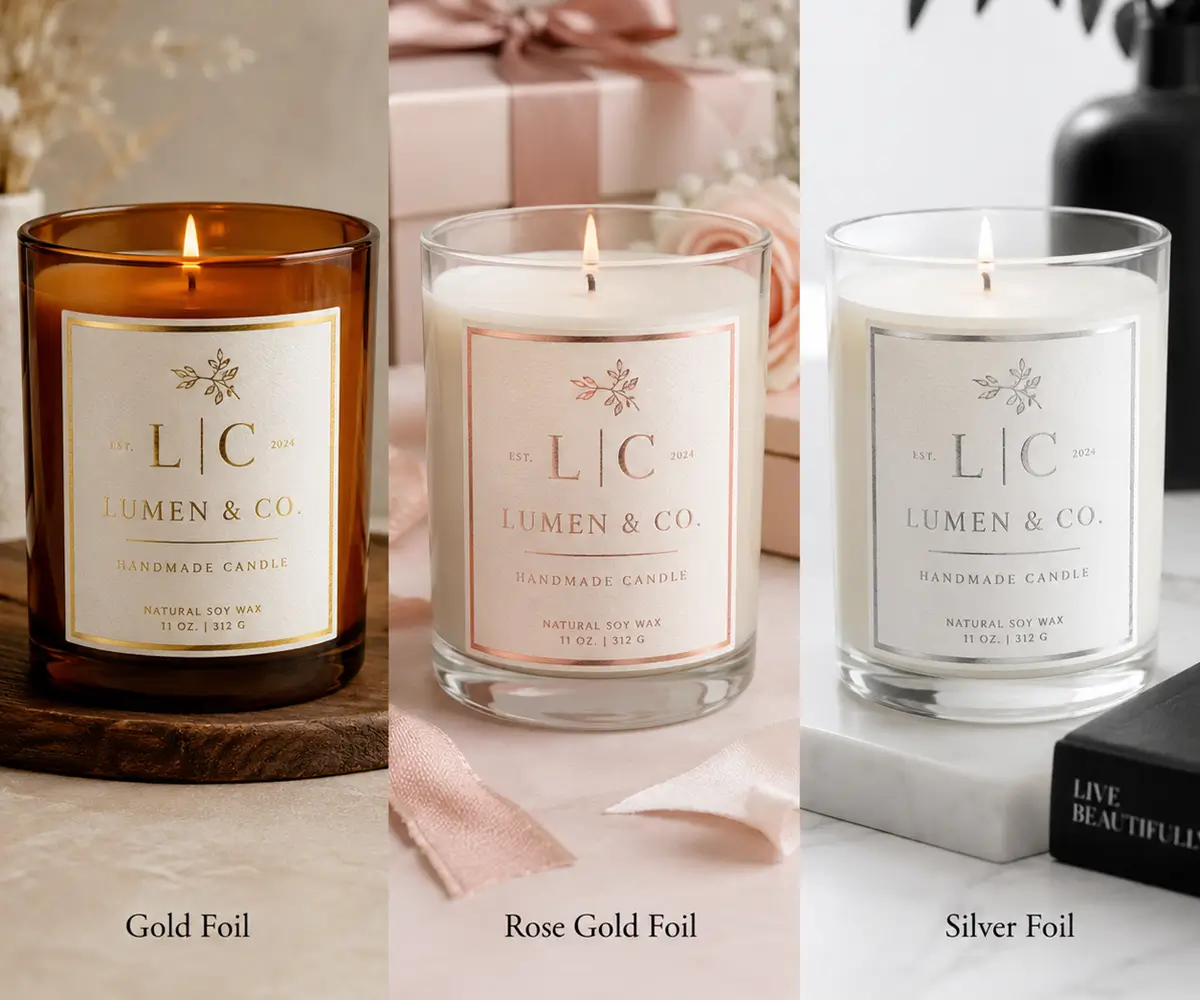
For handmade candle brands, the three most useful metallic directions are:
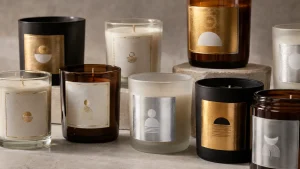
- Gold foil: Gold foil labels pair naturally with amber glass, cream-colored materials, warm woods, vanilla, tobacco, honey, spice, and holiday fragrance collections.
- Rose gold foil: Supports blush, floral, wedding, self-care, feminine, and gift-focused collections.
- Silver foil: Works well with black, white, gray, blue, linen, ocean, eucalyptus, and contemporary minimalist designs.
LabelsAgent offers gold, rose gold, and silver foil label options, allowing a candle brand to retain one label layout while changing the metallic accent across collections.
A second practical insight is that foil should function as visual hierarchy rather than decorative wallpaper:
- Use foil for the logo, fragrance name, border, or signature icon.
- Use standard ink for ingredients, net weight, instructions, and other practical information.
- Keep sufficient contrast around small foil text.
- Review the gold foil artwork requirements and request a physical proof when the design contains thin lines, small reversed text, or tight registration.
This division makes the premium effect easier to notice while keeping required information readable.
Select the Material by Business Priority
| Primary goal | Recommended construction | Main benefit | Main risk to test |
|---|---|---|---|
| Everyday durability | White BOPP + permanent glass adhesive | Moisture-resistant and stable | Ink or foil scuffing |
| Luxury tactile feel | Wet-strength textured paper + glass adhesive | Premium touch and depth | Bubbling or incomplete fine foil |
| Minimalist presentation | Clear BOPP + clear adhesive | Jar remains visible | Bubbles and weak contrast |
| Lower-cost paper appearance | Coated paper + permanent adhesive | Familiar look at a lower entry cost | Moisture and edge lift |
| Full metallic background | Metallized BOPP + opaque printed areas | Strong reflective impact | Glare and readability |
Treat Adhesive, Jar Shape, and Safety as Part of the Material Decision
The facestock attracts attention, but the adhesive determines whether the label stays attached.
Avery Dennison’s adhesive guidance notes that glass has relatively high surface energy, but moisture, dirt, dust, and surface imperfections can still interfere with bonding. Its guidance recommends evaluating the application surface rather than selecting an adhesive only by its general product name. Source: label.averydennison.com
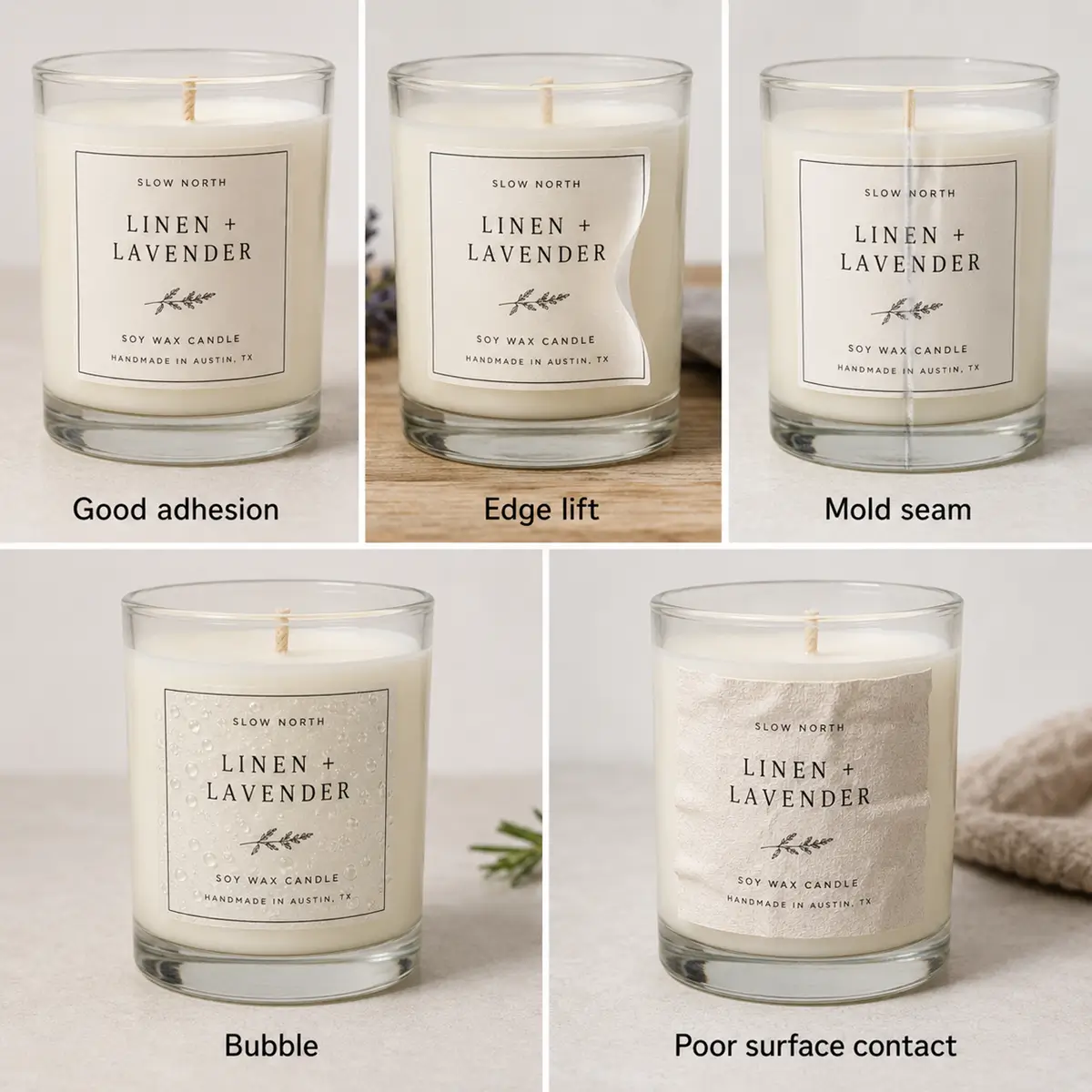
Before approving production, test the following:
- The exact jar surface, including any coating or frosting;
- The widest and narrowest jar diameter used in the collection;
- The label across any mold seam, taper, or compound curve;
- Foil registration and the smallest metallic text;
- Resistance to normal rubbing, wax residue, and fragrance oil;
- Adhesion after filling, storage, and ordinary customer handling.
The key engineering principle is simple:
Material prestige cannot compensate for poor contact between the adhesive and the container.
A smaller label with the right adhesive and adequate pressure may outperform a large, stiff, heavily textured one.
The decorative front label must also coexist with safety information. ASTM F2058-07(2021), the active candle fire-safety labeling standard, covers safety information placed on candle units of sale and requires that the warning remain visible and unobstructed. Source: store.astm.org
The National Candle Association summarizes three central warnings:
- Burn within sight;
- Keep away from combustibles;
- Keep away from children.
A practical packaging system is a gold-foil front label plus a separate base or back label for warnings and burn instructions.
Final Recommendation
For most handmade candle makers, start with foil-compatible white BOPP, a permanent glass adhesive, and selective gold foil. It provides the strongest balance of metallic clarity, moisture resistance, repeatability, and practical handling.
Choose wet-strength textured paper when tactile luxury justifies additional testing and the foil artwork is bold enough for the surface. Choose clear BOPP when the jar should remain visually dominant and the application process can control bubbles, alignment, and contrast.
Before ordering, send the supplier the jar dimensions, label size, artwork, foil color, quantity, and a vessel photo or sample.
LabelsAgent supports gold foil, rose gold foil, and silver foil labels with no minimum order quantity. For orders below 500 labels, a US$50–$100 foil setup fee applies, giving small candle brands the flexibility to test seasonal launches, fragrance variations, and premium gift collections without committing to large inventory.
Not sure whether white BOPP, clear BOPP, or textured paper fits your jar? Request a free label sample pack and compare the materials on your actual candle vessel.
Frequently Asked Questions
Is BOPP or paper better for candle jar labels?
BOPP is usually better when moisture resistance, clean foil detail, and consistent durability are the priorities. Wet-strength paper is better when tactile luxury and a handcrafted appearance matter more. Ordinary paper should not be assumed suitable for humid environments; test the complete paper-and-adhesive construction on the actual jar.
Can gold foil be applied to clear BOPP labels?
Yes. Gold foil can be applied to a compatible clear BOPP construction, but the printer must confirm that the film’s surface treatment works with the selected transfer process. Test contrast on the filled jar because small text may disappear against dark wax, amber glass, or a strongly colored vessel.
Are gold-foil candle labels waterproof?
The foil alone does not make a label waterproof. Water resistance depends on the facestock, ink, coating, adhesive, and finishing process. White or clear BOPP generally offers stronger moisture resistance than ordinary paper, but the finished label should still be tested for rubbing, edge lift, and moisture exposure.
What adhesive works best on glass candle jars?
A permanent pressure-sensitive adhesive designed for glass is the usual starting point. The final choice should account for surface coatings, application temperature, jar shape, storage conditions, and possible oil or moisture contamination. Apply labels to clean, dry glass and test adhesion after filling and normal storage.
What is the minimum order for custom foil candle labels?
LabelsAgent offers custom gold, rose gold, and silver foil labels with no minimum order quantity. A US$50–$100 foil setup fee applies to orders below 500 labels, so the most cost-effective quantity will depend on label size, artwork complexity, finishing requirements, fragrance variations, and the number of designs included in the order.